
North Korea and China open new bridge after 12-year delay
The inauguration of the New Yalu River Bridge marks a tangible shift in the Sino‑North Korean partnership, underscoring Beijing’s strategic intent to reinforce its influence on the Korean Peninsula at a time when Pyongyang faces heightened isolation.
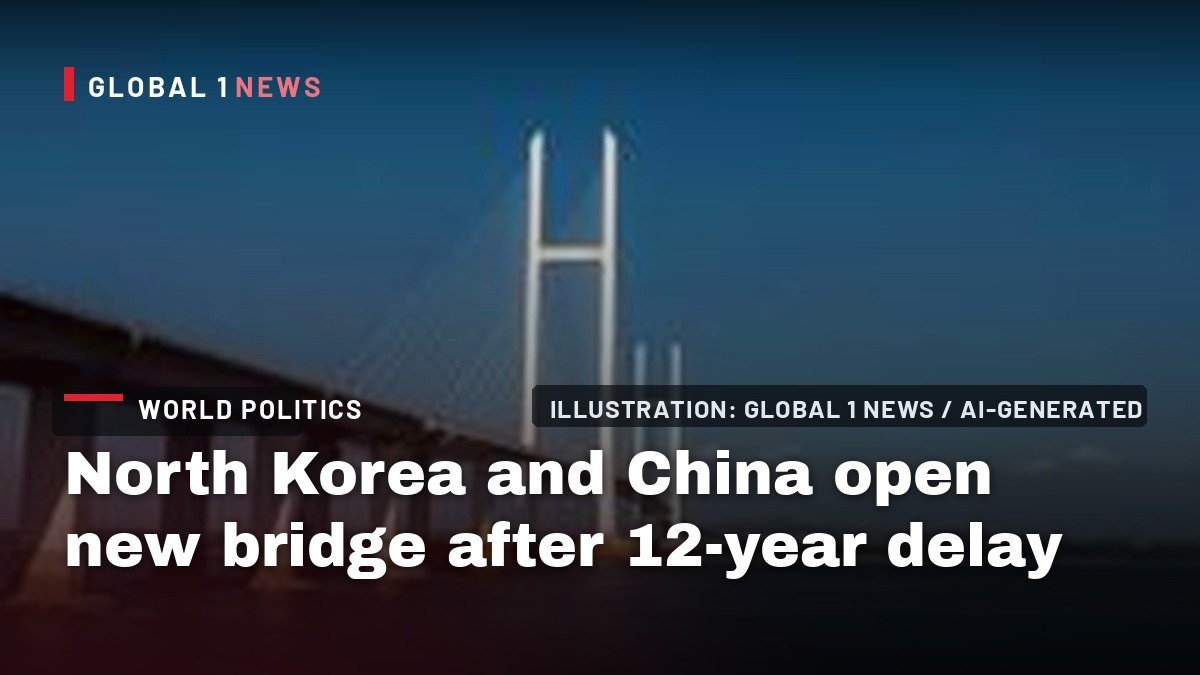
The inauguration of the New Yalu River Bridge marks a tangible shift in the Sino‑North Korean partnership, underscoring Beijing’s strategic intent to reinforce its influence on the Korean Peninsula at a time when Pyongyang faces heightened isolation. The bridge, spanning roughly three kilometres between Dandong and Sinuiju, replaces a decades‑old crossing and is poised to become the principal conduit for bilateral trade and people‑to‑people exchanges. Its delayed opening—originally slated for 2014 but postponed amid frosty relations—signals both the fragility and the resilience of the alliance that underpins China’s broader regional calculus.
Historical backdrop and the symbolism of the new crossing
The New Yalu River Bridge is more than an infrastructure project; it is a physical manifestation of a relationship that has oscillated between ideological camaraderie and pragmatic necessity. The earlier Sino‑Korean Friendship Bridge, constructed during the Japanese occupation between 1937 and 1943, has long served as a reminder of the historical entanglements linking the two neighbours. By contrast, Premier Li Qiang’s description of the new bridge as a “new landmark symbolising the traditional friendship” frames the structure as a forward‑looking emblem of renewed cooperation.
China’s portrayal of the bridge as an “important facility for connectivity” aligns with its longstanding narrative of being a lifeline for North Korea, a role that has persisted despite international sanctions. The bridge’s opening follows a series of diplomatic gestures—including the resumption of direct Air China flights and passenger train services in March, and President Xi Jinping’s state visit to Pyongyang in June—each reinforcing a pattern of incremental rapprochement after a decade of strained ties.
Trade dynamics and the constraints of sanctions
Bilaterally, trade reached $2.7 billion last year, a level described as a recovery to pre‑pandemic volumes and driven largely by Chinese exports to the North. While the bridge promises to streamline logistics, experts caution that a “sharp and sudden increase in trade” remains unlikely because UN sanctions continue to bind both parties. The academic perspective of Kang Jun‑young highlights Pyongyang’s wariness of a flood of Chinese imports that could deepen Beijing’s economic leverage over its domestic market.
Consequently, trade growth is expected to be gradual, reflecting a calibrated approach by Beijing to deepen economic ties without provoking overt sanctions violations. This measured expansion mirrors China’s broader strategy of using economic interdependence as a lever of influence while maintaining a veneer of compliance with the international non‑proliferation regime.
Strategic motivations behind Beijing’s renewed engagement
China’s renewed overtures must be understood against the backdrop of shifting regional alignments. Throughout the 2010s, Beijing’s patience with North Korea’s nuclear programme waned, culminating in a period of overt criticism and calls for denuclearisation. However, as Edward Howell notes, China’s public silence on Pyongyang’s nuclearisation in recent years reflects a recalibration of priorities.
One driver of this shift is the growing proximity between North Korea and Russia, forged in part by the Ukraine conflict. The presence of at least 2,300 North Korean soldiers on the Ukrainian battlefield and Russia’s provision of oil—estimated at over a billion barrels in 2024—illustrate a deepening Moscow‑Pyongyang nexus that threatens to erode Chinese influence. By strengthening its own logistical link, Beijing seeks to counterbalance Russian sway and reaffirm its status as Pyongyang’s primary patron.
Geopolitical implications for the United States and its allies
The bridge’s operationalization carries indirect ramifications for U.S. strategic calculations in East Asia. The United States, already wary of North Korea’s missile and nuclear tests, has intensified security cooperation with South Korea and Japan in response to Pyongyang’s 2017 nuclear test and subsequent ballistic missile developments. Enhanced China‑North Korea connectivity could complicate Washington’s efforts to isolate the regime, potentially providing Pyongyang with a more reliable conduit for essential supplies.
Nevertheless, the bridge does not necessarily translate into an immediate escalation of North Korean capabilities, given the continuing constraints of sanctions and the cautious pace of trade growth. The United States may thus view the development as a signal to reinforce its own regional partnerships and to monitor how Beijing leverages the bridge in diplomatic negotiations concerning denuclearisation and regional stability.
Domestic considerations within North Korea
North Korea’s internal dynamics also shape the bridge’s significance. The pandemic‑induced self‑isolation and subsequent socioeconomic crackdowns have limited Pyongyang’s ability to engage internationally, rendering the new crossing a vital channel for essential imports. Yet, as Kang Jun‑young observes, the regime remains cautious about an influx of Chinese goods that could undermine its domestic control.
The delayed opening, attributed to North Korea’s halt of construction on its own roads and customs facilities, underscores the regime’s capacity to impede joint projects when internal calculations dictate. This historical hesitation reflects a broader pattern of Pyongyang leveraging its strategic value to extract concessions while retaining autonomy over its border management.
Regional infrastructure competition and the broader Belt & Road context
The New Yalu River Bridge fits within China’s expansive Belt & Road Initiative (BRI), which seeks to weave a network of transport and trade corridors across Eurasia. While the bridge is not a flagship BRI project, its function as a “new chapter” in Sino‑North Korean ties mirrors Beijing’s broader use of infrastructure to cement geopolitical influence.
Comparatively, the recent opening of a Russian‑North Korean bridge, capable of handling up to 300 vehicles and 2,000 people daily, illustrates a competitive infrastructure landscape on the Korean Peninsula. China’s bridge, by potentially handling comparable traffic volumes, positions Beijing as a rival conduit to Moscow, reinforcing its claim as the primary conduit for North Korean trade and mobility.
Strategic outlook and potential trajectories
Looking forward, the bridge’s impact will hinge on how Beijing balances its desire for influence against the constraints of international sanctions and the risk of provoking a coordinated response from the United States and its allies. The cautious tone from scholars such as Kang Jun‑young and Edward Howell suggests that while Beijing is eager to showcase tangible support for Pyongyang, it remains mindful of the diplomatic costs.
In the medium term, the bridge is likely to facilitate a steady, if not spectacular, increase in bilateral trade, reinforcing China’s role as North Korea’s economic lifeline. Simultaneously, it provides Beijing with a diplomatic lever to shape Pyongyang’s foreign policy choices, particularly in relation to Russia’s growing presence. For Washington and regional partners, the development underscores the necessity of maintaining a robust security posture while engaging in diplomatic efforts to mitigate the risk of a deeper China‑North Korea alignment that could destabilise the regional balance of power.
This article was produced with AI-assisted research and editorial support. Reporting is based on the source material cited below. Sources: BBC News China; bbc.co.uk; Global1.News (15 October 2026).
By Prof. Marcus Chen, Staff Writer
What's Your Reaction?
 Like
0
Like
0
 Dislike
0
Dislike
0
 Love
0
Love
0
 Funny
0
Funny
0
 Wow
0
Wow
0
 Sad
0
Sad
0
 Angry
0
Angry
0

World Politics Analyst at Global1.News. Based in Beijing, covering US-China relations, global trade, and geopolitical strategy. Brings deep analytical perspective to the power dynamics shaping international affairs.














Comments (0)