
Gemini 4 Argon begins rolling out in Gemini app and Antigravity, but only if you pay
Google’s newest AI offering, Gemini 4 Argon, is finally rolling out, but the rollout comes with a familiar caveat: it’s locked behind a paywall. Even within the paid tiers, there are nuances.
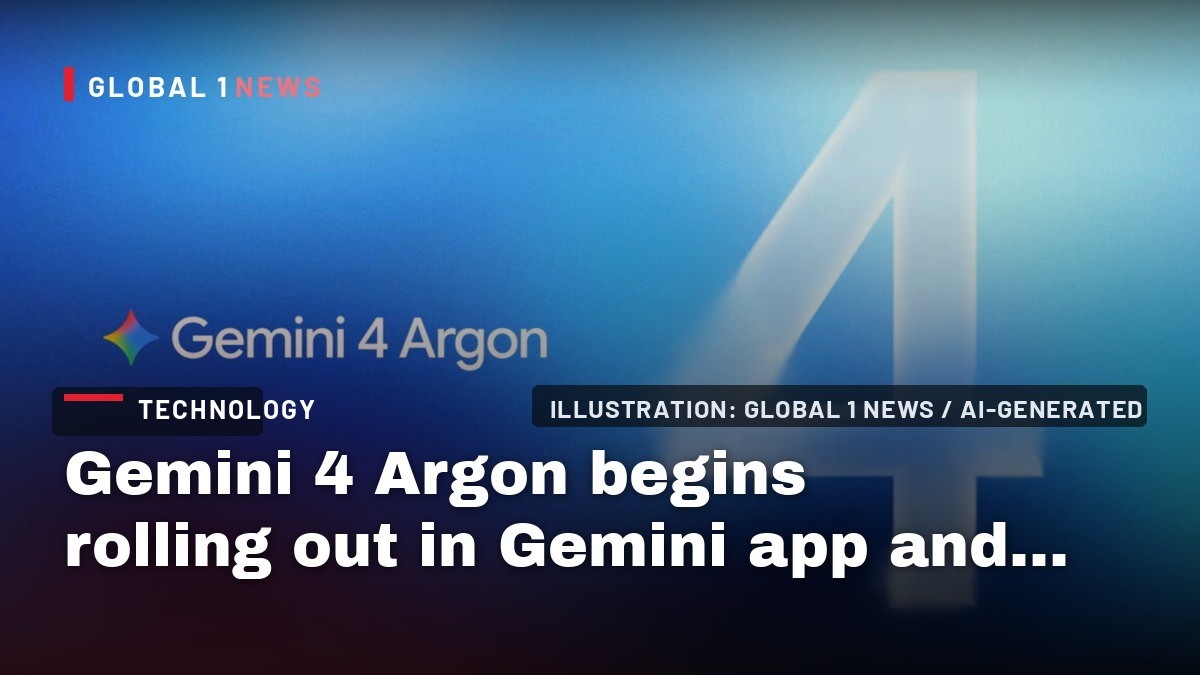
Google’s newest AI offering, Gemini 4 Argon, is finally rolling out, but the rollout comes with a familiar caveat: it’s locked behind a paywall. The tech giant announced the model a few weeks ago, warning that it would need to tread carefully because of the “potential for nefarious use.” Yet today, the company is moving from caution to commercialization, making Argon available only to paying customers and, even then, limiting its full capabilities to higher‑tier plans. The decision underscores a broader industry trend—premium AI features are increasingly becoming a revenue stream rather than a universally accessible tool.
Pay‑to‑Play: Who Gets Access and What They Get
Google is debuting Argon in the Gemini app and its Antigravity platform, but the model is restricted to subscribers of the AI Pro plan at $20 per month and the AI Ultra plan starting at $99 per month. Free users, meanwhile, are left with the stripped‑down Flash‑Lite model, a move that mirrors Google’s recent decision to limit its Flash models for non‑paying accounts. In Antigravity and AI Studio, only AI Ultra subscribers can tap Argon’s full power, reflecting Google’s assessment that the model’s compute demands are too costly for lower‑tier pricing.
Even within the paid tiers, there are nuances. Pro users can generate code in the Gemini app’s Canvas mode, but the “multi‑threaded agentic workflows” that power Antigravity’s most advanced features remain off‑limits. Google has not clarified whether Argon will ever be available for Antigravity users on the Pro plan, leaving a gap that could push developers toward the older Gemini 3.1 Pro model for now.
What Argon Can Do: Benchmarks and Real‑World Wins
Google’s marketing touts Argon’s “advanced reasoning and agentic coding capabilities,” backed by benchmark results released late last month. While the article does not detail specific scores, the company emphasizes that the model is trained to refuse malicious instructions and is paired with an automated misalignment monitor that can halt processing if an unintended workflow is detected. This safety layer, Google argues, is necessary because Argon is “so capable.”
The real‑world impact inside Google is more concrete. Thousands of Googlers have already used Argon, and the model has reportedly improved YouTube’s comment system by identifying redundant emoji rendering. Eliminating that redundancy cut server load by 45 percent—a substantial efficiency gain. In Project Wing, Google’s drone physics simulator, Argon uncovered critical bugs lingering since 2018, demonstrating its ability to spot deep‑seated issues in complex codebases.
Robotics and Embodied Reasoning: A Measurable Step Forward
Beyond software, Argon is making strides in Google’s robotics initiatives. The company claims the model has delivered a “measurable step increase in embodied reasoning,” suggesting that Argon can better understand and act within physical environments. While the source material does not quantify the improvement, the phrasing indicates a noticeable jump in performance, likely tied to the model’s agentic capabilities that enable it to plan and execute multi‑step tasks.
This progress is significant because embodied reasoning has long been a bottleneck for AI in the physical world. If Argon can reliably translate abstract instructions into concrete actions, it could accelerate Google’s push into autonomous drones, warehouse robots, and other embodied AI applications.
Pricing the API: Token Costs and a Countdown
Developers who access Google’s models via the paid API can purchase Argon tokens at a temporary rate of $2 per million input tokens and $10 per million output tokens, with a hefty 95 percent discount for cached tokens. However, this pricing is only in effect until November 30. After that date, the rates will double to $4 per million input tokens and $20 per million output tokens. The looming price hike forces developers to weigh the cost‑benefit of building workflows around Argon now versus waiting for a potential price adjustment.
The token pricing strategy reveals Google’s confidence in Argon’s value proposition. By offering a steep discount on cached tokens, Google encourages heavy usage while still protecting its margins. Yet the short‑term nature of the discount suggests the company may be testing market elasticity before settling on a long‑term price point.
Strategic Implications: Monetization Meets Safety
Google’s rollout of Argon illustrates a balancing act between monetization and responsible AI deployment. The safety mechanisms—refusal training and the misalignment monitor—are presented as justifications for limiting access, yet the primary driver appears to be revenue. By restricting the most capable model to paying tiers, Google not only recoups the massive R&D investment behind Gemini 4 but also controls the diffusion of a powerful tool that could be misused.
This approach mirrors broader industry patterns. Companies like OpenAI and Anthropic have similarly tiered their most advanced models, citing safety while capitalizing on demand. The trade‑off is clear: developers and enterprises must decide whether the premium cost is worth the performance boost, while free users are left with less capable alternatives.
What This Means for Developers and Enterprises
For developers, the immediate takeaway is that building on Argon now comes with a cost calculus. The token pricing is favorable for a limited window, but the steep jump after November 30 could erode budget forecasts. Moreover, the restriction of Argon’s full capabilities to AI Ultra subscribers means that smaller teams may need to stay on Gemini 3.1 Pro or rely on the Flash‑Lite model, potentially limiting the sophistication of their applications.
Enterprises, on the other hand, may find the premium pricing justified by the efficiency gains demonstrated internally at Google—especially the 45 percent server load reduction on YouTube’s comment system. If similar optimizations can be realized in proprietary pipelines, the ROI could offset the subscription fees. However, the lack of a clear roadmap for expanding Argon to lower‑tier plans adds uncertainty to long‑term planning.
Looking Ahead: The Future of Gemini and the AI Marketplace
Google’s cautious yet commercial rollout of Argon signals that the next phase of AI development will be tightly coupled with subscription models and tiered access. While the company emphasizes safety, the rollout timeline—“wide rollout today” for paying users—suggests that the safety concerns have been largely addressed, at least internally. The real test will be how the broader market responds to a model that promises “advanced reasoning” and “agentic coding” but is gated behind a $20‑plus monthly fee.
As the AI marketplace matures, we can expect more providers to adopt similar strategies: premium features for paying customers, safety layers as justification, and aggressive pricing windows to drive early adoption. For now, Argon stands as a potent reminder that the most capable AI tools are becoming premium commodities, and the onus is on developers, enterprises, and even policymakers to navigate this emerging landscape with both ambition and caution.
This article was produced with AI-assisted research and editorial support. Reporting is based on the source material cited below. Sources: Ars Technica; arstechnica.com; Global1.News (14 October 2026).
By Jessica Ali, Staff Writer
What's Your Reaction?
 Like
0
Like
0
 Dislike
0
Dislike
0
 Love
0
Love
0
 Funny
0
Funny
0
 Wow
0
Wow
0
 Sad
0
Sad
0
 Angry
0
Angry
0

Editor-in-Chief at Global1.News. Atlanta-based journalist who cuts through the BS and tells it like it is. Lead anchor, host, and the voice you hear when the spin stops and the truth starts.










Comments (0)