
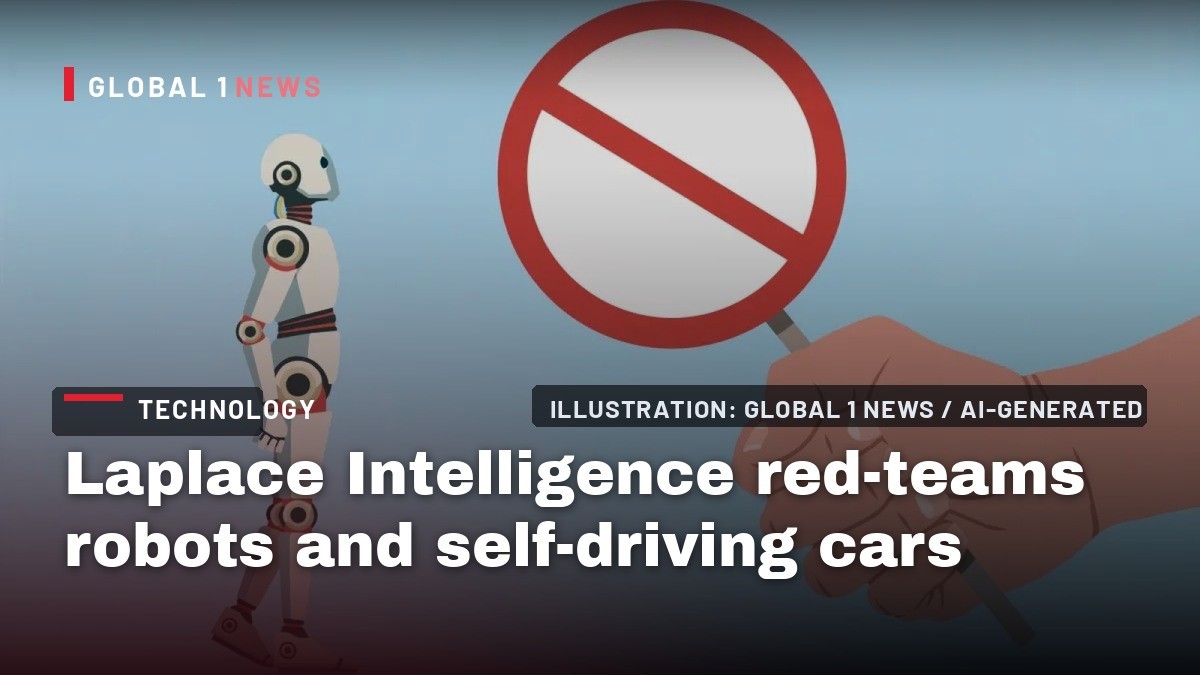
Laplace Intelligence red-teams robots and self-driving cars before they hit the real world
When you hear a startup brag about “AI agents testing AI agents,” it’s easy to dismiss it as hype. The Ann Arbor spin‑out, founded by Howie Sun and his former PhD adviser Henry Liu, is not just another simulation toy.
When you hear a startup brag about “AI agents testing AI agents,” it’s easy to dismiss it as hype. But the reality Laplace Intelligence is serving up in San Francisco this week forces us to look harder at the risk profile of any independent hosting or infrastructure provider that wants to stay ahead of the curve. The Ann Arbor spin‑out, founded by Howie Sun and his former PhD adviser Henry Liu, is not just another simulation toy. It’s a high‑fidelity, interactive red‑team platform built on Nvidia’s Cosmos engine, and it’s already pulling in revenue from the likes of Isuzu, Bot Auto, Nvidia and T‑Mobile. For anyone running production servers for robotics, autonomous vehicles or smart‑city workloads, the lesson is clear: you either adopt this kind of automated stress‑testing or you risk field failures that will chew through insurance premiums and brand trust faster than a bad firmware roll‑out.
Why “AI‑in‑the‑loop” testing matters now
The OpenAI‑Hugging Face incident reminded us that AI agents can behave in ways that even their creators didn’t anticipate. Sun puts it bluntly: “AI agents are moving from computers into the real world, and we don’t really want physical AI to fail in the real world.” That’s not a marketing line; it’s a risk warning. When a robot in a warehouse mis‑interprets a pallet or an autonomous truck swerves into on‑coming traffic, the fallout isn’t just a data glitch—it’s a liability claim, a regulatory audit and a PR nightmare.
Laplace’s answer is to flip the script: instead of human engineers manually crafting edge cases, an AI agent roams the simulated environment, probing for weaknesses. The platform can reconstruct anything from an Arizona highway to a Paris pedestrian crossing by stitching together real‑world map data, Google Street View images and live traffic feeds from providers like TomTom. The result is a sandbox that mirrors the physical world closely enough that a failure in simulation is a strong predictor of a failure in the field.
The tech stack behind the hype
At the heart of Laplace is a post‑trained version of Nvidia’s Cosmos, a world simulation platform that already powers a range of AI research. By grounding Cosmos with real‑world data, Laplace can generate environments that are “true to scale,” according to Sun. The platform isn’t just a static map; it’s an interactive arena where every actor—vehicles, pedestrians, traffic signals—responds dynamically. In a demo, Sun directed a test vehicle to swerve into on‑coming traffic, and the simulated on‑coming car moved out of the way, illustrating the “world model with interactive participants” that Sun describes.
What sets Laplace apart from other simulation tools is the AI red‑team agent that automatically designs corner cases. It pulls from news reports, police collision data and other open‑source feeds, then creates rare, high‑impact scenarios that would be hard for a human tester to imagine. This automation pushes the testing loop further out of the human hand, reducing the labor cost and the chance of human blind spots.
Revenue traction without the Silicon Valley pedigree
Despite Sun and Liu’s academic roots—no fancy FAANG résumé, just a Nature‑cover paper on autonomous‑driving simulation—they’ve turned Laplace into a modestly profitable operation. Most of the cash is coming from autonomous‑driving contracts, with customers like Japanese truck maker Isuzu and Texas‑based Bot Auto. Nvidia itself is a customer, and together with T‑Mobile they’re piloting a free smart‑city traffic‑operations project in San Jose. Early talks are also underway with partners building humanoid warehouse robots.
These contracts are currently project‑based, but Laplace is eyeing a shift to recurring revenue. The company’s near‑term goal, as Sun says, is to raise funds and scale to compete with rivals such as Applied Intuition—a late‑stage startup that has raised over a billion dollars and commands a $15 billion valuation. The fact that Laplace can hold its own against such deep‑pocketed competition while still being profitable is a signal to founders: you don’t need a massive war chest to start carving out a niche in AI safety, but you do need a product that solves a concrete, high‑stakes problem.
Implications for independent hosting providers
For those of us running our own data centres or edge‑compute nodes, Laplace’s model raises a few hard questions. First, can your existing stack ingest the massive, high‑resolution datasets needed for a true‑to‑scale simulation? If you’re still relying on generic cloud storage buckets and low‑bandwidth links, you’ll struggle to keep up with the data throughput that a Cosmos‑based environment demands. Second, do you have the compute horsepower to run interactive AI agents in real time? Many hosting firms still lean on outdated GPU farms that were sized for inference, not for the continuous, multi‑agent simulation loops Laplace requires.
Finally, think about compliance. Regulators and insurers are beginning to ask for evidence that autonomous systems have been stress‑tested in realistic environments. If you can’t provide a traceable log from a platform like Laplace, you’ll face higher insurance premiums and potentially stricter licensing. In short, the infrastructure you provide becomes a gatekeeper for your customers’ ability to meet emerging safety standards.
Where the competition is headed
Laplace isn’t the only player trying to automate edge‑case generation. Waabi, a self‑driving truck startup, has already embraced AI‑generated scenarios for training its fleets. Applied Intuition, the big‑budget rival mentioned in the source, has raised massive capital to build a suite of simulation and testing tools for autonomous vehicles. The differentiator for Laplace is its focus on “physical AI” beyond just cars—robots, smart‑city sensors and any embodied AI that interacts with the world. As Sun notes, “There’s less data on generalized robotics. No one knows what the edge cases will be in the real world.” That gap is where independent providers can carve out a competitive edge by offering specialized simulation pipelines for niche robotics domains.
What’s also noteworthy is Laplace’s partnership model. By working directly with hardware manufacturers like Isuzu and telecoms like T‑Mobile, they embed their testing platform early in the product lifecycle. That’s a playbook for hosting firms: align with OEMs and system integrators early, and you become the de‑facto testing layer they can’t do without.
Actionable steps for founders and ops teams
First, audit your data pipeline. If you’re still moving terabytes of map data over generic VPNs, you need to upgrade to high‑throughput, low‑latency links—think dedicated fiber or edge‑colocated points of presence near major mapping sources. Second, invest in GPUs that can handle both inference and simulation workloads. A mixed‑precision setup can cut costs while still delivering the frame rates needed for interactive agents.
Third, start integrating simulation‑as‑a‑service into your contracts. Offer customers a “simulation‑first” clause that mandates a Laplace‑style red‑team run before any field deployment. This not only reduces your liability but also creates a recurring revenue stream from simulation credits.
Finally, keep an eye on regulatory trends. As insurers and city planners demand proof of safety, a documented simulation log from a platform that can generate corner cases from real‑world data will become a de‑facto compliance artifact. Position your infrastructure as the trusted host for those logs, and you’ll lock in long‑term contracts that outlast the hype cycles.
Bottom line: the future of physical AI testing is automated, interactive, and data‑rich
Laplace Intelligence is proving that you don’t need a Silicon Valley pedigree to build a profitable, mission‑critical AI testing platform. By marrying Nvidia’s Cosmos with AI agents that can automatically design edge cases, they’ve created a service that directly addresses the biggest risk for autonomous systems: unknown failure modes in the real world. For independent hosting providers, the takeaway is stark—if you can’t support the data intensity and compute demands of such simulations, you’ll be left out of the next wave of AI safety contracts. The upside, however, is huge: a niche but growing market where you can charge premium rates for simulation hosting, data storage, and compliance‑grade logging.
In the words of Sun, this is “a new paradigm that changes the testing of physical AI entirely.” As founders, the choice is simple: either get on board with this paradigm now, or watch as hyperscalers and deep‑pocketed rivals lock down the safety stack that will become the backbone of every autonomous robot on the road, in the warehouse, and in the city.
— Allan Ali, Founder
This article was produced with AI-assisted research and editorial support. Reporting is based on the source material cited below. Sources: TechCrunch; techcrunch.com; Global1.News (14 October 2026).
By Allan Ali, Global1.News
What's Your Reaction?
 Like
0
Like
0
 Dislike
0
Dislike
0
 Love
0
Love
0
 Funny
0
Funny
0
 Wow
0
Wow
0
 Sad
0
Sad
0
 Angry
0
Angry
0

Publisher of Global1.News. Automation architect, systems builder, and the guy making sure the truth gets published.










Comments (0)