
Von der Leyen Opens EU Door to Canada as First Associate Member, With Carney in the Chamber
Ursula von der Leyen used her State of the Union address to offer Canada a new associate member status that does not exist in EU law, with Mark Carney watching from the chamber as US tariffs push Ottawa toward Europe.

Ursula von der Leyen used her annual State of the Union address to invite Canada into a category of membership that does not exist in EU law. Mark Carney became the first foreign head of government ever to sit in the chamber for the speech. The offer is real, the label is contested, and the detail is thin.
Von der Leyen Opens EU Door to Canada as First Associate Member, With Carney in the Chamber
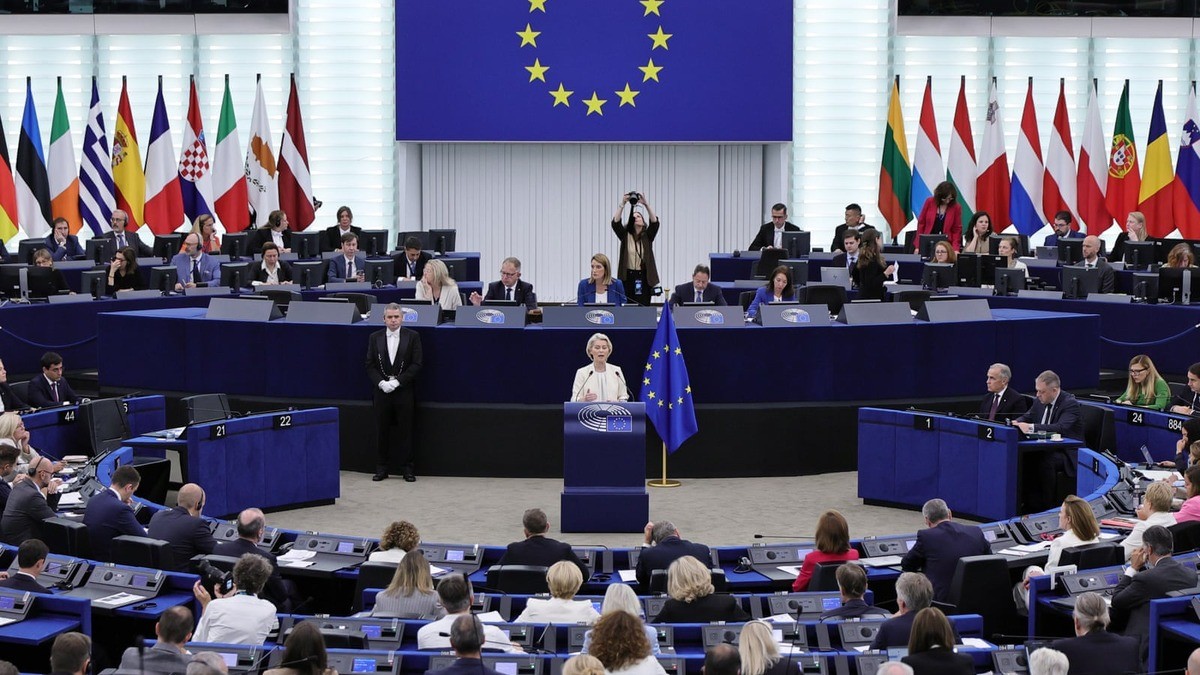
Strasbourg, France - The President of the European Commission told the European Parliament on Wednesday that she wants Canada to become the first associate member of the European Union, a status that does not exist under the bloc's treaties and would have to be created from nothing.
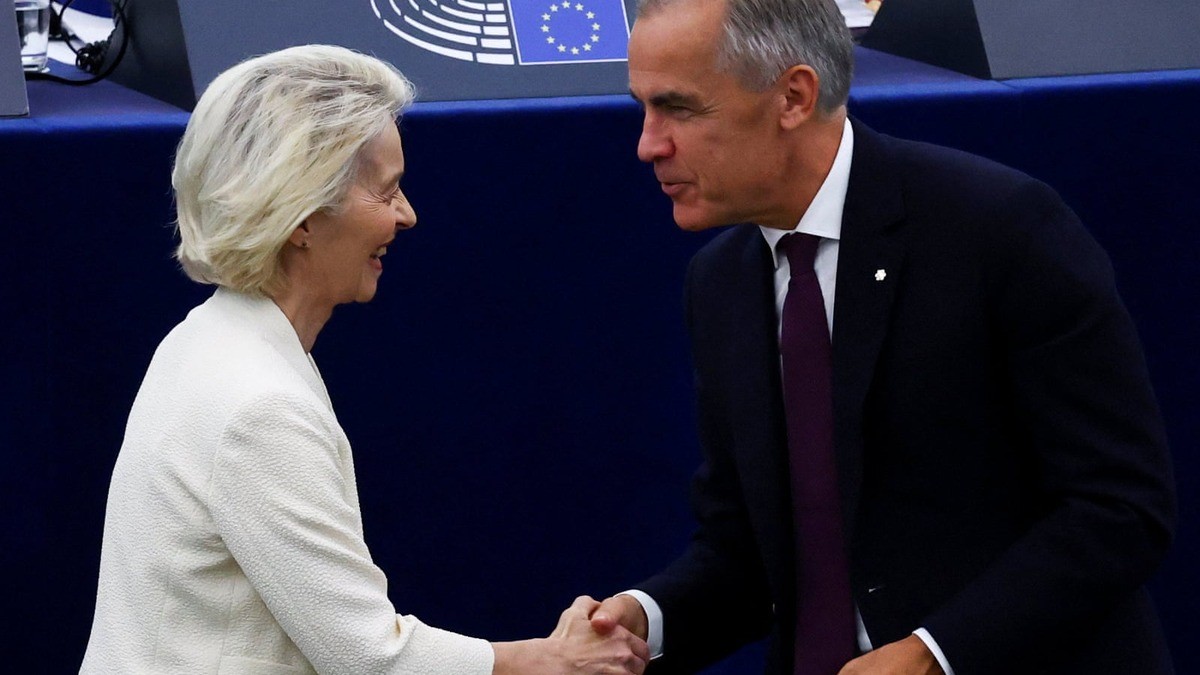
Ursula von der Leyen delivered the proposal directly to Mark Carney, the Canadian Prime Minister, seated in the chamber as a guest of honour. He is the first foreign head of government ever to attend the address. European Parliament President Roberta Metsola opened the session and welcomed him, and lawmakers gave him long and warm applause.
A Door That Has Never Been Opened
Von der Leyen addressed Carney by name: "I would like to work with you on opening the door for Canada to be the first associate member of the EU."
No such status exists. Associate membership is not provided for in the EU's treaties, and creating it would require a legal architecture that has not been drafted, voted on or agreed by member states. No draft legislation, treaty article or timetable for establishing the category has been published.
Reuters reported the offer as an opening of the door to a status that does not exist under the bloc's treaties. Four EU diplomats in Canada told the agency that any kind of EU membership for Canada was impossible, noting geography.
What Associate Membership Would Actually Mean
Von der Leyen announced a comprehensive new "Alliance for the Future" built on the existing EU-Canada trade deal, which she said would "create a common prosperity and economic security space".
The work areas she named were intelligent manufacturing, a tech alliance, integrating defence industries, making "the Arctic a flagship joint project", energy, critical minerals and batteries, and "AI, quantum, cyber and economic security". The plans are light on detail, and she insisted the new partnership is "not against anyone else".
The foundation document is the nine-year-old CETA accord, which has yet to be ratified by national and regional parliaments in 10 EU member states. Canada and the EU will hold a summit at the end of October in Montreal, on 29 and 30 October, and aim to reach a deal on digital trade by the end of the year. That is a target, not a signed agreement.
The label itself has a precedent. German Chancellor Friedrich Merz floated a similar formula for Ukraine earlier this year - a seat at summits without voting rights and access to some EU programmes. In a letter to EU leaders on 18 May he proposed a political commitment to apply Article 42.7, the mutual defence clause, to Ukraine. Kyiv dismissed the offer as unfair.
A First in the Chamber
Carney has not yet spoken to the Parliament. He addresses it on Thursday 17 September at 11:30 local time, 10:30 UK. His trip runs from 15 to 17 September, taking in Strasbourg and Liverpool, where he meets UK Prime Minister Andy Burnham for the first time.
Before leaving Canada he rejected full membership outright. Speaking to reporters at the Toronto International Film Festival on 13 September, he said: "We're not looking to become a member of the European Union. What we are looking, and will begin discussions for, is a unique alliance between Canada and the European Union. We share the same values, we have the same priorities and we have very complementary strengths."
He told Bloomberg News: "It's an exciting time. Look, it's not going to be solved this week in Strasbourg. This, to be clear, it's the start of a process, but it's the start of a high-ambition process."
The Trade War Behind the Invitation
The invitation lands against a collapsed trade relationship with Washington. US-Canada talks broke down in August when Carney suspended them and recalled his negotiators, accusing the Americans of introducing unacceptable demands at the last minute.
The United States imposed 50 per cent tariffs on about C$28 billion, or EUR 17.74 billion, of Canadian goods on 22 August. Canadian counter-measures took effect on 8 September. President Donald Trump has banned a range of Canadian imports, including dairy and alcohol, and has threatened to shut Bombardier out of the US market for aircraft it builds abroad. He has repeatedly floated the idea of Canada becoming the "51st state".
Carney has named three red lines for resuming talks: sovereignty, francophone cultural protection, and the unrestricted right to sign trade deals with third countries. Trump said a deal could come "fairly quickly", but no timetable has been set.
About 68 per cent of Canadian goods exports went to the United States in the first half of 2026, down from close to three-quarters before the trade war. The EU is Canada's second-largest trading partner, with two-way goods and services trade of about C$178 billion, or EUR 112.74 billion, in 2025.
Arctic, Minerals and Missiles: What Is on the Table
The named work areas map onto programmes that already exist. Canada became the first non-European country to join the EU's Security Action for Europe defence procurement initiative in February 2026, unlocking access to a 150 billion euro fund. So far it has produced one Canadian contract: a C$10 million deal announced at the G7 in Evian in June 2026, under which Marconi Technologies, a Montreal defence firm, will build tactical radios for Poland's Cyber Command.
In May, Carney became the first non-European leader to attend a European Political Community summit, in Yerevan, Armenia, where he pledged roughly $270 million toward NATO's Ukraine procurement list and touted $18 billion in critical minerals agreements struck with European partners over the prior year. Carney and French President Emmanuel Macron are due to meet on 20 September in Saint-Pierre and Miquelon, the French territory off the coast of Newfoundland.
The Label Canada Never Asked For
Canadian officials have cooled the "associate member" label. A senior source told the Globe and Mail that talks are exploratory, that Ottawa is not pursuing a Norway-style arrangement, and that the phrase originated in Brussels rather than Canada. The priority, the official said, was substance: labour and student mobility, research links and closer economic and security cooperation without sacrificing sovereignty.
A senior Canadian official told CBC News that Canada is engaging with Europe to strengthen its sovereignty, not to dilute it, and that Wall Street Journal reporting suggesting Canada wanted to reproduce Norway-style arrangements was false.
Conservative leader Pierre Poilievre, on social media on 13 September, wrote: "We will NEVER be the 51st U.S. state. And we will NEVER be the 28th EU state." He also wrote that Carney "could not be more out of touch".
The scepticism is not confined to Ottawa. Achim Hurrelmann, co-director of the Centre for European Studies at Carleton University, said: "I'm not really sure if the substance will actually justify the new label."
Russia, Ukraine and a European Security Council
Von der Leyen framed the address around what she called "an openly hostile world", describing the EU as "the strongest" but "most precarious" it has ever been. She warned against anti-European ultranationalists and Russia, who she said "despise our values", and said: "Europe will defend each and every single square metre of its territory."
She said "Russia's war of aggression on Ukraine rages on and threats are mounting on our soil", citing incidents in Lithuania, Denmark and Poland "just this week" and describing "an attack using military grade material carried out by Russian operatives on European soil and attack not only on one member state, but against all of our union". She added: "hybrid threats facing Europe are less and less hybrid and less and less threats. Cyber sabotage, arson. Drone incursion. They are ramping up every day."
She called for an EU "counter-hybrid playbook" and an EU equivalent of NATO's Article 4, "an emergency security protocol", so that "when triggered by one member state, all member states should convene to coordinate a European response". She called for the establishment of a "European Security Council".
On Ukraine she said "the coming winter will be tough for Ukraine" but that nothing can break "the Ukrainian spirit of resistance", and that the bloc "will give our strongest ever support to Ukraine over the toughest winter of the war". It is using its funding to help Ukraine buy air defence systems and wants to develop "an affordable modular missile defence system" made in Europe. On sanctions: "What is needed is not necessarily new sanctions, but above all the enforcement of existing ones. Russia is doing everything it can to get around them. So we must close the loopholes."
China, Climate and the Rest of the Address
On China, von der Leyen said the EU's trade relationship is "unsustainable" and needs to be rebalanced. She cited a goods trade deficit of 1 billion euros a day last year and said Europe was already suffering from "the second China shock" through deindustrialisation. "Let me be clear: we will use all the tools at our disposal to rebalance our relationship."
On climate she warned Europe faces "the hottest summer months ever, but the coolest of years to come", and announced a new climate resilience package next month plus a separate heatwave preparedness initiative covering urban adaptation and cooling infrastructure. On energy: "We need to electrify Europe", because Europe cannot remain an industrial powerhouse if energy prices are structurally too high.
On artificial intelligence she said "We want AI with human agency", calling AI a pillar of the economy and security and saying "the EU must stay in the race; it is crucial for our independence". On online safety she said young Europeans "spend four to six hours a day on screens" and warned of "a great capture of our children". She confirmed plans to bring forward a "Kids' Act": "No social media under the age of 13. No personal account under the age of 15", with supervised mini accounts up to 15 and safe design obligations for platforms up to 18. "It is us who decide the rules, not big tech," she said.
On Israel and the Palestinians she called the Israeli government's decision to proceed with the illegal E1 settlement project "unacceptable", saying "the deep suffering in Gaza and unchecked settler violence in the West Bank have deeply affected Europeans". She acknowledged it was "painful for many Europeans that member states have been unable to build the necessary majorities for a unified response".
On migration she said of the Ceuta border crisis that "vulnerable people are being exploited by callous traffickers and smugglers, by our adversaries", and told the Spanish people: "Ceuta is Spain and Ceuta is Europe." She proposed a new "European Emergency Response instrument" for emergencies, "especially in scenarios when mass movements are engineered and weaponised".
She said she was "horrified by the pictures from Ratko Mladic's funeral in Belgrade last week", adding: "Glorifying war criminals simply has no place in the European Union." She celebrated the change in Hungary after 16 years of Viktor Orban, with a new pro-EU government led by Peter Magyar.
The Room Reacts
In the Parliament, Sven Simon, chair of the committee on constitutional affairs, said: "Europeans looked very positively on him and on that speech in Davos. He nailed it. He put it really in the right direction. I think in those uncertain times, we, both the Europeans and Canadians, have a huge interest in closer cooperation."
Hans-Gert Poettering, a former president of the European Parliament who visited Canada last week, said: "There is somebody who wants to make Canada the 51st state of the United States. And all these crazy ideas, I think are the basis that we see how important Canada is for us."
David McAllister, chair of the foreign affairs committee, said neither side had yet paid much attention to labels and stressed the EU is not trying to get Canada to surrender sovereignty. The Guardian's live-blog analysis by Jakub Krupa said the offer "cannot be underestimated in political and trade significance", noting that Canada holds critical raw materials and rare earths the EU needs as it diversifies away from China, while Europe offers Canada a market for goods it can no longer sell into the United States.
What Happens Next
Carney addresses the European Parliament on Thursday at 11:30 local time, then travels to Liverpool to meet Burnham. On 20 September he meets Macron in Saint-Pierre and Miquelon, and the EU-Canada summit follows in Montreal on 29 and 30 October.
No vote has been scheduled. No member-state ratification process has been opened. No date has been set for any decision on creating the associate membership category von der Leyen described. Canada has not accepted the label, and Carney has ruled out membership.
By Jessica Ali, Staff Writer
This article was produced with AI-assisted research and editorial support. Sources: The Guardian, Reuters, POLITICO, CNBC, CBC News, Brussels Signal, the European Commission and the Government of Canada.
What's Your Reaction?
 Like
0
Like
0
 Dislike
0
Dislike
0
 Love
0
Love
0
 Funny
0
Funny
0
 Wow
0
Wow
0
 Sad
0
Sad
0
 Angry
0
Angry
0

Editor-in-Chief at Global1.News. Atlanta-based journalist who cuts through the BS and tells it like it is. Lead anchor, host, and the voice you hear when the spin stops and the truth starts.









Comments (0)