
Moscow Gas Stations Reimpose Fuel Limits as Second Wave of Shortages Grips Russia
Moscow gas stations reimpose fuel limits as a second wave of shortages grips Russia. Gazprom Neft and Tatneft cap purchases while AI-95 premium gasoline vanishes from the capital.
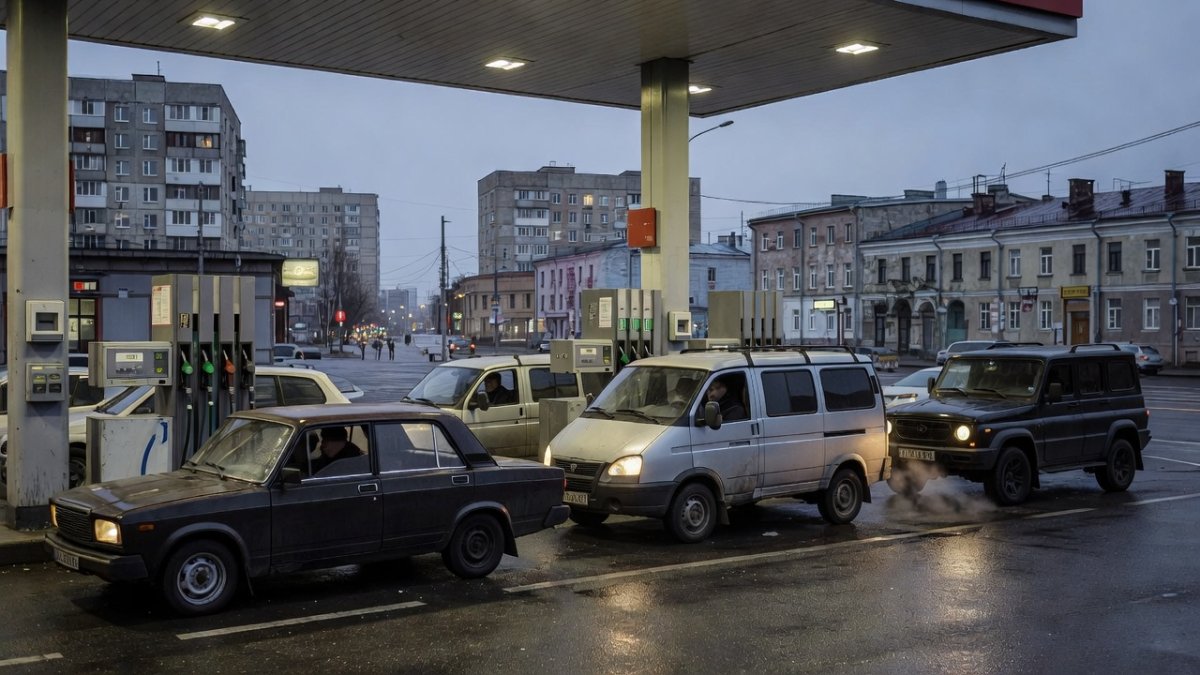
Moscow's fuel crisis has returned with renewed force this week as Gazprom Neft and Tatneft reimposed strict purchase limits at filling stations across the capital and the surrounding region, marking what industry sources describe as a "second wave" of shortages sweeping the Russian Federation. The restrictions, which cap regular gasoline purchases at 60 liters per customer, come barely two weeks after the government had signaled the worst of the crisis had passed by easing limits across 13 regions. Premium AI-95 gasoline has become so scarce that as of Tuesday evening, only a single station in all of Moscow was able to offer it, according to the Neftmagistrali hotline.
Moscow Gas Stations Reimpose Fuel Limits as Second Wave of Shortages Grips Russia
Moscow, Russia — The return of rationing at Moscow's gas stations marks a stark reversal for a government that had spent the summer insisting the fuel crisis was under control. Gazprom Neft, the country's second-largest fuel retailer, reinstated the 60-liter cap on regular gasoline for individual customers at its stations in Moscow and the Moscow region this week, while Tatneft has similarly restricted purchases in the capital area. The move follows a brief rollback earlier this month when Gazprom Neft had eased restrictions across 13 regions, raising hopes that the worst of the shortages had passed.
Premium Fuel Nearly Vanishes From Moscow Market
The scarcity of AI-95 premium gasoline has reached critical levels in the capital. As of the evening of August 18, the fuel was available at only one Neftmagistrali station in all of Moscow, the company's hotline confirmed to RBC. Some LUKOIL stations were offering only partial fuel ranges, with certain grades unavailable entirely. At Gazprom Neft's filling stations, diesel sales remain unrestricted, but gasoline purchases are now capped at 60 liters per vehicle — roughly three-quarters of a typical sedan's tank capacity. Recent videos circulating on social media show drivers queueing for petrol across Moscow and multiple Russian regions, with some waiting hours for a chance to fill up.
A Crisis Eighteen Months in the Making
The current fuel crisis traces its origins to August 2025, when Ukrainian drone strikes on Russian oil refineries began to accelerate dramatically. What started as localized disruptions has metastasized into a nationwide emergency affecting an estimated 50 million people — approximately 35 percent of Russia's population, according to the Financial Times. Novaya Gazeta Europe estimated on July 2 that the crisis had spread to at least 78 of Russia's 83 regions, with 38 regions imposing official restrictions on gasoline sales. Three regions — Penza Oblast, Irkutsk Oblast, and Zabaykalsky Krai — have declared states of emergency, while occupied Crimea and Sevastopol went further on June 26, banning all fuel sales outright.
Ukrainian Strikes Have Disabled Nearly Half of Refining Capacity
The scale of damage to Russia's refining infrastructure is staggering. CNN analysis published on June 25 found that Ukraine had struck Russian oil facilities over 300 times since February 24, 2022 — with the pace accelerating from just 3 strikes in the first year of the war to 138 in year four and 59 more between February and June 2026 alone. BBC Verify reported in October 2025 that 21 of Russia's 38 large refineries had been hit since January of that year. The Ukrainian General Staff estimated on July 4 that 42.74 percent of Russia's oil refining capacity had been disabled, while the International Energy Agency put the figure at "more than 20 percent." Finnish President Alexander Stubb has said Russia's capacity to produce and export oil has been reduced by 40 percent. The Financial Times reported that Russia produced 4.1 million barrels of oil per day in June 2026 — 28 percent below the five-year average and 35 percent below design capacity.
Second Wave Hits Regions That Had Relaxed Restrictions
Reuters reported on August 17 that a second wave of fuel shortages is now sweeping across the country. Ten regions — Orenburg, Lipetsk, Tver, Krasnodar, Zabaykalsky, Primorsky, Krasnoyarsk, Oryol, Tuva and Khakassia — which had previously relaxed their restrictions, tightened them again by August 14. SPIMEX exchange data shows that gasoline sales in Russia fell by 20 percent in the first half of August compared to the second half of July, indicating that supply is contracting even as demand remains steady. Witnesses in Moscow Oblast reported on August 17 that several filling stations had no gasoline available at all, although most still offered diesel. The July 6 strike on the Omsk refinery — Russia's largest and its top producer of gasoline — proved particularly devastating; industry sources said it halted operations the following day. The Saratov refinery also ceased operations after a July 7 strike.
Kremlin Response: Export Bans, Quality Reductions, and Rationing
The government's mitigation measures have been extensive but increasingly desperate. On July 30, the government extended the gasoline and diesel export ban through the end of January 2027, with jet fuel exports banned until the end of November. Deputy Prime Minister Alexander Novak said on June 23 that the government was considering a "total ban" on diesel exports. On July 2, Prime Minister Mikhail Mishustin signed a decree allowing certain refineries to lower production quality from Euro-5 to Euro-3 gasoline — a grade with higher sulfur content and greater pollution — until the end of 2026. The gasoline may not be exported, but the quality reduction has already caused many cars to break down, according to reports from affected regions. Six regions have introduced alternating license-plate rotation systems, under which drivers can only buy gasoline on even or odd days based on their plate number. Russia has also been forced to import refined products from abroad — a humiliating reversal for a country that was once the world's second-largest exporter of refined fuels.
Ordinary Russians Bear the Brunt of the Shortages
The human cost of the fuel crisis is becoming impossible to ignore. Queues, rationing, and crowdsourced maps of stations with fuel have become part of daily life, with social media showing drivers fighting over fuel at stations across the country. Farmers in the wheat belt have warned they cannot harvest crops without fuel for their machinery, threatening the autumn harvest. The psychological impact is equally profound. Sberbank CEO German Gref told shareholders on June 30: "I don't believe there is anyone in this country whose primary concern is anything other than an end to military hostilities as soon as possible." Analyst Jade McGlynn captured the shift in public consciousness: "For four years Russians in major cities have been able to treat this war as something that happens to other people, somewhere else... Fuel rationing across Russia ends that: when you are sitting in a petrol queue for the better part of a day, the war stops being an abstraction on the evening news." The polling data reflects this growing discontent. A Levada Center poll found that the share of Russians believing the country was heading in the right direction fell to 52 percent, down from 61 percent in May 2026. A Gallup poll from early July found that 60 percent of Russians said economic conditions were getting worse where they lived — the highest figure in 20 years. Putin's approval ratings have slipped to around 73-74 percent, which, while still high by Western standards, represents a significant erosion for the Russian leader.
Analysis and Implications
The reimposition of fuel limits in Moscow — the city that has been most insulated from the war's economic consequences — signals that the Kremlin's ability to shield its urban population from the conflict's costs is reaching its limits. The fact that premium gasoline has virtually disappeared from the capital's market is particularly telling: it suggests that even the most politically sensitive consumers are no longer protected from the consequences of the refinery strikes. International affairs professor Nina Khrushcheva has argued that it is more likely Putin will double down rather than be inclined toward peace negotiations, even as the economic pressure mounts. The strikes continue unabated — Ukrainian drones hit an oil refinery in Ufa, Bashkortostan this week, sparking a fire at a unit undergoing maintenance, while Putin ordered the government to help rebuild warehouses destroyed in Ukrainian attacks, claiming the damage had "not been critical."
The second wave of fuel shortages raises profound questions about Russia's ability to sustain its war effort and its domestic economy simultaneously. With refining capacity crippled, export bans extended, and quality standards lowered, the country is consuming its strategic reserves to keep the domestic market functioning. The coming months will test whether the Kremlin can maintain social stability as Russians queue for fuel, farmers struggle to harvest, and the economic pain of the war becomes impossible to ignore. For a government that has staked its legitimacy on providing stability and prosperity, the sight of Muscovites fighting over gasoline is not merely an inconvenience — it is a political liability of the first order.
This article was produced with AI-assisted research and editorial support. Sources: The Moscow Times, Reuters, Meduza, RBC, SPIMEX, CNN, BBC Verify, Financial Times, Novaya Gazeta Europe, International Energy Agency.
By Irina Volkov, Staff Writer
What's Your Reaction?
 Like
0
Like
0
 Dislike
0
Dislike
0
 Love
0
Love
0
 Funny
0
Funny
0
 Wow
0
Wow
0
 Sad
0
Sad
0
 Angry
0
Angry
0
Russia/Eastern Europe Correspondent at Global1.News. Covering Russian politics, energy, security, and the shifting dynamics of the post-Soviet space. Provides clear-eyed analysis on one of the world's most opaque regions.









Comments (0)