
Venezuela's interim president promises election after Maduro ousted
Venezuela stands at a crossroads. The country’s interim president, Delcy Rodríguez, has pledged that elections will be held as part of a transition to “full democracy,” yet she has offered no timetable.
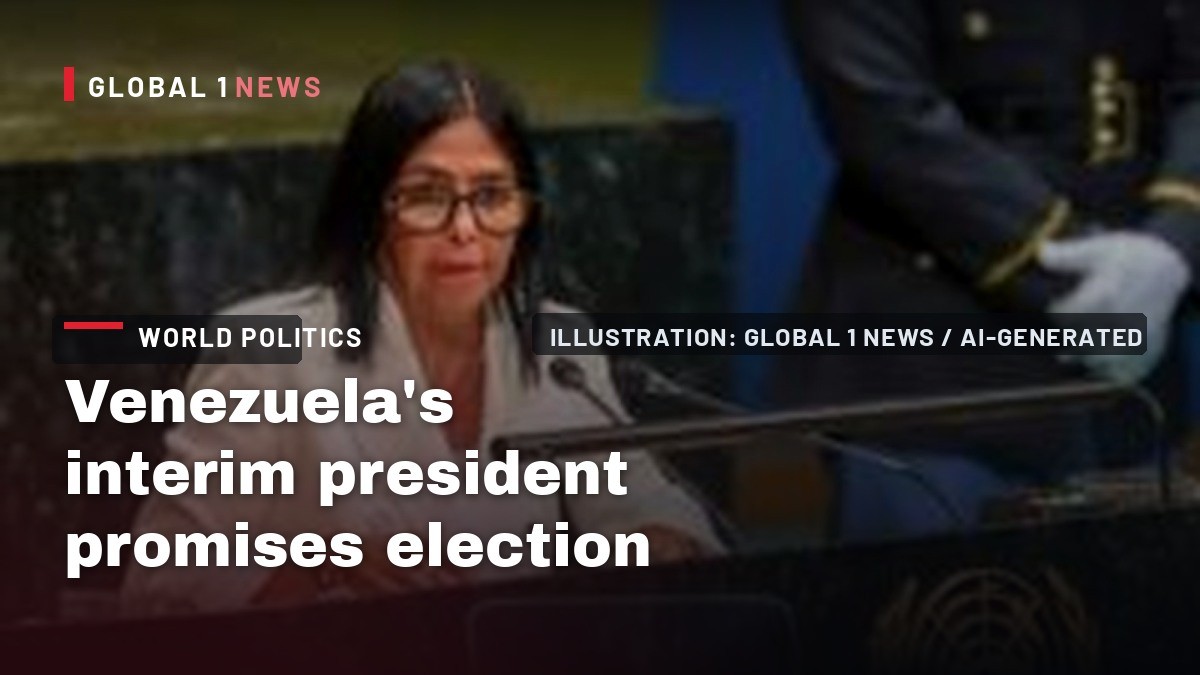
Venezuela stands at a crossroads. The country’s interim president, Delcy Rodríguez, has pledged that elections will be held as part of a transition to “full democracy,” yet she has offered no timetable. The promise comes just days after the United States seized former president Nicolás Maduro in a high‑profile raid on Caracas, dragging the long‑time ruler to New York to face drug‑trafficking charges. The political drama that follows is as much about the fate of Venezuela’s people as it is about the geopolitical chessboard that the United States and its allies now occupy.
From ally to interim leader: Rodríguez’s sudden rise
Delcy Rodríguez was sworn in as interim president barely a week after Maduro’s capture. Until then, she had served as his vice‑president, a role that placed her firmly within the inner circle of the Maduro regime. The abrupt shift from loyal deputy to head of state underscores the rapid reconfiguration of power in Caracas, a reconfiguration driven largely by external forces.
Rodríguez’s new position is bolstered by the backing of the Trump administration, which has embraced her despite her former proximity to Maduro. In her remarks at the United Nations General Assembly, she thanked President Donald Trump for “his willingness to take the path of diplomatic relations and cooperation,” signaling a clear pivot toward U.S. support. This alignment raises questions about the independence of her interim government and the extent to which Venezuelan sovereignty will be compromised in the pursuit of U.S. strategic interests.
The United States’ hand in Venezuela’s transition
The United States has taken a front‑row seat in Venezuela’s political upheaval. After the raid that captured Maduro, U.S. forces also killed or detained roughly one hundred people in Caracas, an episode that has left deep scars across the capital. In the aftermath, President Trump celebrated what he called “the largest oil deal in history covering 65 bn barrels of oil” signed with Rodríguez’s interim government. While the exact terms of the agreement are not detailed in the source, the rhetoric suggests a massive transfer of Venezuelan oil assets to U.S. control.
Trump’s statements at the UN painted Maduro as an “outlaw dictator, a real criminal,” reinforcing the narrative that the United States is the liberator of a nation plagued by authoritarian rule. Yet, Trump also warned that Venezuela is not yet ready for elections, a comment that hints at a calculated delay to ensure a favorable political environment for U.S. interests. The interplay of military might, oil economics, and diplomatic pressure illustrates how deeply intertwined Venezuela’s future is with American policy.
Opposition frustration and the missing Machado
The Venezuelan opposition has reacted with sharp criticism to Rodríguez’s vague election promise. They argue that the interim president’s failure to set even a tentative date betrays a lack of genuine commitment to democratic transition. Moreover, the opposition points out that the most prominent dissenting voice, María Corina Machado, remains excluded from any negotiations.
Machado, who fled Venezuela in December to accept the Nobel Peace Prize in Oslo, has been unable to return. Her advisers report three thwarted attempts to travel back this week alone. The ban on her candidacy, originally imposed under Maduro, still stands, and Interior Minister Diosdado Cabello has warned that any return would be met with “a surprise.” Machado’s absence from talks underscores a broader pattern: the opposition’s leadership is being sidelined, raising doubts about the inclusivity and legitimacy of any forthcoming political settlement.
U.S. diplomatic language versus on‑the‑ground realities
U.S. Secretary of State Marco Rubio, who attended the meeting between Rodríguez and Trump, framed the transition in terms of institutional rebuilding. He warned against electing a leader who would inherit “a complete catastrophe, economic and social,” suggesting that the United States sees itself as a guarantor of stability. Rubio’s call for a “political transition process” before free elections reflects a standard diplomatic formula, but it also masks the real power dynamics at play.
While Rubio urges patience, the Venezuelan populace continues to endure severe shortages, hyperinflation, and a crumbling health system—conditions that have persisted since the 2024 election widely denounced as fraudulent. The promise of “energy relations, the promotion of security, the common fight against transnational crime and economic cooperation” sounds hopeful, yet the immediate reality for ordinary Venezuelans remains one of scarcity and uncertainty.
The shadow of the 2024 election and claims of fraud
The 2024 presidential election, which saw Maduro declared the winner and Rodríguez appointed his vice‑president, has been a focal point of opposition criticism. They claim the vote was fraudulent and assert they possess “vote tallies” to substantiate their allegations. Although the source does not provide the specifics of these tallies, the persistent narrative of electoral fraud has eroded trust in any process overseen by the current interim administration.
Rodríguez’s refusal to mention the jailed former president at the UN, despite her close ties to him, signals an attempt to distance herself from the tainted legitimacy of the 2024 vote. Yet, without a clear timeline for new elections, the opposition’s skepticism remains justified, and the broader public may view the promised transition as another veneer over entrenched power structures.
Economic stakes: oil, sanctions, and the promise of cooperation
The oil deal celebrated by Trump represents a pivotal economic lever. By securing a massive volume of Venezuelan oil, the United States not only gains a strategic energy source but also exerts pressure on any future Venezuelan government to align with U.S. interests. The source mentions “energy relations” as a cornerstone of the new bilateral agenda, suggesting that oil will be a bargaining chip in negotiations over political reforms.
Sanctions, already a heavy burden on Venezuela’s economy, are likely to remain in place until the United States deems the transition satisfactory. The interim government’s pledge to work “seriously to resolve existing differences through dialogue” hints at a willingness to negotiate, but the lack of concrete steps or timelines leaves the economic future of ordinary citizens in limbo. The promise of “economic cooperation for the benefit of both peoples and our continent” sounds inclusive, yet the reality may be a restructuring of Venezuela’s oil wealth to serve external interests.
Looking ahead: what a democratic transition could mean for Venezuela
If Rodríguez’s promise of elections materializes, the stakes are enormous. A credible, inclusive electoral process could restore some legitimacy to the state and open pathways for rebuilding institutions crippled by years of mismanagement and sanctions. However, the path to such a transition is fraught with obstacles: the exclusion of key opposition figures like Machado, the lingering influence of pro‑Maduro officials such as Cabello, and the overarching presence of U.S. strategic interests.
For the Venezuelan people, the promise of “full democracy” must translate into tangible improvements—access to food, medicine, and reliable services. The international community, especially regional actors wary of foreign intervention, will be watching closely to see whether the United States respects Venezuela’s sovereignty or continues to shape its political destiny from the outside. As the nation waits for a concrete election date, the tension between hope and skepticism remains palpable, and the outcome will reverberate across Latin America’s fragile democratic landscape.
This article was produced with AI-assisted research and editorial support. Reporting is based on the source material cited below. Sources: BBC News Latin America; bbc.co.uk; Global1.News (27 September 2026).
By Elena Vasquez, Staff Writer
What's Your Reaction?
 Like
0
Like
0
 Dislike
0
Dislike
0
 Love
0
Love
0
 Funny
0
Funny
0
 Wow
0
Wow
0
 Sad
0
Sad
0
 Angry
0
Angry
0
Latin America Correspondent at Global1.News. Based in Mexico City, covering politics, economics, energy, and culture across the region. Brings an on-the-ground perspective to stories spanning from the Rio Grande to Patagonia.









Comments (0)