
The Yazidi Doctor Who Restored Life to Survivors of Islamic State Captivity
The 2014 Attacks on Sinjar and the Captivity of Yazidi Women On 3 August 2014, Islamic State militants entered the home of 19-year-old Shireen in Sinjar and took her from her family. She was sold first to an Islamic State fighter in Tal Afar and three months later to Abu Omar in Mosul, becoming his third wife. Shireen later described how Abu Omar said he loved her, yet subjecte
The 2014 Attacks on Sinjar and the Captivity of Yazidi Women
On 3 August 2014, Islamic State militants entered the home of 19-year-old Shireen in Sinjar and took her from her family. She was sold first to an Islamic State fighter in Tal Afar and three months later to Abu Omar in Mosul, becoming his third wife. Shireen later described how Abu Omar said he loved her, yet subjected her to repeated rape. His two other wives, who lived separately, beat her when they met. She was confined to the house in Mosul for more than two years, cooking, washing dishes and cleaning daily under the watch of two guards at the entrance. She was not permitted outside, even to the garden.
Islamic State fighters also brought two other Yazidi girls to the house, one aged six and one aged ten, both forced into domestic labour. The ten-year-old was raped repeatedly. Shireen was told that the Yazidi Peacock Angel, Melek Tawwus, was the devil and was pressured to convert. In 2016, during the Iraqi forces campaign to retake Mosul, she was released. Her father and sister remain missing since 2014, and an uncle and many friends were killed.
Scale of the Genocide Against the Yazidi Community
As of 2018 reports, Islamic State seized nearly a third of Iraq in 2014. The United Nations has described the events as an ongoing genocide against the Yazidi religious minority. At least 12,000 Yazidis were killed or kidnapped. By July 2018, 2,023 Yazidi women had been liberated from Islamic State territories. Yazidis follow a faith centred on Yasdan and seven angels, with particular reverence for Melek Tawwus. The attacks displaced surviving families into Iraqi Kurdistan and placed enormous strain on local health and social services in Duhok governorate.
Dr. Nagham Nawzat's Medical Training and Entry into Survivor Care
Dr. Nagham Nawzat was born in Mosul in 1976 to a Yazidi family. She graduated with a degree in gynaecology from Mosul Medical College in 2002. In 2015 she joined the Duhok Survivors' Centre, the only facility in Iraq at that time specialising in gender-based violence and funded by the UN Population Fund. Hussein al-Qaidi, director of the Kidnapped Affairs department at the Kurdistan Regional Government in Duhok, estimated that she has assisted approximately 1,200 of the liberated women.
Her work has reached more than half of the 2,023 Yazidi women recorded as liberated by July 2018. She conducts physical examinations, records patients' accounts of captivity and offers consistent follow-up support within the centre's framework.
Daily Work at the Duhok Survivors' Centre
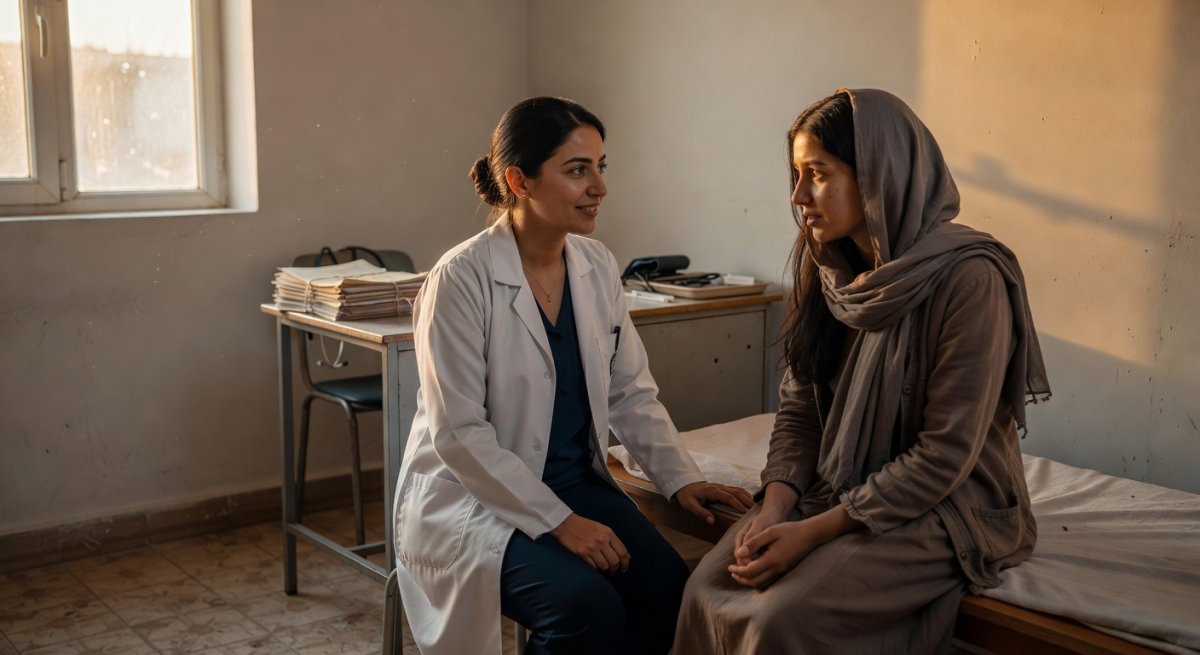
At the centre, Dr. Nawzat meets survivors for thorough physical check-ups and extended conversations about their experiences. She listens to accounts of sexual violence, forced labour and isolation without interruption. Survivors describe her approach as that of a trusted older sister in whom they can confide. The centre provides the only dedicated space in Iraq focused exclusively on gender-based violence services for this population during the period covered by 2018 reports.
Many women arrive with immediate health needs and longer-term psychological effects, including depression and recurring nightmares. Dr. Nawzat's presence allows them to receive care from a Yazidi physician who shares their cultural and linguistic background, reducing barriers that might otherwise prevent disclosure of traumatic events.
Shireen's Recovery and the Broader Human Impact
After her release in 2016, Shireen received care from Dr. Nawzat at the Duhok Survivors' Centre. She recalled that Dr. Nawzat told her she had been brave and credited the physician with helping her reach a point where she could continue living. Shireen stated that without this support she would not be here today. Her account illustrates the direct link between specialised medical and psychological services and the ability of individual survivors to manage the aftermath of captivity.
The experiences of women such as Shireen connect to wider patterns documented in Iraqi Kurdistan. Families remain separated, communities have lost thousands of members, and survivors continue to require sustained medical attention. Dr. Nawzat's work forms one sustained response within the limited infrastructure available in Duhok.
International Recognition and Continued Need
In March 2016, Dr. Nawzat received the International Women of Courage Award presented by US Secretary of State John Kerry. The award recognised her provision of psychological support to traumatised Yazidi survivors and her efforts to address gender-based violence. Despite this recognition, the number of women still missing and the scale of documented killings indicate that services for liberated survivors remain essential in the Kurdistan Region of Iraq.
By Fatima Al-Rashid, Staff Writer
This article was produced with AI-assisted research and editorial support. Reporting is based on sources cited in the article.
What's Your Reaction?
 Like
0
Like
0
 Dislike
0
Dislike
0
 Love
0
Love
0
 Funny
0
Funny
0
 Wow
0
Wow
0
 Sad
0
Sad
0
 Angry
0
Angry
0
Middle East Correspondent at Global1.News. Based in Beirut, covering politics, conflict, energy, and society across the Middle East. Brings context and depth to a region often reduced to headlines.











Comments (0)