
The 2026 Shangri-La Dialogue and Seoul's Strategic Reckoning: South Korea in a Quietly Rebalancing Alliance
The 2026 Shangri-La Dialogue and Seoul's Strategic Reckoning: South Korea in a Quietly Rebalancing Alliance The Shangri-La Dialogue held in Singapore on May 30-31, 2026, unfolded against a backdrop of shifting U.S. strategic priorities and regional uncertainties. U.S. Defense Secretary Pete Hegseth articulated a "strong, quiet, and clear" doctrine that framed partners as equals
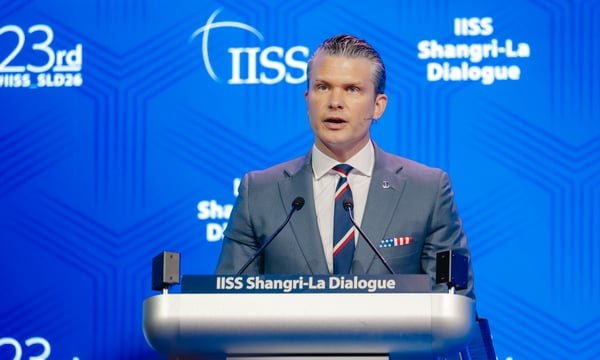
The Shangri-La Dialogue held in Singapore on May 30-31, 2026, unfolded against a backdrop of shifting U.S. strategic priorities and regional uncertainties. U.S. Defense Secretary Pete Hegseth articulated a "strong, quiet, and clear" doctrine that framed partners as equals rather than protectorates, while distinguishing model allies from free-riders. This posture emerged amid munitions shortages stemming from the Iran-U.S. conflict and coincided with announcements of a planned $1.5 trillion defense budget. Japan's Defense Minister Koizumi Shinjiro sought explicit reassurance, Australia's representative defended the rules-based order for smaller states, and New Zealand's minister noted that dialogue and submarines need not contradict each other. Taiwan's representative Andrew Nien-Dzu Yang voiced public doubts about U.S. commitments, and China's defense minister was notably absent. These elements placed South Korea in a position of strategic reckoning, prompting Korean institutions such as the Korea Institute for Defense Analyses and the Ministry of National Defense to reassess alliance dynamics and long-term positioning within an evolving hierarchy of Indo-Pacific partnerships.
The 'Strong, Quiet, Clear' Doctrine and Its Origins
The "strong, quiet, and clear" doctrine introduced by U.S. Defense Secretary Pete Hegseth at the 2026 Shangri-La Dialogue represented a deliberate recalibration of American engagement in Asia. Rooted in the aftermath of the Iran-U.S. conflict that depleted missile and ammunition stockpiles, the approach emphasized self-reliant partners capable of contributing meaningfully to collective defense rather than relying on Washington as a sole protector. The planned $1.5 trillion defense budget signaled sustained investment, yet the doctrine's core message stressed efficiency and burden distribution. This differed markedly from earlier U.S. postures that often featured expansive forward deployments and open-ended security guarantees. Historical parallels include the post-Vietnam era of retrenchment, when American forces drew down amid domestic fatigue, and the post-Cold War period of selective engagement that encouraged allies to shoulder greater responsibilities.
Korean analysts at the Korea Institute for Defense Analyses interpreted the doctrine as an operationalization of offshore balancing, whereby the United States maintains a lighter footprint while leveraging capable regional actors to manage local threats. Concretely, this meant allies would need to invest in their own munitions production, logistics resilience, and integrated planning rather than assuming automatic U.S. resupply during crises. The doctrine's quiet tone avoided rhetorical escalation while delivering clear expectations: model allies demonstrating concrete contributions would receive priority coordination, whereas free-riders risked diminished access to planning processes. For Seoul, this framework required internal reviews of combined operational plans to align with reduced U.S. tolerance for one-sided dependency, highlighting the need for accelerated modernization of precision-strike capabilities and domestic industrial capacity.
Japan, Australia and the New Burden-Sharing Hierarchy
Japan's Defense Minister Koizumi Shinjiro directly sought reassurance from Secretary Hegseth, reflecting Tokyo's proactive adjustment to the new doctrine. Japan positioned itself through expanded cooperation with Australia, the Philippines, the United Kingdom, the Quad, ASEAN, and AUKUS, thereby demonstrating alignment with the model-ally category. Australia's defense minister reinforced this hierarchy by defending the rules-based order as essential for smaller states, while New Zealand's minister clarified that dialogue mechanisms and submarine programs could coexist without contradiction. Hegseth's distinction between model allies and free-riders thus created an implicit ranking visible in public exchanges at the dialogue.
The Asan Institute's scenario modeling suggested this hierarchy would affect Seoul's standing by rewarding states that integrated early into minilateral structures. Japan's role illustrated how burden-sharing translated into greater influence over regional planning. For South Korea, remaining outside certain groupings risked placement in a secondary tier, limiting access to intelligence-sharing and joint exercises. The resulting dynamic pressured Korean policymakers to evaluate participation options without undermining core bilateral ties with Washington. Institutional assessments emphasized that visible contributions to munitions stockpiling and interoperability would determine whether Seoul maintained parity with Tokyo and Canberra in future U.S. coordination mechanisms.
South Korea's Alliance Calculus
The ROK-U.S. Mutual Defense Treaty continued to anchor Seoul's security posture, yet the 2026 dialogue prompted the Ministry of National Defense to review combined operational plans for alignment with the new doctrine. Korean defense industrial investments in shipbuilding and precision-strike systems gained urgency as planners sought to offset potential shortfalls in U.S. munitions availability. Modernization of the three-axis system, encompassing kill-chain, missile defense, and massive retaliation capabilities, formed a central element of this calculus. Debates over Quad participation intensified within policy circles, with some arguing that selective engagement could signal model-ally status without full entanglement.
The Korea Development Institute provided fiscal assessments indicating that sustained increases in defense spending would be necessary to meet alliance expectations. Ministry of Foreign Affairs internal assessments highlighted the value of trilateral U.S.-Japan-ROK mechanisms for managing coordination gaps. These reviews concluded that concrete steps in joint logistics and production capacity would strengthen Seoul's position. Policymakers recognized that demonstrating autonomous contributions aligned with Hegseth's emphasis on partners rather than protectorates, thereby preserving treaty benefits while adapting to reduced U.S. willingness to subsidize allied shortfalls.
North Korean Reactions and Deterrence Credibility
Pyongyang has historically exploited perceived gaps in alliance cohesion, a pattern evident during the 1990s Agreed Framework negotiations when divisions among U.S., South Korean, and Japanese positions created openings for delay tactics. Ministry of National Defense and Korea Institute for Defense Analyses warnings following the Shangri-La Dialogue stressed that Taiwan representative Andrew Nien-Dzu Yang's public doubt about U.S. commitments could similarly embolden North Korean signaling. Such statements risked undermining deterrence credibility if not countered by visible alliance solidarity and Korean self-help measures.
In response, Seoul accelerated conventional strike and missile defense modernization programs while expanding munitions production and logistics resilience. Demonstrating concrete steps in these areas served to reassure both domestic audiences and Washington that South Korea would not function as a free-rider. Institutional analysis concluded that sustained investment in these capabilities would limit Pyongyang's ability to probe alliance fissures, particularly during periods of U.S. resource strain from other theaters. This approach reinforced deterrence without requiring expanded American commitments.
China's Absence and Korea's Diplomatic Position
China's defense minister absence from the dialogue underscored Beijing's preference for bilateral channels over multilateral forums where U.S. influence predominates. This vacuum placed additional weight on Seoul's diplomatic agility to manage relations with both Washington and Beijing. The 2016-2017 THAAD dispute served as a recent precedent illustrating the economic costs of alliance choices that Beijing viewed unfavorably, including retaliatory measures affecting Korean companies.
Korea Institute for Defense Analyses outlined three policy pathways: deepened alignment with U.S. minilateral structures, calibrated autonomy emphasizing bilateral U.S. ties, or sequenced engagement that maintained economic channels with China. The Asan Institute advocated a sequenced approach that prioritized alliance commitments while preserving chaebol supply-chain stability. Balancing economic interdependence with China against security obligations required careful signaling that avoided both provocation and perceived weakness, ensuring South Korea retained flexibility amid competing great-power pressures.
The CPTPP Precedent and Korea's Path Forward
After the 2017 U.S. withdrawal from the Trans-Pacific Partnership, Japan led the reorganization that produced the CPTPP, demonstrating how a capable ally could fill leadership gaps and reshape regional architecture. Analysts at Korean institutions viewed this episode as an analogy for the security domain following the 2026 Shangri-La Dialogue. As a CPTPP applicant, South Korea already possessed experience navigating post-U.S. regional frameworks, offering a template for security cooperation.
Ministry of National Defense and Ministry of Foreign Affairs internal coordination focused on joint munitions production arrangements with Australia and Japan, alongside Korea Institute for Defense Analyses scenario planning for Taiwan contingencies. Korea Development Institute cost modeling supported selective investments that would position Seoul within the model-ally category. Aligning with this standard entailed visible contributions to collective capacity rather than passive reliance on U.S. guarantees. Over the longer term, such positioning could stabilize Northeast Asian security by reinforcing a layered alliance structure less vulnerable to fluctuations in American political will.
By Prof. David Park, Staff WriterThis article was produced with AI-assisted research and editorial support. Reporting is based on sources cited in the article.
What's Your Reaction?
 Like
0
Like
0
 Dislike
0
Dislike
0
 Love
0
Love
0
 Funny
0
Funny
0
 Wow
0
Wow
0
 Sad
0
Sad
0
 Angry
0
Angry
0

East Asia/Technology Correspondent at Global1.News. Seoul-based voice covering Korean politics, technology, business, and culture. Analyzes how technology and geopolitics intersect across East Asia.










Comments (0)