
Tulfo Blasts Meralco Over System Loss as Senate Moves to Scrap Charge
In a recent ANC 24/7 report, Senator Erwin Tulfo tore into Manila Electric Co. (Meralco) during a Senate Committee on Energy hearing, demanding an end to a charge that he said forces Filipino families to pay for electricity they never even used. At the center of the storm is the system loss charge — roughly five percent of a typical household bill — and a Senate push, backed by President Ferdinand Marcos Jr., to scrap it before Christmas.
In a recent ANC 24/7 report, Senator Erwin Tulfo tore into Manila Electric Co. (Meralco) during a Senate Committee on Energy hearing, demanding an end to a charge that he said forces Filipino families to pay for electricity they never even used. At the center of the storm is the system loss charge — roughly five percent of a typical household bill — and a Senate push, backed by President Ferdinand Marcos Jr., to scrap it before Christmas. For millions of Filipinos who open their electric bills every month with a wince, this is a fight about real money: the P70 billion to P80 billion a year that consumers shoulder for power lost in transmission and distribution.
Tulfo Blasts Meralco Over System Loss as Senate Moves to Scrap Charge
Manila, Philippines – Friday — Senator Erwin Tulfo, chairman of the Senate Committee on Energy, lashed out at Meralco officials on Thursday after the distribution utility explained how it plans to address system loss, in a hearing that came a day after the committee grilled regulators over President Marcos' call to remove the charge from electricity bills. The confrontation is part of a fast-moving campaign, launched after the President's fifth State of the Nation Address, to amend the 25-year-old Electric Power Industry Reform Act (EPIRA) and erase system loss — and its value-added tax — from the bills of ordinary consumers.
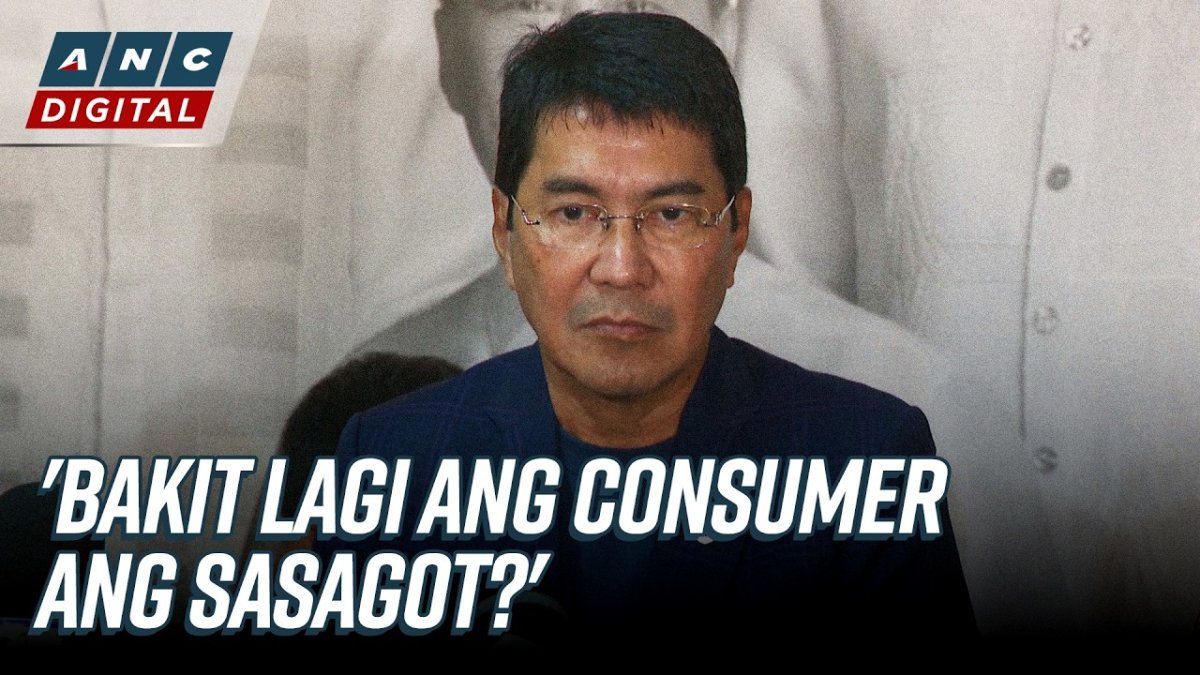
The Story — A Heated Senate Hearing
At the hearing, Tulfo confronted Meralco's Atty. Jose Ronald Valles, senior vice president and head of regulatory management, over the utility's explanation that eliminating non-technical system loss — electricity lost to pilferage and illegal connections using "jumpers" — would require more personnel conducting 24/7 inspections and patrolling every kilometer of power lines. Valles said the operational and capital expenses would be substantial and would have to be loaded into the tariff, because no distribution utility would allow itself to lose money because of electricity thieves.
The senator was having none of it. "Are you saying that when you need to have no losses, you pass it on to us?" Tulfo said. "Adding your people, you will pass that on and load it onto our bill again? That is no longer our problem. It is no longer the consumer's problem either. Hire your people, expand — we do not care about that."
He added: "If you do not want losses, then do not — go into another business. That is what my point is, that is what the people are saying right now. Why is it always us? Do you not have any losses to answer for? It is always pass on, pass on, pass on."
Tulfo's frustration boiled down to a single question he put to the hearing: "Kasalanan ba natin 'yun?" — Is that our fault? He noted that the pass-on amounts to roughly P70 billion to P80 billion that consumers absorb every year. "We keep hearing complaints from these companies that they will lose billions if we take out the systems loss charge," Tulfo said. "But let us be clear: this will not cause operational losses to distribution utilities. It will simply reduce their massive, multibillion-peso incomes. It is time we stop forcing everyday Filipino consumers to pay for electricity they never even used."
Meralco's Defense — A Charge It Says It Merely Collects
Meralco, the country's largest distribution utility serving more than eight million customers across Metro Manila and nearby provinces, defended the charge as a pass-through cost it does not profit from. Valles said Meralco has been aggressive in addressing illegal connections, raising meters in depressed areas so they cannot be reached, yet non-technical losses still occur. He explained that the cost of addressing system loss is part of the "reasonable cost" the company presents to the Energy Regulatory Commission (ERC), which decides whether it may be passed on to consumers.
The executive also told the committee that Meralco refunds consumers once it successfully prosecutes pilferage cases, returning recovered amounts to customers as a reduction in generation cost. "Nothing goes to Meralco there," Valles said. "What is recovered is returned to the customers." He stressed that the company merely collects the system loss charge and does not earn from it.
Meralco chairman Manny V. Pangilinan has expressed concerns over scrapping the total system loss, and the company said it will comply with whatever the law mandates — but hopes the government can provide a subsidy so its services are not affected.
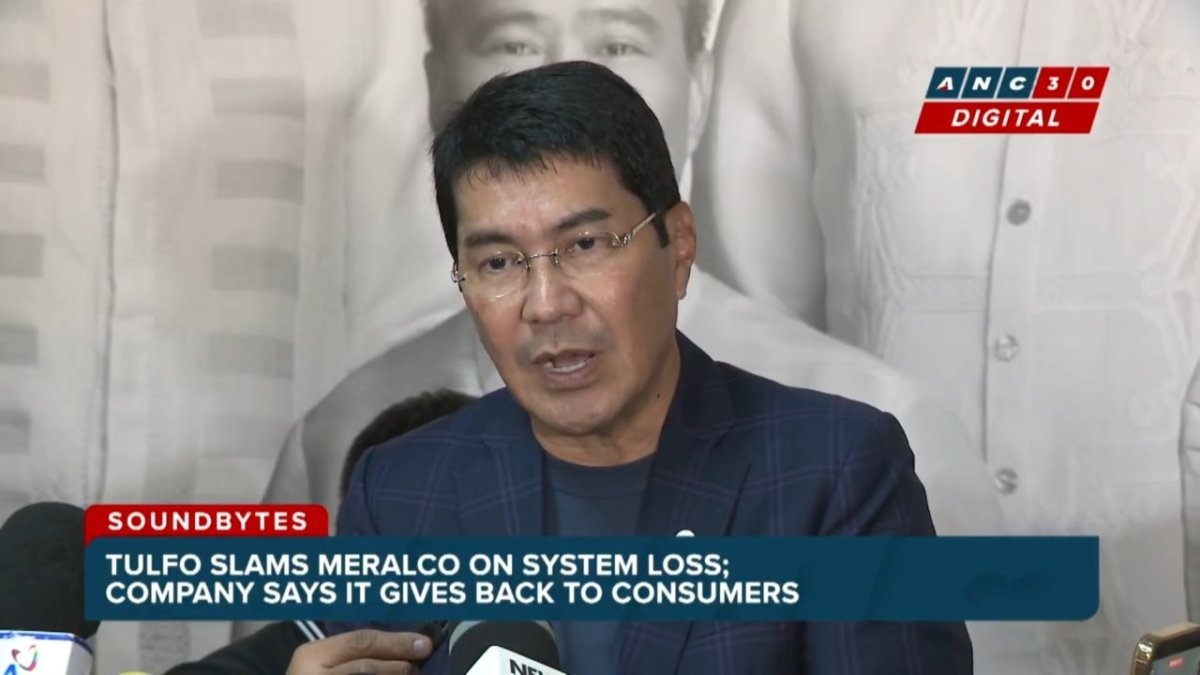
Philippine Context — From SONA to EPIRA Amendment
The hearing did not happen in a vacuum. It followed President Ferdinand Marcos Jr.'s fifth State of the Nation Address, delivered earlier this week, in which he called on Congress to pass a law scrapping system loss from electricity bills — a pocketbook issue that resonates in every Filipino household, from the high-rise condominiums of Makati to the wooden houses of Tondo.
Days after the SONA, Tulfo filed measures to match the President's directive: bills removing the energy tax, Senate Bill No. 2340 exempting the system loss charge from value-added tax, and Senate Resolution No. 537 seeking an inquiry into the EPIRA provision that allows system loss charges to be passed on to consumers. He has vowed to amend EPIRA itself — the Electric Power Industry Reform Act of 2001, now a quarter-century old — and said under his watch, "aalisin natin ang system loss charge."
The executive branch wants speed. Malacañang has called for the measure ASAP, while Tulfo has set an ambitious target: an EPIRA amendment before Christmas. To back the effort, a joint task force composed of the Department of Energy, the ERC, the National Electrification Administration, and electric cooperatives has been formed to pursue the removal of system loss charges and VAT from electricity bills and coordinate a comprehensive review of power bill reforms. The Philippines has long had some of the highest electricity rates in Southeast Asia, and lawmakers see the system loss charge as the most visible — and most politically winnable — target in a broader fight over the cost of power.
How System Loss Works — and Why It's on Your Bill
System loss is the electricity that disappears between the power plant and the socket. Technical losses come from natural causes — resistance in power lines and transformers, and aging equipment — while non-technical losses come from pilferage and illegal connections, often through improvised "jumpers" that bypass the meter. Under the EPIRA framework, distribution utilities are allowed to recover these losses by passing the cost on to paying consumers, subject to caps set by the ERC.
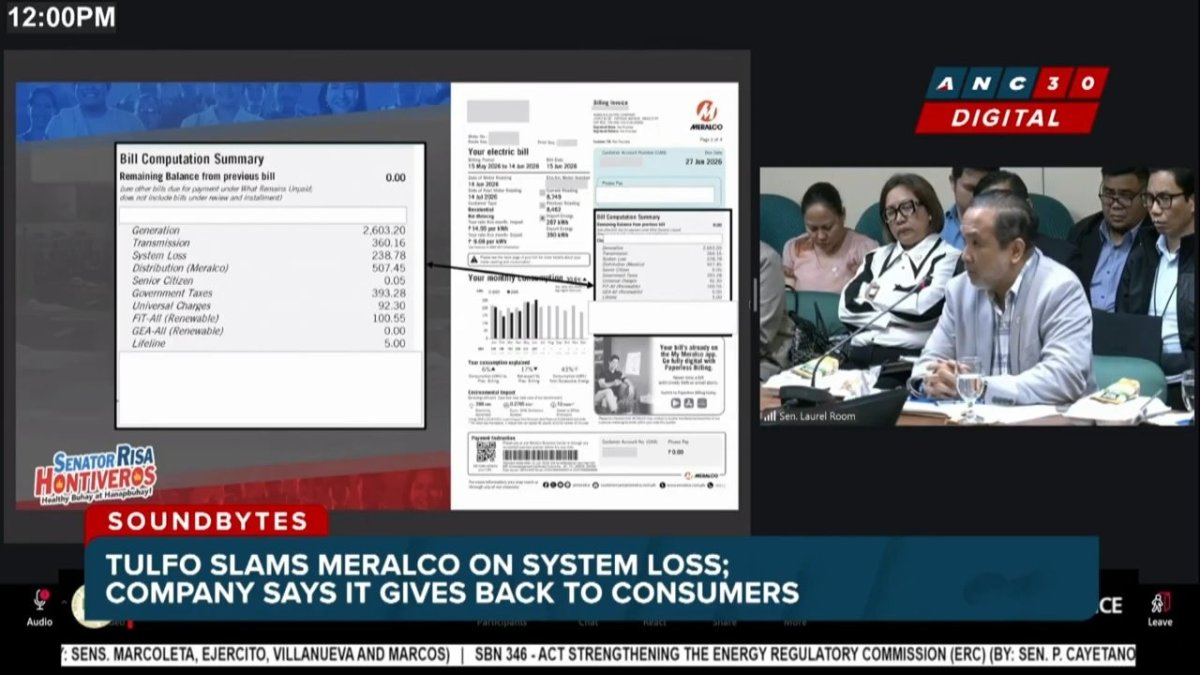
For a typical household, the system loss charge shows up as a line item of about five percent of the total bill — on top of generation, transmission, distribution, and government taxes. ERC Chairperson and CEO Francis Saturnino Juan told the committee that while scrapping the pass-on for non-technical causes could bring down bills, the majority of system loss is technical, so the savings would only go so far. Still, Tulfo argued that the principle is simple: whatever the cause, the loss is not the consumer's fault, and consumers should not be the ones paying for it.
Impact on Filipinos — What Removing the Charge Means
For the average household, every line item on the electric bill matters — and for minimum-wage earners, jeepney drivers, and families in the barangays who budget down to the last peso, even a small charge adds up, especially during the hot months when electric fans and air conditioners run longer and bills balloon. A sari-sari store owner in Quezon City who keeps a refrigerator running all day, or an OFW family in Cavite relying on remittances to cover utilities, has no way to avoid the charge — it is simply printed on the bill, month after month.
Senate President Win Gatchalian estimated the system loss nationwide at about P45 billion and believes distribution utilities can absorb it. "The good thing there is it will force the distribution utilities to be more efficient," Gatchalian said. "Right now, efficient or not efficient, bahala na si consumer — it gets passed on." He noted that about 60 percent of an electricity bill is the generation charge and urged lawmakers to target generation if they truly want to lower bills.
Reactions and Responses — Lawmakers, Regulators, and Consumer Groups
The hearing drew a rare convergence of voices. Juan agreed that scrapping the pass-on charge for non-technical causes could bring down bills, but asked that distribution utilities be given the ability and resources to keep operating viably so service to consumers is not affected. While awaiting the EPIRA amendments, the ERC is studying how to lower the system loss charge. On Gatchalian's directive, the ERC is also conducting a fuel cost audit and has sent more than 400 show cause orders to distribution utilities and generation companies for failing to comply with submission requirements.
Senator Risa Hontiveros cautioned that system loss is not the only pass-through charge on the bill. "By far, generation is higher, then distribution — in this case Meralco — then government taxes, and finally on this bill, system loss," Hontiveros said. She urged the committee to examine five other bigger pass-through charges with the same scrutiny, warning that ending at system loss would not eradicate the real reason electricity is expensive.
Outside the Senate, reaction was swift. The Philippine Rural Electric Cooperatives Association (PHILRECA), representing 121 electric cooperatives, said it can back the complete removal of system loss charges if the government shoulders the costs through a dedicated subsidy mechanism — warning that without a subsidy, scrapping the charge could drive non-profit electric cooperatives toward bankruptcy. Gabriela party-list rejected Meralco's claim that it cannot absorb the charge, citing the company's P26.5 billion profit: "Removing system loss charges is an important first step, but Congress must not mistake it for the solution. We urge lawmakers to fast-track the EPIRA amendments while working toward the law's eventual repeal."
Gerry Arances of the Power for People Coalition echoed that call. "It's not just the system loss provision that needs changing," Arances said. "The entire policy and regulatory framework governing the electricity sector needs an overhaul."
What to Watch For
The Senate Committee on Energy has scheduled another hearing next week, and Tulfo has made clear he intends to keep the pressure on. Watch for three things: first, whether the committee moves the EPIRA amendment bill to plenary before the Christmas target; second, how the ERC's fuel cost audit reshapes the debate over the generation charge, the largest component of the bill; and third, whether the government produces the subsidy mechanism that electric cooperatives say they need to survive the change.
For Filipino consumers, the outcome will be measured in pesos and centavos on every monthly bill. If the Senate delivers on its promise, households could finally see the charge disappear — but as lawmakers themselves warn, the deeper work of bringing down the cost of power in the Philippines has only just begun.
By Bella Reyes, Staff Writer
This article was produced with AI-assisted research and editorial support. Reporting is based on sources cited in the article.
What's Your Reaction?
 Like
0
Like
0
 Dislike
0
Dislike
0
 Love
0
Love
0
 Funny
0
Funny
0
 Wow
0
Wow
0
 Sad
0
Sad
0
 Angry
0
Angry
0

Philippines/Southeast Asia Correspondent at Global1.News. Manila-based journalist covering Philippine politics, environment, maritime security, and social issues. Passionate about marine conservation and the communities protecting the Philippines' natural heritage.













Comments (0)