
US Senate blocks resolution on Judea and Samaria rights report
The U.S. Senate on Tuesday voted 47–51 to block a procedural resolution that would have required the Trump administration to report to Congress on human‑rights conditions and the deaths of American citizens in Judea and Samaria.
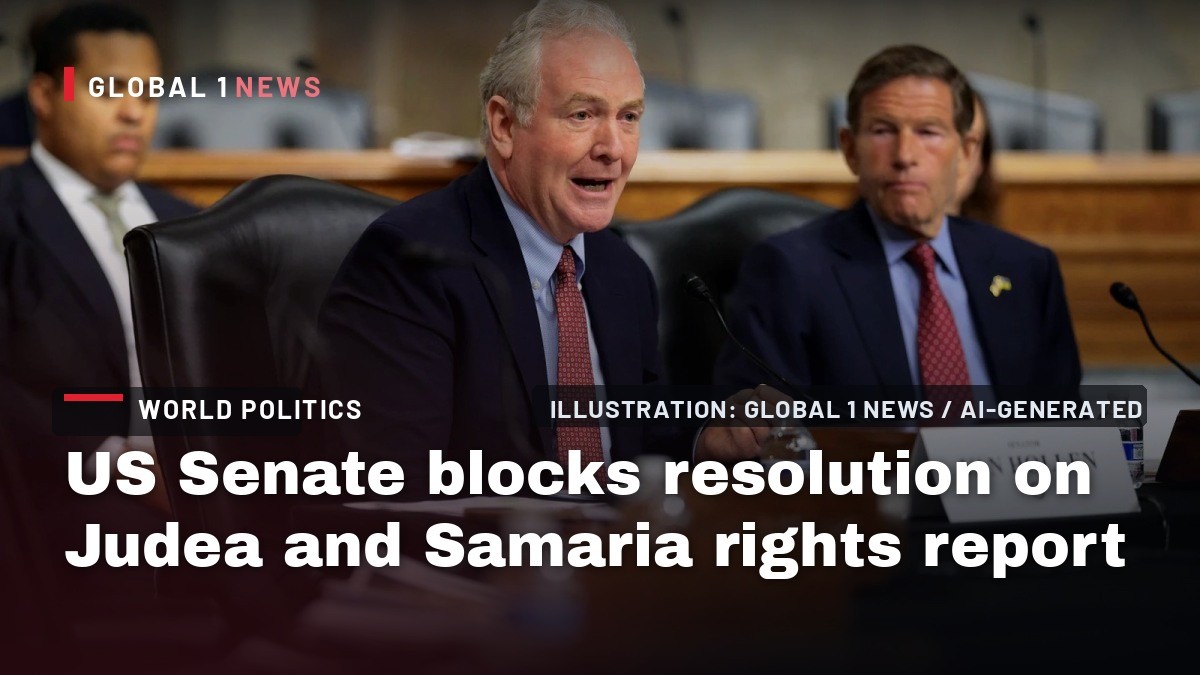
The U.S. Senate on Tuesday voted 47–51 to block a procedural resolution that would have required the Trump administration to report to Congress on human‑rights conditions and the deaths of American citizens in Judea and Samaria. The measure, championed by Sen. Chris Van Hollen (D‑Md.), sparked a sharply partisan debate that reflects broader tensions over how Washington monitors the use of its foreign‑aid dollars in a region fraught with security challenges and diplomatic sensitivities.
Political dynamics of the vote
The vote fell largely along party lines, with the Democratic caucus largely supporting the resolution and the Republican caucus opposing it. Notably, Sen. Rand Paul (R‑Ky.) crossed the aisle to back the proposal, while Sen. John Fetterman (D‑Pa.) joined the Republican bloc in voting against it. This split underscores the fact that, despite the resolution’s procedural nature, the issue of U.S. accountability for aid to Israel remains a flashpoint within Congress.
Sen. Van Hollen framed the initiative as a matter of principle, arguing that “Congress must ensure that recipients of U.S. foreign aid abide by American statutory standards and values.” He emphasized that the resolution was not intended to cut defense assistance directly, but that a failure by the administration to provide the demanded assessment could eventually trigger legislative restrictions. The language of the resolution therefore sought to create a reporting mechanism that could, if necessary, become a lever for future policy action.
Content of the proposed reporting requirement
The resolution would have compelled the Trump administration to submit a detailed report to Congress on two key issues: the human‑rights situation in Judea and Samaria, and the circumstances surrounding the deaths of nine American citizens on the West Bank. By focusing on the deaths of U.S. nationals, the measure aimed to bring a personal dimension to the broader debate over Israel’s security policies and the impact on Palestinian civilians.
Although the text of the resolution did not call for immediate cuts to defense assistance, it signaled that the administration’s compliance—or lack thereof—could set the stage for future legislative action. This approach mirrors previous congressional attempts to attach conditions to foreign‑aid programs, using reporting requirements as a first step toward more substantive policy changes.
Republican opposition and security arguments
Opponents of the resolution, led by Sen. Steve Daines (R‑Mont.), framed the measure as an attempt to politicize the U.S.–Israel alliance. Daines urged his colleagues to defeat the initiative, arguing that the United States must stand with an ally that is “countering Iranian‑backed terrorism rather than applying punitive diplomatic pressure.” The Republican narrative emphasized Israel’s role as a strategic bulwark against Tehran’s regional ambitions, especially as Jerusalem continues to confront an ongoing conflict with Iran.
By rejecting the resolution, Republican senators signaled that they view any additional reporting or conditionality as potentially undermining the security partnership. Their stance reflects a broader concern that heightened congressional scrutiny could be leveraged by adversaries to sow division within the alliance.
Implications for U.S. foreign‑aid policy
While the resolution did not impose immediate financial penalties, its defeat leaves open the question of how future congressional oversight might be structured. The vote demonstrates that a majority of senators—though short of a majority—support a more rigorous accounting of how U.S. aid is used in the occupied territories. If the administration were to ignore the reporting request, the language of the resolution suggests that legislative restrictions could follow, potentially affecting the flow of aid.
For Israel, the outcome reaffirms the durability of the defense partnership, but it also highlights the growing scrutiny of its policies in the West Bank. The Israeli government, accustomed to robust U.S. support, now faces a congressional audience that is increasingly attentive to human‑rights considerations, especially when American lives are involved.
Regional context: Tehran’s influence and the West Bank
The debate unfolded against a backdrop of heightened regional tension, with Jerusalem confronting an “ongoing regional conflict with Tehran.” Iran’s support for proxy groups and its broader strategic objectives in the Levant continue to shape Israeli security calculations. In this environment, any perception of weakening the U.S.–Israel alliance is viewed by Israeli officials as a potential opening for Tehran to increase its influence among Palestinian factions.
At the same time, the West Bank remains a flashpoint for civilian casualties and human‑rights concerns. The nine Americans killed on the West Bank, referenced in the resolution, underscore the personal stakes for U.S. citizens living or traveling in the area. Their deaths have amplified calls within Congress for greater transparency on how Israeli security operations intersect with civilian safety.
Domestic political calculations
Sen. Van Hollen’s push for the resolution can also be read as part of a broader Democratic effort to demonstrate a commitment to human‑rights oversight, especially as the party seeks to differentiate itself from Republican foreign‑policy positions. By highlighting the deaths of American citizens and the daily injustices faced by Palestinians, Van Hollen framed the issue as both a moral imperative and a matter of constituent concern.
Conversely, Republican senators framed opposition as a defense of a strategic alliance, positioning themselves as protectors of Israel’s security against Iranian aggression. The partisan split reflects deeper ideological divides over how the United States balances strategic interests with human‑rights advocacy in its foreign policy.
Looking ahead: Potential next steps
Although the resolution was blocked, the debate has not ended. The fact that 47 senators supported the measure—more than any previous attempt, according to Van Hollen—suggests a growing appetite within Congress for more stringent oversight of aid to Israel. Future legislative proposals may seek to embed reporting requirements directly into aid authorizations, or to attach conditions tied to specific human‑rights benchmarks.
For Israeli officials, the Senate’s decision reinforces the importance of maintaining strong diplomatic ties with Washington while also managing the international scrutiny of actions in Judea and Samaria. As the region continues to grapple with Iran’s influence and the complex realities on the ground, the interplay between security imperatives and human‑rights concerns will likely remain a central theme in U.S.–Israel relations.
This article was produced with AI-assisted research and editorial support. Reporting is based on the source material cited below. Sources: JNS (Jewish News Syndicate); jns.org; Global1.News (30 September 2026).
By Hannah Berg, Staff Writer
What's Your Reaction?
 Like
0
Like
0
 Dislike
0
Dislike
0
 Love
0
Love
0
 Funny
0
Funny
0
 Wow
0
Wow
0
 Sad
0
Sad
0
 Angry
0
Angry
0

Israel Correspondent at Global1.News. Based in Tel Aviv, covering Israeli politics, security, technology, and society. Provides balanced, deeply-sourced reporting on one of the most closely-watched regions in the world.














Comments (0)