
Sisi says Egypt lost about $20 billion in Suez Canal revenue amid regional instability
Egyptian President Abdel Fattah el‑Sisi warned that the ongoing turbulence across the region has cost his country dearly, estimating a loss of roughly $20 billion in Suez Canal revenue in recent years.
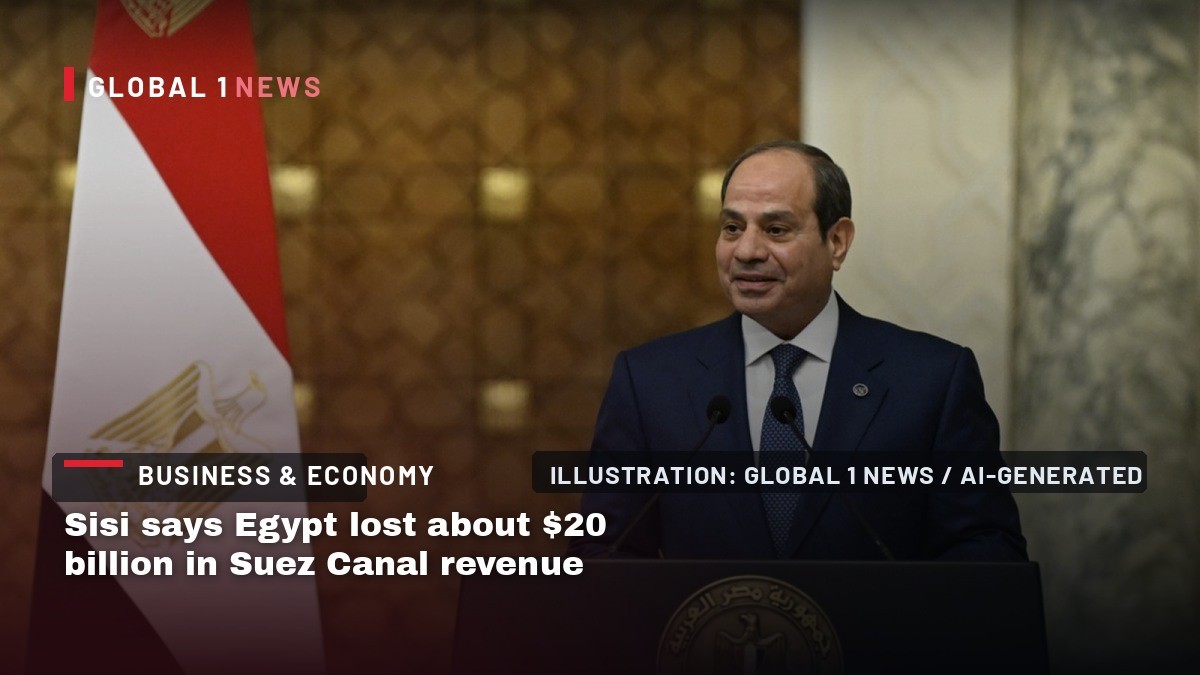
Egyptian President Abdel Fattah el‑Sisi warned that the ongoing turbulence across the region has cost his country dearly, estimating a loss of roughly $20 billion in Suez Canal revenue in recent years. Speaking at an expanded gathering of senior officials in the newly inaugurated Strategic Command complex in the New Administrative Capital, Sisi linked the economic shortfall directly to the broader instability that continues to shape the lives of millions, especially the displaced Palestinians of Gaza. His remarks underscore how the financial health of a nation’s vital arteries can be inseparably tied to the human cost of conflict and the obligations of international law.
Economic fallout from regional instability
During the meeting, which brought together Prime Minister Mostafa Madbouly, cabinet ministers, governors, senior state officials, and military and police commanders, Sisi highlighted that disruptions in Red Sea shipping and the Suez Canal have eroded Egypt’s earnings by about $20 billion over recent years. He framed this loss as a direct consequence of “regional instability,” a term that encompasses the ripple effects of the COVID‑19 pandemic, the Russia‑Ukraine war, and the ongoing Gaza conflict. While the exact annual figures were not broken down, the president’s estimate signals a substantial dent in a revenue stream that underpins Egypt’s public finances.
Beyond the raw numbers, the president warned that the economic contraction triggered by the political upheaval of 2011‑2013 still lingers, and that successive shocks have compounded the strain on state resources. He called for a more efficient use of those resources, a restoration of public confidence in government institutions, and measures to protect domestic stability. Implicit in this appeal is the recognition that economic resilience is essential for maintaining the social contract in a country already grappling with high inflation and widespread poverty.
Human cost of the Gaza conflict
Sisi’s address turned sharply to the humanitarian dimension of the regional crisis when he warned that attempts to forcibly displace Palestinians from Gaza “have not ceased.” He reiterated Egypt’s long‑standing opposition to any plan that would relocate Gaza’s population outside the Palestinian territories, a stance that has been tested repeatedly by proposals from Israeli officials and, more recently, by a public suggestion from former US President Donald Trump in 2025. The president’s insistence that “efforts to displace Palestinians…remain a threat” reflects Egypt’s concern that forced migration would exacerbate the already dire humanitarian situation, creating further refugee flows into Egypt’s already stretched border regions.
While the source material does not provide casualty figures, the repeated emphasis on displacement underscores a growing fear that the conflict’s impact extends beyond the immediate battlefield. The potential for a new wave of refugees would strain Egypt’s health, education, and housing systems, already burdened by a large domestic population and a history of absorbing displaced peoples from previous crises.
International law and freedom of navigation
In the same speech, Sisi invoked the principle of freedom of navigation through international maritime routes, a cornerstone of international law that underpins the Suez Canal’s global significance. He reaffirmed Cairo’s commitment to “freedom of navigation…in accordance with international law,” linking the canal’s operational integrity to the broader legal framework that guarantees safe passage for commercial shipping. This legal stance is particularly salient given the recent disruptions caused by regional conflict, which have threatened the canal’s reputation as a secure conduit for world trade.
The president’s emphasis on legal norms serves a dual purpose: it positions Egypt as a guardian of a critical global commons while also highlighting how breaches of international law—whether through attacks on shipping lanes or forced population transfers—can have cascading economic and humanitarian repercussions. By anchoring his argument in legal principles, Sisi seeks to rally both domestic and international support for a stable, law‑based order in the Middle East.
Egypt’s strategic foreign policy priorities
Sisi described peace as Egypt’s “strategic choice,” placing the Palestinian issue at the heart of regional stability. He reiterated Cairo’s support for a two‑state solution as the foundation for resolving the Israeli‑Palestinian conflict, aligning with long‑standing Arab League positions. Moreover, he underscored Egypt’s commitment to the security and stability of Gulf Arab states, reflecting the interconnected nature of Middle Eastern geopolitics where unrest in one arena can quickly spill over into others.
By framing the Palestinian question as central to broader regional security, the president signals that any escalation—such as attempts to relocate Gaza’s population—could destabilize not only Egypt’s borders but also the delicate balance among Gulf allies. This perspective reinforces the notion that economic losses like the $20 billion shortfall are symptoms of a deeper, systemic instability that can only be addressed through a comprehensive political settlement.
Domestic implications of the revenue loss
The estimated $20 billion loss in canal revenue, while a macro‑economic figure, translates into concrete challenges for ordinary Egyptians. Sisi’s call for better utilization of state resources implies that the shortfall may affect public services, subsidies, and development projects that many citizens rely upon. In a country where unemployment remains high and inflation pressures household budgets, any reduction in state income can exacerbate social tensions.
Furthermore, the president’s appeal to “strengthen public confidence in government institutions” suggests an awareness that economic grievances can quickly erode trust in the state. By linking the canal’s performance to domestic stability, Sisi is warning that prolonged revenue deficits could fuel dissent, especially if citizens perceive that the government is unable to protect national assets or deliver essential services.
Potential pathways forward
In light of the intertwined economic, humanitarian, and legal dimensions highlighted by Sisi, several avenues emerge for mitigating the crisis. First, bolstering security around the Red Sea and the canal could restore confidence among shipping companies, encouraging a return to pre‑disruption traffic levels. Second, renewed diplomatic engagement aimed at halting forced displacement proposals—whether from Israeli officials or external actors—could prevent a new refugee surge and preserve regional stability.
Finally, Egypt’s appeal to international law and the principle of free navigation offers a platform for multilateral cooperation. By working with global partners to safeguard maritime routes and uphold legal norms, Egypt can help ensure that the canal remains a reliable engine of economic growth, while also reinforcing the broader rule‑of‑law framework essential for a just resolution of the Palestinian question.
Conclusion: Linking revenue, rights, and peace
President Sisi’s remarks at the Strategic Command headquarters illuminate how a single economic indicator—the Suez Canal’s revenue—can reflect the broader health of a region beset by conflict and instability. The estimated $20 billion loss is not merely a fiscal statistic; it is a symptom of disrupted trade, threatened humanitarian rights, and strained legal norms. By foregrounding the plight of Palestinians in Gaza and emphasizing the importance of international law, Sisi underscores that economic recovery and human security are mutually dependent.
For Egypt, safeguarding canal revenues, protecting its borders from a potential influx of displaced Palestinians, and championing the rule of law are intertwined goals. Achieving them will require concerted diplomatic effort, robust security measures, and a genuine commitment to a two‑state solution that respects the rights and dignity of the Palestinian people. Only through such a holistic approach can the financial losses be reversed and, more importantly, the human cost of regional instability be alleviated.
This article was produced with AI-assisted research and editorial support. Reporting is based on the source material cited below. Sources: Middle East Monitor; middleeastmonitor.com; Global1.News (30 September 2026).
By Fatima Al-Rashid, Staff Writer
What's Your Reaction?
 Like
0
Like
0
 Dislike
0
Dislike
0
 Love
0
Love
0
 Funny
0
Funny
0
 Wow
0
Wow
0
 Sad
0
Sad
0
 Angry
0
Angry
0

Gulf/MENA Correspondent at Global1.News. Based in Doha, covering Gulf politics, energy markets, diplomacy, and development across the Middle East and North Africa. Tracks the economic transformation of the Gulf states.













Comments (0)