
Spotify and Claude Went Down on the Same Morning - and Neither Will Say Why
Spotify and Anthropic's Claude both went down for thousands of users on Tuesday 29 September 2026. Neither company has stated a cause, and the gap between the plausible story and the confirmed record is the real problem.

Spotify and Anthropic's Claude went down for thousands of users on Tuesday 29 September 2026, in the same morning window, and neither company has explained why. By the time both services settled, the public record contained two vague statements and no cause at all. The failures were partial, the recovery was quick, and the explanation was absent.
Spotify and Claude Went Down on the Same Morning - and Neither Will Say Why
Atlanta, United States - Two of the most heavily used services on the consumer internet stopped working on the same Tuesday. What follows is what is documented, what is not, and why the gap between the two is the story.
Two Services, One Morning
Reuters reported the two failures together and noted that neither company responded to its requests for comment before publication. Spotify's acknowledgement came later, in a single post on X: it was aware of "some issues" and was investigating. Anthropic's came as a line about "elevated error rates" across Claude services. That is the full extent of the official explanation. No cause. No timeline from Spotify. No root cause from Anthropic. Both failures were partial rather than total. Spotify's playback held up better than its search and navigation. Claude's status page reported some components in partial outage while others merely degraded. That distinction narrows the fault to particular systems, which is exactly the information a customer or a developer would need. Neither company has provided it, and neither has said when or whether it will.
The Numbers Climbed Fast
Downdetector's figures moved quickly. Reuters reported that more than 17,000 US users reported issues with Spotify as of 10:12 a.m. ET, while more than 11,000 users reported issues with Claude. An earlier Reuters dispatch carried the same morning figure as "more than 15,000 US users reported issues with Spotify as of 10:06 a.m. ET." Forbes, in a report by Zachary Folk published at 10:43 a.m. EDT, said Spotify reports began to spike around 9:45 a.m. EDT and reached 18,443 by 10:24 a.m. Moneycontrol reported that DownDetector's global tracker showed 19,351 reports for Spotify at around 8:04 PM on 29 September, against a baseline of 11, with the app accounting for 59% of reported problems, audio streaming 21% and server connection 13%. The Straits Times reported that Downdetector's Singapore portal showed over 450 users reporting Spotify issues as at 10.30pm, and around 120 for Claude. Reuters noted that Downdetector's numbers are based on user-submitted reports, and that the actual number of affected users may vary.
What Anthropic Actually Said
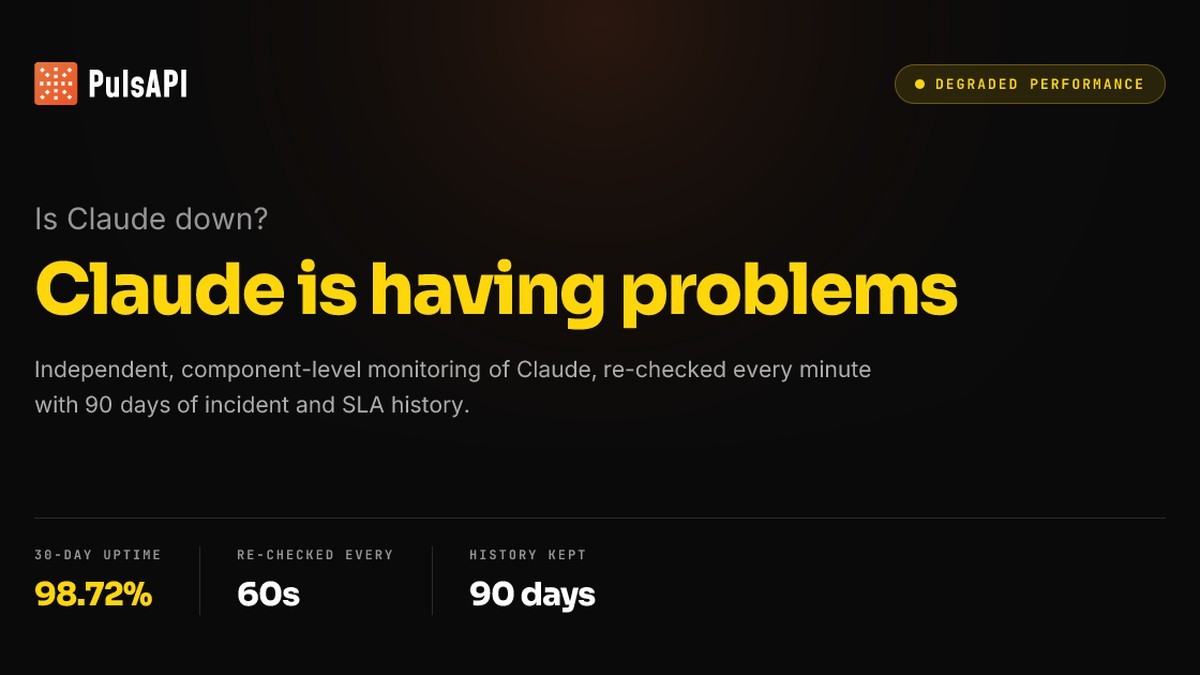
Anthropic's own status page, status.claude.com, logged the incident under the title "Elevated errors on claude.ai, Claude Code, Claude Cowork and the Claude API." The affected components listed were claude.ai, Claude Console, the Claude API, Claude Code and Claude Cowork. The page records that the errors began at 14:00 UTC. At 14:21 UTC Anthropic said it was investigating elevated error rates and warned users they might be asked to sign in again. By 14:28 UTC it added that some requests to the Claude API were also returning errors. At 14:36 UTC it said the original errors had been mitigated, but that a second issue was blocking sign-in, new chats, voice conversations, Claude Code and Cowork sessions, purchases and file uploads, and it told users: "If you're signed in, please don't sign out." A mitigation was recorded at 14:41 UTC. At 14:59 UTC most services had recovered, with a caution that messages sent between 14:00 and 14:59 UTC may not have been saved. At 15:30 UTC the page said all services had been operating normally since 14:59 UTC. Anthropic has not stated a cause.

What Spotify Actually Said
Spotify's public statement was one line. Reuters reported that Spotify said on X it was aware of "some issues" and was investigating. The post, as carried by 9to5Google, read: "We're aware of some issues right now and are checking them out!" It was posted by Spotify Status on 29 September 2026. 9to5Google, in a report by Ben Schoon published at 7:05 am PT, described a partial outage that left the Spotify app in shambles with core functions not working for many users. Users reported that search and other functions were inaccessible with a "Something went wrong" error message. Spotify Connect was also impacted. Some users reported the app logging them out, and those users could not sign back in. Ongoing music playback seemed to be affected least. Forbes reported that the nature of the problem was unclear, and that the acknowledgement came through the company's status update page. Android Authority reported at 11:08 AM ET that the company was in recovery. It has not published a cause since.
The Question Everyone Asked First
Two major services. One morning. The obvious question followed immediately: are they connected? The documented record does not support that conclusion. No provider has asserted a common cause for the 29 September outages, and nothing in the public record links the two incidents. That absence is not proof of independence. It is proof of silence. Independent monitoring agrees the disruption was real: isitdownchecker.com recorded a one-hour service disruption for Spotify from 01:00 PM UTC to 02:00 PM UTC, with two of six automated HTTPS probes failing and a 619ms average response time on the checks that succeeded. The precedent is more instructive still. On 3 September 2026, Claude, Grok and ChatGPT all experienced outages inside a roughly 90-minute window, according to a Cloud Security Alliance research note titled "One Data Center, Two AI Rivals: Concentration Risk."
Claude's Own Ledger
Anthropic's status page history is public, and it is busy. The incident history lists 13 incidents for September 2026, including 29 September; 25 incidents for August 2026; and 55 incidents for July 2026. No incidents were reported on any day from 23 September through 28 September 2026. On 22 September 2026, an incident titled "Elevated errors for multiple models" was recorded with impact from 00:50 UTC to 02:10 UTC; at 01:17 UTC Anthropic said it had identified the cause of elevated errors on requests to Claude Mythos 5.1, Claude Fable 5.1 and Claude Opus 5, and the incident was marked resolved at 02:35 UTC. The month before, the same page records elevated errors on Claude Code and Claude Cowork on 28 August, two separate claude.ai incidents on 31 August, error spikes on 15 September and a Google Play subscription fault on 16 September. Monthly uptime for claude.ai was 99.01% for July 2026, 99.59% for August 2026 and 99.70% for September 2026.
The Azure Theory That Fell Apart
Reporting on 3 September, by Computing.co.uk, said a shared Microsoft Azure East US failure was the likely common cause, because all three providers route some traffic through Azure infrastructure. That theory did not hold up. Microsoft logged no Azure service-health incident covering that window and denied that Azure caused the outages when reporters asked. Cloudflare's chief technology officer separately reported no disruption on Cloudflare's network during the relevant hours. The Cloud Security Alliance then revised its own analysis. Version 1.1, dated 9 September 2026, withdrew two claims from the version published earlier the same day: that Claude's outage was caused by a cascading failure from the shared Memphis facility, and that Grok failed first with Claude following. Neither is established by the public record. On duration alone the three incidents did not match: the alliance records Grok at roughly three hours 35 minutes, Claude at roughly two hours 53 minutes, and ChatGPT and Codex at roughly 34 minutes, with OpenAI attributing its own disruption to an internal routing error.
The Dependency Nobody Outside Can Check
The Cloud Security Alliance's stated conclusion is that the concentration-risk argument is unchanged. Anthropic agreed in May 2026 to take the entire output of SpaceX's Colossus 1 data centre in Memphis, Tennessee - more than 300 megawatts of capacity and upward of 220,000 Nvidia GPUs, at a price reported at approximately $1.25 billion per month running through May 2029, a term worth close to $45 billion. Anthropic subsequently expanded the partnership to Colossus 2. SpaceXAI, the merged SpaceX-xAI entity that operates Grok, said it was "sorry for the issues you may have experienced with Grok following an outage at our Memphis compute center" and added: "We'd also like to apologize to our impacted compute partners." SpaceXAI did not name those partners and has not disclosed what failed inside the facility. Anthropic has never said whether that facility was involved in its own outage, and has not published a postmortem. The alliance's own line: "A shared business or compute relationship is not the same thing as a confirmed shared failure path."
What Uptime Numbers Really Mean
Ninety-day component uptime on Claude's status page reads: claude.ai 99.42%, Claude Console 99.95%, Claude API 99.52%, Claude Code 99.44%, Claude Cowork 99.44%, Claude for Government 100%. Those figures are real. They are also unauditable from outside, because the company publishing them is the same company withholding the cause of an incident. The Cloud Security Alliance put the problem plainly: "The gap between the plausible narrative and the confirmed record is itself the operational lesson." And: "the one moment it gets tested, a real outage, is also the moment vendors are least likely to disclose the detail that would let you check." And: "The honest entry in a vendor risk register reads 'unconfirmed', not 'diversified'." A percentage tells a customer how often a service was up. It does not tell them what failed, what it depended on, or whether the same failure can happen again.
What To Do Before The Next One
The September record is crowded. Meta's Facebook and Instagram saw reports peak at more than 17,000 and over 5,000 respectively on Sunday 21 September 2026; Meta has not given a cause. AWS us-east-1 failed new EC2 instance launches between 22:49 and 00:06 UTC on 21-22 September 2026, which AWS attributes to a recent deployment. OpenAI's ChatGPT and Codex errored from around 22:55 UTC on Friday 25 September 2026, recovering within about an hour. Cloudflare opened an incident on 21 September after multiple subsea cable outages congested its Tokyo and Singapore data centres, with related items open at Akamai since 22 September. The AWS disruptions in the Middle East that began in March 2026 were still open. None of these is linked to the others by any provider. The lesson is not that everything is connected. It is that nobody will tell you when it is.
By Jessica Ali, Staff Writer
This article was produced with AI-assisted research and editorial support. Sources: Reuters, The Straits Times, The Star, Forbes, 9to5Google, Moneycontrol, Android Authority, Unite.AI, Computing.co.uk, the Cloud Security Alliance, the Claude status page, DownDetector, isitdownchecker.com and public internet outage trackers.
What's Your Reaction?
 Like
0
Like
0
 Dislike
0
Dislike
0
 Love
0
Love
0
 Funny
0
Funny
0
 Wow
0
Wow
0
 Sad
0
Sad
0
 Angry
0
Angry
0

Editor-in-Chief at Global1.News. Atlanta-based journalist who cuts through the BS and tells it like it is. Lead anchor, host, and the voice you hear when the spin stops and the truth starts.














Comments (0)