
Thai children shorter than Singaporean and Japanese peers
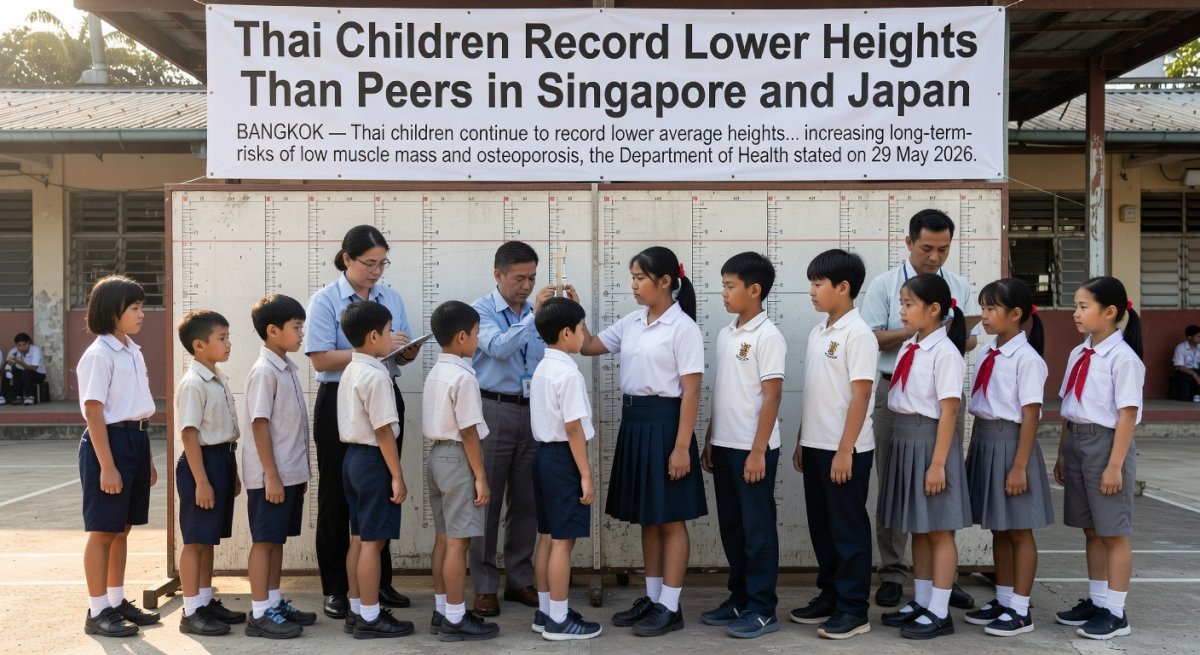
Thai Children Record Lower Heights Than Peers in Singapore and Japan
BANGKOK — Thai children continue to record lower average heights than their counterparts in Singapore and Japan, increasing long-term risks of low muscle mass and osteoporosis, the Department of Health stated on 29 May 2026. The warning followed release of national growth monitoring data showing persistent shortfalls linked to inadequate milk intake across age groups.
Dr. Ampaiphan Benjapolpitak, director-general of the Department of Health, said the findings reflect patterns observed in annual school health surveys conducted by the ministry. “Average heights for Thai boys aged 10 to 14 remain approximately 4 to 6 centimetres below those reported in Singapore and Japan,” Dr. Ampaiphan stated in the department’s Friday briefing. “Low calcium intake from milk and dairy products is a primary contributing factor we can address through sustained public health measures.”
The Findings
Department of Health data compiled from 2025 screenings of more than 1.2 million students nationwide indicate that 18 per cent of primary-school children fall below the 25th percentile on WHO child growth standards for height-for-age. Comparative figures published by Singapore’s Health Promotion Board and Japan’s Ministry of Health, Labour and Welfare show corresponding rates below 8 per cent. Milk consumption statistics released alongside the height data reveal that only 32 per cent of Thai children aged 6–12 drink milk daily, compared with 71 per cent in Singapore and 68 per cent in Japan. Among adolescents aged 13–18, daily intake drops further to 19 per cent. The department attributes part of the disparity to limited availability of affordable fortified milk in rural provinces and cultural preferences for sweetened beverages over plain dairy.Background
Thailand has tracked secular increases in average adult height since the 1980s, coinciding with national economic growth and expanded school feeding pBy Ann Srisawat, Staff Writer
This article was produced with AI-assisted research and editorial support. Reporting is based on sources cited in the article.
What's Your Reaction?
 Like
0
Like
0
 Dislike
0
Dislike
0
 Love
0
Love
0
 Funny
0
Funny
0
 Wow
0
Wow
0
 Sad
0
Sad
0
 Angry
0
Angry
0

Ann Srisawat
Southeast Asia Correspondent at Global1.News. Based in Bangkok, covering Thai and Southeast Asian politics, economy, technology, and culture. Deep regional perspective on one of the world's most dynamic regions.















Comments (0)