
South Korea's 2026 Live-Fire Exercise: AI, Indigenous Platforms, and the Changing ROK-US Alliance
**Meta Description:** South Korea's May 28 live-fire drill showcased AI warfare, suicide drones and the KF-21 jet, while excluding US forces raised alliance questions under President Lee. **Keywords:** South Korea defense, Lee Jae-myung, live-fire exercise, ROK-US alliance, AI warfare, KF-21 fighter, North Korea threat, Chunmoo MLRS, unmanned systems, Pocheon drill, self-relian
On May 28, 2026, South Korea conducted its first integrated live-fire exercise under the Lee Jae-myung administration at the Seungjin Fire Training Field in Pocheon, Gyeonggi Province — just 25 kilometers south of the inter-Korean border. The Combined Joint Live-Fire Exercise showcased 1,400 troops, 457 pieces of equipment, and marked a significant shift toward AI-enabled warfare and self-reliant defense, while the notable absence of U.S. Forces Korea raised new questions about the trajectory of the ROK-US alliance.
AI Targets, Drones Strike: Inside South Korea's Revolutionary Live-Fire Drill
SEOUL, South Korea — June 2026 — South Korea staged an integrated military firepower exercise on May 28, 2026 at the Seungjin Fire Training Field in Pocheon, showcasing advanced and homegrown assets including suicide drones, AI-driven command systems, and multi-legged combat robots. The Combined Joint Live-Fire Exercise, hosted by Defense Minister Ahn Gyu-baek, drew over 1,900 observers including 400 citizen spectators, marking the final public iteration of a drill series that began with two similar exercises the previous week.
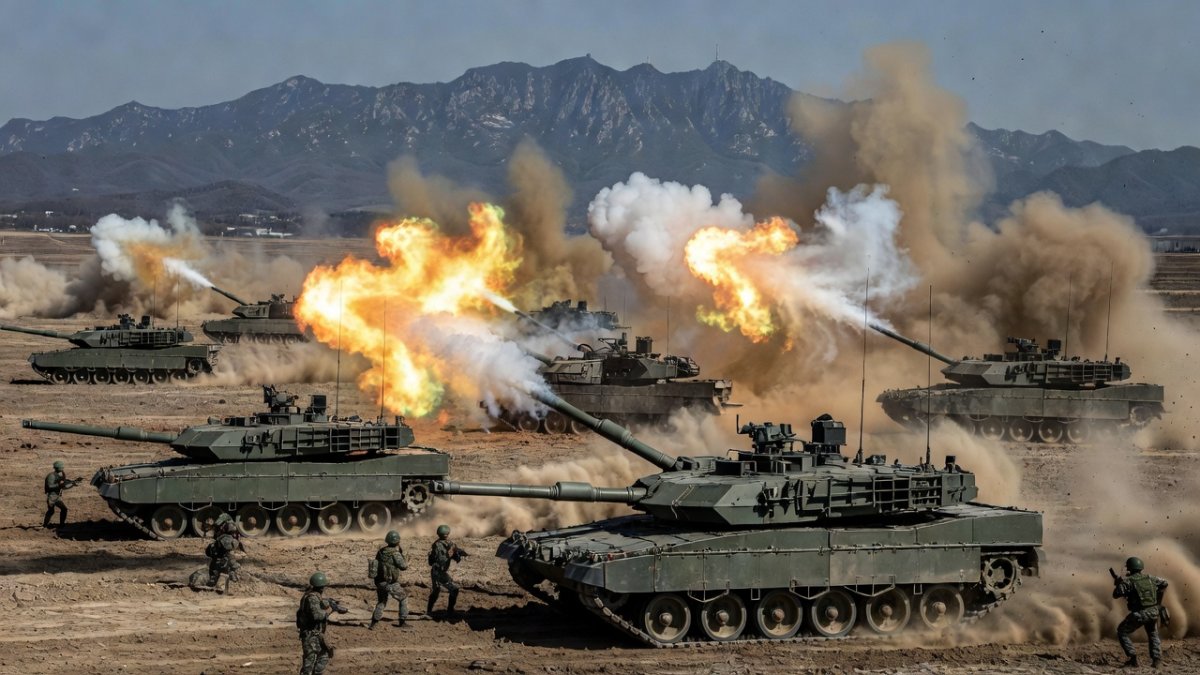
Scale and Scope of the May 28 Exercise
The exercise mobilized 1,400 troops drawn from 27 units across the Army, Navy, Air Force, and Marine Corps, together with 457 pieces of equipment — making it one of the largest domestic live-fire demonstrations in recent years. The drill unfolded in two distinct phases. Phase one simulated an enemy attack and tested defensive responses guided by recommendations from an AI-driven command and control center. Phase two focused on striking simulated enemy mechanized forces through manned-unmanned teaming, allowing South Korean forces to evaluate new operational concepts under realistic, high-tempo conditions.
Indigenous Platforms and Unmanned Systems Take Center Stage
Among the systems demonstrated were the Chunmoo multiple-launch rocket system (MLRS), K2 main battle tanks, K9A1 self-propelled howitzers, and the domestically developed KF-21 fighter jet — South Korea's first indigenous supersonic aircraft. Unmanned platforms included surveillance drones, loitering munitions commonly referred to as "suicide drones," and multi-legged robots designed for reconnaissance and logistics in rugged terrain. The AI-enabled command center supplied strike recommendations to commanders in real time, illustrating the growing integration of artificial intelligence into South Korean operational doctrine.
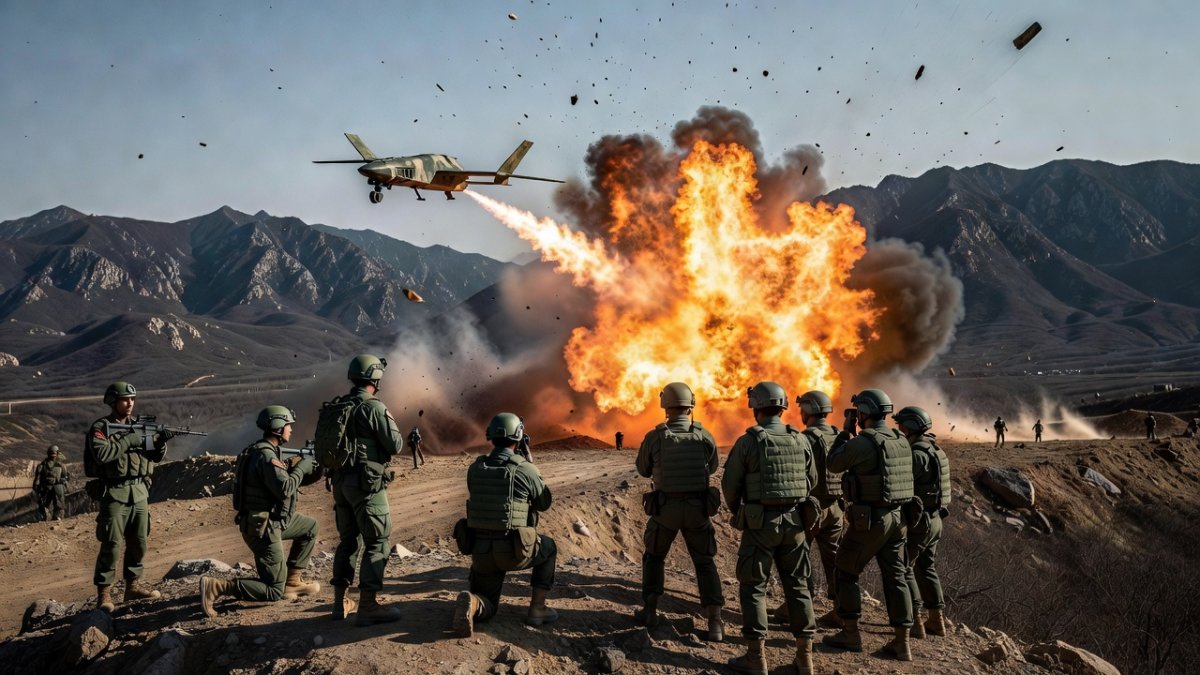
The emphasis on domestically developed systems such as the KF-21 and Chunmoo MLRS aligns with broader modernization programs that have accelerated in recent years under the Defense Acquisition Program Administration (DAPA). These platforms represent South Korea's ambition to reduce reliance on foreign suppliers for critical components while building an export-capable defense industrial base.
Political Significance: The Absence of U.S. Forces Korea
For the first time in a major live-fire exercise of this scale, U.S. Forces Korea (USFK) did not participate. The absence has prompted significant discussion within defense policy circles about the future trajectory of the alliance under President Lee Jae-myung's stated preference for greater "self-reliant defense" (자주국방). While routine combined training continues in other formats, the exclusion from this high-profile event has led analysts at the Asan Institute for Policy Studies to examine whether adjustments in joint operational planning are being phased in. South Korean officials have reiterated that the ROK-US Mutual Defense Treaty remains the cornerstone of peninsular deterrence, yet the drill underscored a deliberate emphasis on national command structures and indigenous decision-making chains.
North Korean Threats and Regional Deterrence Dynamics
The exercise occurred against the backdrop of persistent North Korean missile tests and conventional force modernization along the Demilitarized Zone. By conducting live-fire training so close to the border in Pocheon, South Korean forces signaled readiness to respond rapidly to potential incursions. The integration of AI-supported targeting and unmanned strike options is specifically intended to enhance responsiveness against the massed artillery and armored formations that the Korean People's Army has historically emphasized along the western corridor approach to Seoul. These developments fit within a wider pattern of Northeast Asian military modernization, with Japan and China also investing heavily in precision-strike and autonomous systems.
Strategic Implications for Northeast Asian Geopolitics
The May 28 drill illustrates South Korea's attempt to calibrate its defense posture amid shifting regional power balances. China's continued military expansion in the South China Sea and East China Sea, combined with North Korea's advancing missile and nuclear capabilities, create overlapping security challenges that complicate alliance management. By highlighting AI command systems and domestically produced platforms, Seoul seeks to strengthen its own deterrent capacity while maintaining operational interoperability with the United States. The cautious rollout of new operational concepts suggests that adjustments to combined planning are being introduced incrementally rather than through abrupt policy shifts — a pattern consistent with the Lee administration's broader approach to foreign policy.
Defense Modernization and the Future of the ROK-US Alliance
Looking ahead, the capabilities showcased at Seungjin are expected to inform subsequent training cycles and procurement decisions under the Ministry of National Defense's mid-term defense blueprint. The Lee administration has indicated that investments in unmanned systems and AI-enabled command will continue, with further integration across all service branches. How these national programs interact with existing alliance frameworks will remain a central question for policymakers in both Seoul and Washington. The exercise serves as an early indicator of how South Korea intends to balance self-reliant defense objectives with the enduring requirements of collective deterrence on the Korean Peninsula — a calculation that will shape Northeast Asian security architecture for years to come.
Looking Ahead: AI, Autonomy, and Alliance Management
The demonstration at Seungjin suggests that South Korea's defense establishment is moving toward a model of warfare that combines advanced indigenous platforms with AI-enabled decision support. This trajectory raises important questions about command-and-control integration with allied forces and the extent to which autonomous systems can be incorporated into combined operations. As North Korea continues to develop its own asymmetric capabilities — including cyber warfare and long-range artillery — the pace and direction of South Korea's military modernization will carry implications far beyond the peninsula. The coming months, including the annual Ulchi Freedom Shield exercises and trilateral drills with Japan, will offer further insight into how Seoul navigates the tension between strategic autonomy and alliance solidarity.
By Prof. David Park, Staff Writer
This article was produced with AI-assisted research and editorial support. Reporting is based on sources cited in the article.
What's Your Reaction?
 Like
0
Like
0
 Dislike
0
Dislike
0
 Love
0
Love
0
 Funny
0
Funny
0
 Wow
0
Wow
0
 Sad
0
Sad
0
 Angry
0
Angry
0

East Asia/Technology Correspondent at Global1.News. Seoul-based voice covering Korean politics, technology, business, and culture. Analyzes how technology and geopolitics intersect across East Asia.















Comments (0)