
Russians Are Rushing for Cash. Should the Kremlin Be Worried?
Russians have added 2.1 trillion rubles to cash holdings this year, the biggest rush since the war began. Payment outages, tax hikes and fears of deposit freezes drive the trend, straining bank liquidity as the Kremlin rolls out its digital ruble.
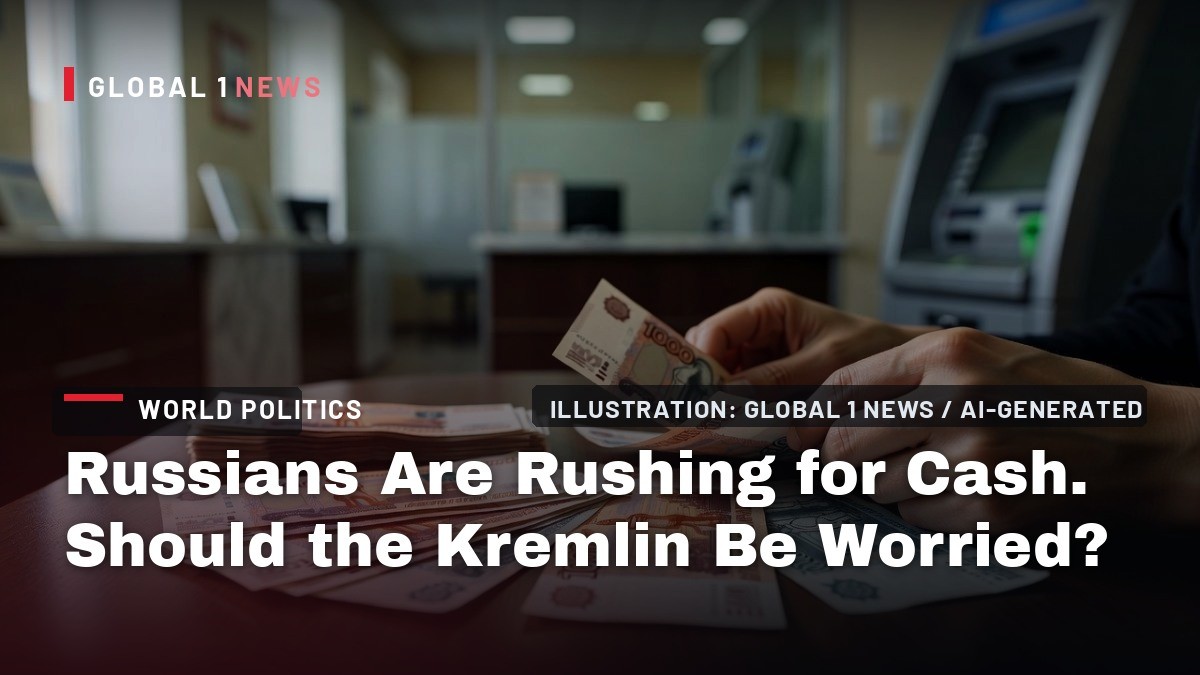
Russians are pulling record amounts of money out of the banking system this year, hoarding physical rubles at a pace not seen since the chaotic months following the 2022 invasion of Ukraine. The surge comes as the Kremlin prepares to launch its digital ruble, a state-controlled currency that could give authorities unprecedented visibility into every transaction. The question now is whether this is a rational response to instability or a warning sign for the Russian financial system.
Russians Are Rushing for Cash. Should the Kremlin Be Worried?
Moscow, Russia — August 26, 2026 — Households and businesses have added 2.1 trillion rubles ($25.3 billion) to their cash holdings so far this year, according to data from the Central Bank of Russia. That marks the largest increase recorded since the start of the war, surpassing the 1.8 trillion rubles ($21.7 billion) added between January and August 2023.
The Numbers Behind the Cash Rush
The scale of the current cash accumulation is striking even by Russian standards. Sberbank, Russia's largest lender, projects that cash in circulation could rise by 3.8 trillion rubles ($45.8 billion) over the course of 2026, which would make it the largest annual increase on record. The bank's economists base this projection on current withdrawal trends and seasonal patterns observed over the past two years.
Back in 2023, cash demand was driven by Russians fleeing the country amid military mobilization, panic during the short-lived Wagner mutiny and, reportedly, off-the-books payments to mercenaries fighting in Ukraine. This year's drivers are different, but the outcome is similar: more physical rubles sitting outside the banking system.
While the absolute numbers look staggering, the percentage growth tells a more subtle story. Cash in circulation grew 11.7% between January and July — roughly matching 2023 rates, and well below the 22.4% spike seen during the height of the COVID-19 pandemic. Cash also still accounts for roughly 15% of Russia's overall money supply, known to economists as M2, which combines physical currency with funds held in bank accounts. That percentage has remained largely stable.
Why Russians Are Hoarding Rubles
Much like in 2023, several factors are driving the current rush to cash, according to economists and banking officials interviewed by The Moscow Times. The motivations range from practical concerns about payment infrastructure to deeper anxieties about the state's intentions toward private savings.
Moscow-based economist Yegor Susin cautioned against overinterpreting the trend. "The recent trend of cash's declining market share has reversed, but given normal seasonal fluctuations, nothing extreme is happening overall," he said. Susin noted that summer months typically see higher cash withdrawals as Russians travel to regions where card acceptance remains patchy.
Janis Kluge, an economist at the German Institute for International and Security Affairs, offered a more structural explanation. He observed that alongside cash, "transferable" checking accounts have also grown. This suggests Russians are not panic-draining their bank accounts all at once, but are instead keeping their funds easily accessible as falling interest rates lower the appeal of holding money in savings accounts.
Jamming, Blackouts and the Practical Case for Cash
Withdrawals began rising in February, when Russia started routinely jamming mobile signals to counter Ukrainian drone attacks. The jamming inadvertently knocked out card payment terminals and mobile banking apps across major cities, leaving millions of Russians unable to complete even basic transactions.
"When the internet was shut down across the city in the spring, cards simply didn't work. Cash was the only way to buy groceries or pay for services," said Artyom, a Moscow resident who, like others cited in this story, asked to use a pseudonym.
Svetlana, who lives in the southern Samara region, said she also encountered regular problems when trying to use her card to pay for groceries at the supermarket earlier this year. However, she added, the internet outages mostly stopped by the summer. For many Russians, the experience of being locked out of digital payments even temporarily was enough to change their habits permanently.
Fear of Deposit Freezes and Mobilization Rumors
Public anxiety is also playing a role. Despite official assurances that personal savings will not be touched to fund the military, Communist Party leader Gennady Zyuganov sparked alarm in June when he suggested that the 67 trillion rubles Russians hold in bank deposits were merely "enriching bankers" and should instead be put toward manufacturing or the war effort.
Dmitry Orlov, deputy chairman of Moscow-based Fora-Bank, said that high withdrawal rates reflect people hedging against both internet blackouts and "unsettling comments" from public officials about potentially freezing bank deposits. "When a senior political figure publicly floats the idea of seizing deposits, even as a suggestion, people listen," Orlov said.
At the same time, rumors of renewed military mobilization have led to a spike in people looking into the possibility of relocating abroad. Because Russian bank cards no longer work abroad, anyone planning to leave must withdraw cash to convert into euros or dollars. Real estate agents in Istanbul and Tbilisi report renewed interest from Russian buyers, though the numbers remain well below 2022 levels.
Businesses and the Grey Economy
Businesses are also driving the shift, though mostly to avoid taxes. In January, the government raised the value-added tax (VAT) from 20% to 22% and lowered the income threshold at which companies are required to pay it. Operating off the books helps smaller businesses stay under that threshold or cut costs by paying employees and suppliers under the table.
In Moscow and smaller regional towns alike, small shops, coffee stands, repairmen and hotels frequently ask for cash, often offering small discounts to avoid electronic payments, according to multiple Russians who spoke to The Moscow Times. A coffee shop in central Moscow offers a 10% discount for cash payments; a car repair shop in the suburbs charges 15% more for card transactions.
Taras Skvortsov, Sberbank's Chief Financial Officer, said that the main driver of cash leaving the banking system is companies keeping cash in circulation for "grey-market" transactions rather than depositing it back into banks. That trend expands Russia's infamous informal economy — already estimated at around 11% of GDP — and fuels tax evasion, with tax-related offenses jumping 17% year-over-year in the first half of 2026.
What the Cash Flight Means for Banks
The shift to cash also squeezes the banking sector. When money stays out of bank vaults, banks have less capital available to lend to consumers or to buy the government bonds that fund Russia's budget deficit and infrastructure projects. Skvortsov warned that these liquidity shortages may eventually force the Central Bank to step in with support measures.
Last month, the Russian Central Bank cut its key interest rate for the tenth consecutive time to 14%, down from 18% a year prior, thus giving Russians less incentive to deposit their money in savings accounts. The rate cuts are intended to stimulate lending and economic activity, but they also reduce the opportunity cost of holding cash.
Kluge explained the dynamic: "Russian households and businesses are prioritizing liquid assets over locked savings accounts. The primary driver behind both rising cash and checking balances is simply falling interest rates." This suggests the cash rush is less about panic and more about rational portfolio management in a low-yield environment.
The Digital Ruble Paradox
The cash surge comes at an awkward moment for the Kremlin, which has been preparing to roll out the digital ruble — a central bank digital currency that would give authorities real-time visibility into all transactions. The digital ruble is designed to increase financial transparency, reduce tax evasion and give the state new tools for targeted social payments.
But the parallel rise in cash demand suggests a public that is not entirely comfortable with the idea of fully digital money. For Russians who remember the 1998 default, the 2014-15 crisis and the 2022 sanctions shock, physical currency represents a hedge against state surveillance and potential account freezes.
The Kremlin has sought to reassure the public that the digital ruble will be optional and that cash will remain legal tender indefinitely. Central Bank officials have emphasized that the digital ruble is not designed to replace cash but to complement it. Yet the timing of the cash rush — coinciding with the digital ruble's pilot phase — suggests many Russians are voting with their wallets.
Analysis and Implications
The current cash accumulation is significant but not yet alarming. The percentage growth in cash in circulation remains within historical norms, and the overall share of cash in the money supply has not shifted dramatically. However, the trend bears watching for several reasons.
First, if Sberbank's projection of 3.8 trillion rubles in new cash for 2026 proves accurate, it would represent a record annual increase and could strain the banking system's liquidity. Second, the growth of the grey economy undermines the state's fiscal position at a time when the budget deficit is already under pressure from military spending. Third, the public's preference for cash over digital alternatives sends a signal about trust in state financial institutions.
For ordinary Russians, the calculus is straightforward: cash works when the internet goes down, it cannot be frozen by government decree, and it does not require trusting a bank that might be sanctioned or fail. The digital ruble may offer convenience and transparency, but it does not offer the same sense of security that physical currency provides.
As the Kremlin prepares to expand the digital ruble's rollout, it faces a paradox: the more it pushes digital financial infrastructure, the more some Russians may cling to the old-fashioned alternative. Whether this is a temporary phenomenon or a lasting shift in behavior will depend on how the war evolves, how the economy performs and whether the state can rebuild trust in its financial system.
By Irina Volkov, Staff Writer
This article was produced with AI-assisted research and editorial support. Sources: The Moscow Times.
What's Your Reaction?
 Like
0
Like
0
 Dislike
0
Dislike
0
 Love
0
Love
0
 Funny
0
Funny
0
 Wow
0
Wow
0
 Sad
0
Sad
0
 Angry
0
Angry
0
Russia/Eastern Europe Correspondent at Global1.News. Covering Russian politics, energy, security, and the shifting dynamics of the post-Soviet space. Provides clear-eyed analysis on one of the world's most opaque regions.















Comments (0)