
Government Submits 3-Year Budget to State Duma as 2026 Deficit Set to Reach $88Bln
Russia’s finance ministry has presented a three‑year draft federal budget covering 2027‑2029 to the State Duma, but the numbers reveal a fiscal picture that is increasingly strained by the costs of war.
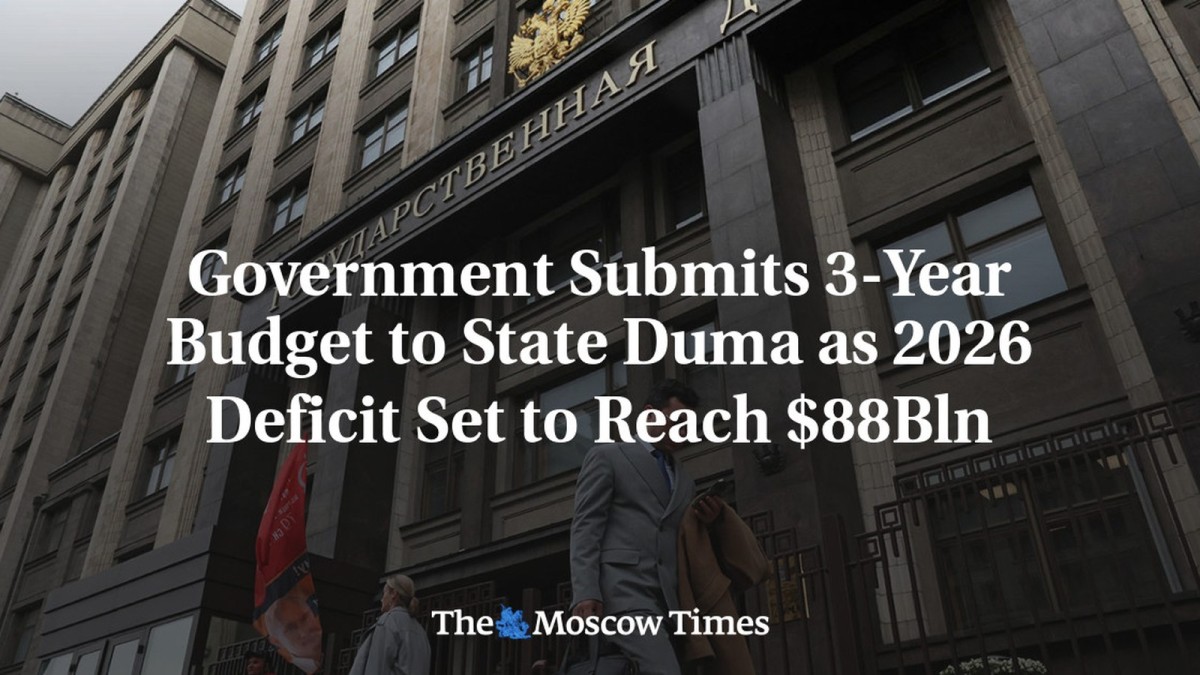
Russia’s finance ministry has presented a three‑year draft federal budget covering 2027‑2029 to the State Duma, but the numbers reveal a fiscal picture that is increasingly strained by the costs of war. The latest figures show the 2026 deficit soaring to a record 7.345 trillion rubles – roughly $88 billion – more than double the previous forecast. This surge, together with a growing share of classified spending, raises serious questions about the Kremlin’s ability to sustain its military‑driven economic model without jeopardising macro‑stability.
Record Deficit and Its Macro‑Economic Context
The ministry’s submission confirms that the 2026 budget deficit now represents 3.2 % of gross domestic product (GDP), up from the earlier target of 1.6 %. In nominal terms, the shortfall is 7.345 trillion rubles, compared with the prior estimate of 3.785 trillion rubles. This jump reflects a sharp upward revision that the government attributes to “soaring war spending.”
President Vladimir Putin has publicly downplayed the risk, stating that the deficit poses no “critical” threat to the Russian economy and will be managed. Analysts, however, note that deficits up to 4‑5 % of GDP are generally considered manageable, implying that the current trajectory is approaching the upper limit of what the economy can absorb without external pressure.
Three‑Year Outlook: Deficits and Growth Projections
Looking ahead, the draft budget projects deficits of 5.443 trillion rubles (2.2 % of GDP) in 2027, 5.12 trillion rubles (1.9 % of GDP) in 2028, and 5.245 trillion rubles (1.9 % of GDP) in 2029. Cumulatively, the three‑year deficit window amounts to nearly 16 trillion rubles, or about $192 billion at current exchange rates.
At the same time, the ministry forecasts nominal GDP growth of 1.4 % in 2027, reaching 248.3 trillion rubles ($2.98 trillion), and a 2.4 % rise by 2029, to 281.7 trillion rubles ($3.38 trillion). These modest expansion targets are juxtaposed against a fiscal environment that is increasingly reliant on borrowing, reserve fund withdrawals, and higher taxation.
War Spending and the Rise of Classified Expenditure
Defense outlays are the primary driver of the fiscal strain. Earlier reports indicate that 2027 defense spending will climb by 27 % to a record 17.1 trillion rubles, representing more than a third of total federal spending. Yet only 2.3 trillion rubles of this amount appear in publicly itemised documents; the remainder is classified as “top secret.”
According to the exiled outlet Vyorstka, a record 34.9 % of total budget spending for 2027 will remain classified. This unprecedented level of secrecy hampers external assessment of how much of the budget is devoted to the war effort and obscures the true scale of fiscal pressures facing the state.
Inflation Targets and Oil Price Assumptions
The budget sets an annual inflation target of 4 %, a figure the government argues is essential for macro‑economic stability and inflation control. To underpin revenue forecasts, the budget also adopts a baseline oil price of $50 per barrel. This price assumption is notably lower than recent market averages, suggesting a conservative approach that may underestimate revenue shortfalls if global oil prices remain volatile.
Given that oil revenues have traditionally been a cornerstone of Russia’s fiscal balance, the reliance on a modest price baseline underscores the regime’s concern about future commodity income, especially as sanctions and market realignments continue to affect export flows.
Political Implications of the Budget Process
The State Duma is scheduled to begin the first of three readings of the draft budget bill on 29 October, with Budget Committee chairman Andrei Makarov overseeing the proceedings. The multi‑year nature of the budget reflects an attempt by the Kremlin to improve long‑term planning, yet the repeated upward revisions signal a reactive rather than proactive fiscal strategy.
Within the political hierarchy, the budget debate offers a venue for the executive to demonstrate control over economic policy while also testing the legislature’s willingness to endorse increasingly opaque spending. The high share of classified allocations may limit parliamentary scrutiny, consolidating executive discretion over key fiscal decisions.
Socio‑Economic Consequences of Fiscal Strain
Rising deficits inevitably translate into higher borrowing costs and greater pressure on the population through tax increases. The government’s reliance on the fiscal reserve fund and expanded borrowing underscores a depletion of traditional buffers, raising concerns about the sustainability of public services and social welfare programmes.
Moreover, the inflation target of 4 % may be challenging to achieve if the fiscal gap widens, potentially prompting the central bank to tighten monetary policy. Such a move could dampen the modest GDP growth projected for the coming years, creating a feedback loop between fiscal weakness and slower economic expansion.
Strategic Outlook: Balancing War Finance and Economic Stability
In sum, the 2026 deficit surge and the looming three‑year fiscal plan illustrate the Kremlin’s precarious balancing act: financing an expansive war effort while attempting to preserve macro‑economic stability. The record share of classified spending, coupled with a modest oil price baseline, signals that the state is preparing for a prolonged period of fiscal opacity and uncertainty.
Analysts will watch closely how the State Duma’s deliberations unfold, particularly whether any concessions are made to curb the deficit or to increase transparency. For now, the government’s narrative that the deficit poses no “critical” risk rests on the assumption that inflation can be contained and that oil revenues will meet baseline expectations. Should either of these pillars falter, the fiscal strain could intensify, forcing the Kremlin to reconsider its financing mix and potentially reshaping the economic landscape of Russia in the years ahead.
This article was produced with AI-assisted research and editorial support. Reporting is based on the source material cited below. Sources: The Moscow Times; themoscowtimes.com; Global1.News (05 October 2026).
By Irina Volkov, Staff Writer
What's Your Reaction?
 Like
0
Like
0
 Dislike
0
Dislike
0
 Love
0
Love
0
 Funny
0
Funny
0
 Wow
0
Wow
0
 Sad
0
Sad
0
 Angry
0
Angry
0
Russia/Eastern Europe Correspondent at Global1.News. Covering Russian politics, energy, security, and the shifting dynamics of the post-Soviet space. Provides clear-eyed analysis on one of the world's most opaque regions.














Comments (0)