
Japan's Strategic Balancing Act: The Dual Hedge Faces New Pressures from Washington and Beijing
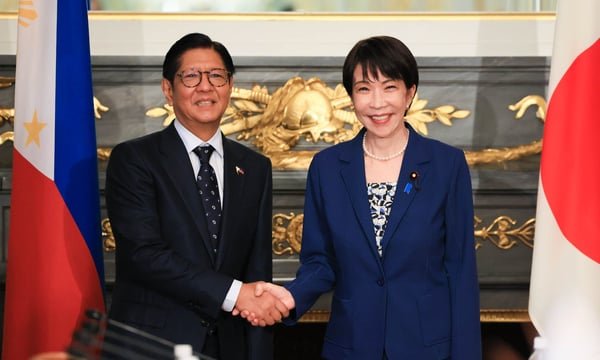
The Foundations of Tokyo's Dual Hedge Japanese Prime Minister Takaichi Sanae met with Philippine President Ferdinand Marcos, Jr. in Tokyo on May 28, 2026, highlighting ongoing efforts to strengthen ties amid regional uncertainties. Since the end of the Cold War, Japan's geostrategic approach has centered on the dual hedge: anchoring security through the Japan-U.S. alliance whil
The Foundations of Tokyo's Dual Hedge
Japanese Prime Minister Takaichi Sanae met with Philippine President Ferdinand Marcos, Jr. in Tokyo on May 28, 2026, highlighting ongoing efforts to strengthen ties amid regional uncertainties. Since the end of the Cold War, Japan's geostrategic approach has centered on the dual hedge: anchoring security through the Japan-U.S. alliance while pursuing economic interdependence with China. This posture has required constant calibration against competing pressures from both partners.
Security Concerns: Abandonment and Entanglement Risks
Tokyo has long navigated fears of U.S. abandonment in East Asia alongside risks of entanglement in American-led operations. In March, Prime Minister Takaichi dismissed suggestions from U.S. President Donald Trump that Japan deploy naval assets to the Strait of Hormuz, citing constitutional constraints. During the mid-May Trump-Xi summit, concerns shifted toward potential U.S. retrenchment on Taiwan, though no major bargain emerged and Trump reportedly defended Japan in talks with Chinese leader Xi Jinping.
China Relations: Political Rhetoric and Targeted Economic Measures
Tokyo-Beijing ties deteriorated after Takaichi's November 2025 comments framing a potential Taiwan blockade as a "survival-threatening situation" warranting Self-Defense Forces mobilization. Beijing responded forcefully, including social media statements from its Osaka consul general and repeated warnings about Japanese re-militarization. These exchanges contributed to a 56.8 percent year-on-year drop in Chinese tourism to Japan by April, alongside renewed bans on Japanese seafood imports and limits on rare earth exports.
Japan's Expanding Network of Partnerships
With the U.S. "pivot to Asia" giving way to spheres-of-influence language, Japan has broadened security cooperation beyond the traditional hub-and-spokes model. This includes the Reciprocal Access Agreement with the Philippines, deepened ties with Australia and India, and intelligence-sharing pacts with Australia and the United Kingdom. On the economic side, Tokyo has advanced the CPTPP and RCEP frameworks while pursuing deals with the European Union and United Kingdom to diversify supply chains.
Implications for South Korea and Regional Stability
Japan's incremental adjustments create both openings and complications for South Korea, which maintains its own complex relations with Beijing and Washington. The weakening yen has bolstered Japanese exports and tourism, offering a buffer against Chinese economic pressure, yet it raises import costs for households and businesses. For ASEAN countries, Japan's multi-directional approach provides additional options for cooperation that reduce reliance on any single power.
Building Redundancy Without Abandoning Core Ties
Tokyo continues to avoid abrupt shifts away from the U.S. alliance or full economic decoupling from China. Instead, officials emphasize measured steps such as subsidies for semiconductor production and outreach to Africa, Southeast Asia, and Central Asia. This strategy aims to create flexibility in a fluid environment where personal dynamics in Washington and state-driven measures from Beijing add unpredictability to longstanding relationships.
By Prof. David Park, Staff WriterThis article was produced with AI-assisted research and editorial support. Reporting is based on sources cited in the article.
What's Your Reaction?
 Like
0
Like
0
 Dislike
0
Dislike
0
 Love
0
Love
0
 Funny
0
Funny
0
 Wow
0
Wow
0
 Sad
0
Sad
0
 Angry
0
Angry
0

East Asia/Technology Correspondent at Global1.News. Seoul-based voice covering Korean politics, technology, business, and culture. Analyzes how technology and geopolitics intersect across East Asia.















Comments (0)