
Ecuador Courts Beijing on Shrimp, Energy in State Visit
Ecuador's Daniel Noboa opened an eight-day state visit to Beijing on Aug 16, seeking to lift suspensions on 14 shrimp processors, unlock energy and mining investment, and settle the troubled Coca Codo Sinclair hydro plant while keeping Washington security ties intact.
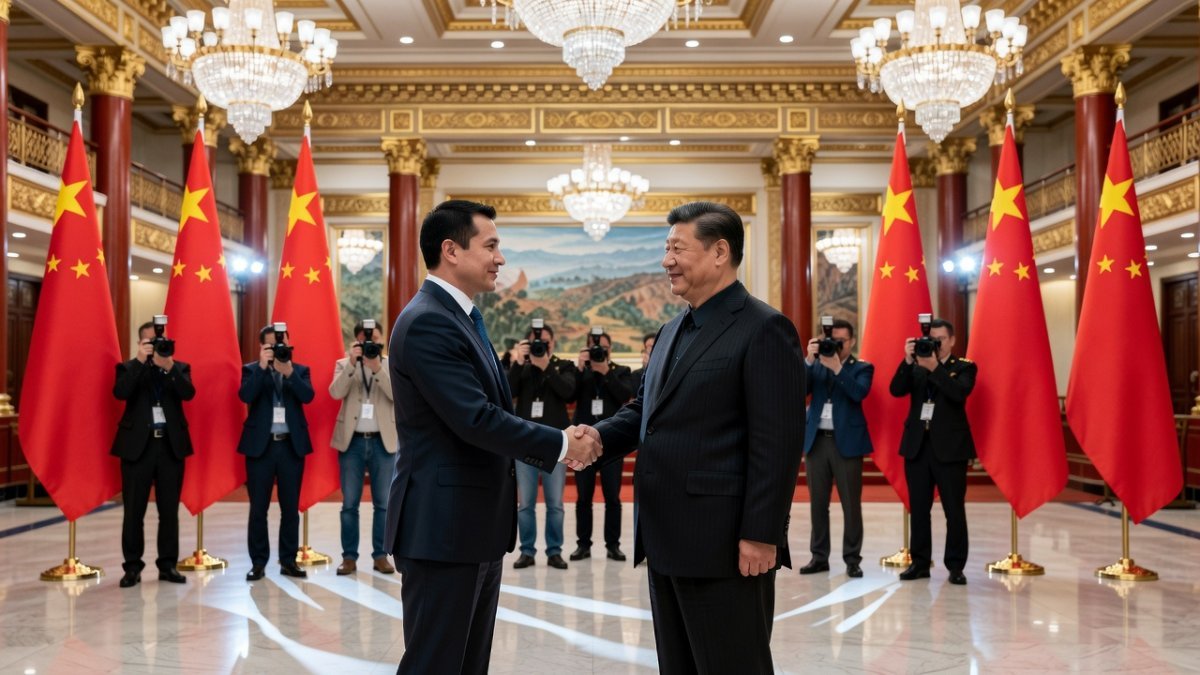
Noboa's Beijing Agenda: Shrimp Access, Energy Money and a 25-Year Contract
Ecuadorian President Daniel Noboa arrived in Beijing on Sunday for his first state visit to China, an eight-day trip that will test how far Quito can push its trade and investment relationship with Beijing without undermining the security alignment it has built with Washington. Noboa is scheduled to hold talks with President Xi Jinping and meet separately with Premier Li Qiang and Zhao Leji, China's top legislator, according to Beijing's foreign ministry. The visit runs to August 23, after which the Ecuadorian delegation continues to Singapore and Vietnam until August 28.
Tags: Ecuador China state visit, Noboa Beijing, shrimp exports China, Coca Codo Sinclair, PowerChina contract, Belt and Road Initiative, Xi Jinping, China Latin America, Ecuador US relations, Sinohydro, Jiangxi Copper, Cosco shipping
A State Visit Framed Around an Anniversary, Not a Transaction
This is Noboa's second trip to China since June last year, when he and Xi witnessed the signing of a cooperation plan under the Belt and Road Initiative, which Ecuador joined in 2018. What has changed is protocol: a state visit carries the full ceremonial apparatus, and with it the expectation of deliverables. Beijing has framed the trip around an anniversary rather than a transaction. In a written statement issued on August 14, a Chinese foreign ministry spokesperson noted that this year marks a decade since China and Ecuador established their comprehensive strategic partnership, and expressed hope that the visit would consolidate political mutual trust and advance the partnership.
The courtesies are being extended to a government that has spent the past 18 months deepening security cooperation with Washington. Ecuador's foreign minister, Roberto Kury, framed the trip in narrower terms, telling Radio Sucre days before departure that "China is interested in investing in energy and mining while Ecuador is interested in strengthening its exports."
The Shrimp Dispute That Tops the Agenda
The most immediate item is a trade problem Beijing created. China's customs administration has suspended 14 Ecuadorian shrimp processors in stages since October 2025, the most recent suspension taking effect on June 30, over the use of sodium metabisulphite as a preservative and detections of white spot syndrome virus. Ecuador's National Chamber of Aquaculture puts the losses at about US$45 million so far this year, while stressing that the measures do not amount to a general closure of the Chinese market and that shipments continue.
The stakes are high because shrimp is Ecuador's largest non-oil export, and the chamber says China took 51.24 per cent of the US$3.52 billion shipped between January and May. At the centre of the dispute is a technical disagreement over what Chinese laboratories are testing. Ecuador's agriculture ministry said in early July that it had asked Beijing to clarify how it defines the "edible portion" in its analyses, escalating the queries to the Codex Alimentarius food standards body and China's National Health Commission. A deadline for Ecuadorian rebuttals expired on July 16 with no published ruling.
The free-trade agreement in force since May 2024 establishes a bilateral trade commission empowered to review implementation and handle disputes of this kind, but it has not been convened. Banana exporters are also pressing to accelerate a tariff schedule that began at 10 per cent and stands at seven per cent in its third year of a decade-long phase-out, and to ease fruit fly protocols. The delegation is due to meet Cosco to discuss new shipping routes into China and neighbouring markets.
Coca Codo Sinclair: A Decade-Old Problem Comes Due
The harder conversation concerns Coca Codo Sinclair, Ecuador's largest hydroelectric plant, built by China's Sinohydro. Ecuador formally took delivery on April 17, nearly a decade after inauguration and following an arbitration ruling, with thousands of fissures documented in the plant's distributors, the assemblies that direct water onto the turbine runners. The state auditor counted 7,648, a figure later tallies have pushed higher.
Quito has returned US$98.9 million in guarantees to Sinohydro and is pursuing an outstanding US$36 million insurance policy, according to the energy ministry. At the same time, it is negotiating an operations and maintenance contract with PowerChina, Sinohydro's parent, worth about US$46 million a year over 25 years, or roughly US$1.15 billion in total. A 2009 study by consultancy Electroconsult estimated annual O&M costs at around US$18 million. The two figures are not directly comparable, given 17 years of inflation and changes in the plant's condition, but the gap has drawn scrutiny in Quito. The government has said it could sign the contract by December. PowerChina did not respond to a request for comment, and Sinohydro has not publicly addressed the fissures since delivery.
Chinese Credit and the Coming 1,300MW Gap
With the energy ministry projecting a shortfall of about 1,300MW for the 2026-27 dry season, the government is pressing Chinese-held mining projects to generate their own power. Cascabel, which came under Jiangxi Copper's control in March, is seeking a contract addendum whose sticking point is exactly that. Mirador, run by CRCC-Tongguan subsidiary Ecuacorriente, has delayed expansion over a similar dispute.
Ecuador's negotiating position is complicated by what it wants from Chinese lenders. The 2026 budget anticipates US$764 million in disbursements, US$420 million from Eximbank and US$344 million from China Development Bank, tied to specific investment projects, although the final terms have not been made public.
Keeping Washington Close While Courting Beijing
Noboa has aligned Ecuador more closely with the United States than any recent president. In March, Quito and Washington signed a Reciprocal Trade Agreement removing US surcharges on 53 per cent of Ecuador's non-oil exports, though it has not yet taken effect and sits before Ecuador's Constitutional Court, which must decide whether the legislature has to ratify it. US special forces began joint counter-narcotics operations on Ecuadorian soil in March, the same month Noboa attended a regional security summit hosted by US President Donald Trump in Doral, Florida. He was received at the Pentagon by US defence chief Pete Hegseth in June.
Ecuadorian voters set a ceiling on that alignment last November, rejecting a lifting of the constitutional ban on foreign military bases by about 61 per cent, along with every other question Noboa put to them. The result closed off the most visible form of US military presence. "The United States is Ecuador's main security partner," Noboa told a Guayaquil radio station in April, "but the country has to keep trading with the whole world."
Two Decades of Chinese Engagement, One Regional Shift
Chinese engagement in Ecuador predates Noboa by close to two decades. Beijing financed Coca Codo Sinclair and a series of other infrastructure projects under Rafael Correa, whose government also began pre-selling oil to Chinese state firms. The relationship continued through Lenin Moreno, who turned to the International Monetary Fund but did not unwind the Chinese loans, and through Guillermo Lasso, under whom the free-trade agreement was negotiated and signed.
China has become Ecuador's second-largest source of imports, accounting for 28.3 per cent in the first quarter, down from 30 per cent for the United States, central bank figures show. The pattern echoes what Asia-Pacific economies have watched for years: Beijing's infrastructure-finance model creates deep interdependencies that later surface as maintenance claims, contract renegotiations and lending leverage. For Tokyo, which has its own long-running infrastructure and development finance competition with Beijing across Southeast Asia and the Pacific, the Ecuador case is a reminder of how those debts mature — and how borrowing governments try to renegotiate once the relationship turns.
What to Watch For
The measurable outcomes of this visit will be whether Xi and Noboa announce a resolution on the shrimp suspensions, whether Quito's energy ministry moves closer to signing the PowerChina operations contract by December, and whether the bilateral trade commission finally convenes. The China-Global South angle is also one Washington will be watching: a successful visit would show that Beijing can still deliver trade and investment relief to a government that has publicly anchored itself to US security. Noboa's own framing — security with Washington, trade with everyone — is the new template for middle powers in the Americas, and Beijing will be eager to prove it can operate within it.
By Kenji Tanaka, Staff Writer
This article was produced with AI-assisted research and editorial support. Sources: South China Morning Post; Xinhua; The Rio Times.
What's Your Reaction?
 Like
0
Like
0
 Dislike
0
Dislike
0
 Love
0
Love
0
 Funny
0
Funny
0
 Wow
0
Wow
0
 Sad
0
Sad
0
 Angry
0
Angry
0

Japan Correspondent at Global1.News. Tokyo-based voice covering Japanese politics, technology, economy, and culture. Tracks the intersection of tradition and innovation in one of the world's most dynamic societies.











Comments (0)