
Xi visit to Washington all pomp but little progress so far
President Xi Jinping’s recent visit to Washington has been marked by elaborate ceremony and cordial rhetoric, yet substantive breakthroughs on the most pressing bilateral issues remain elusive.
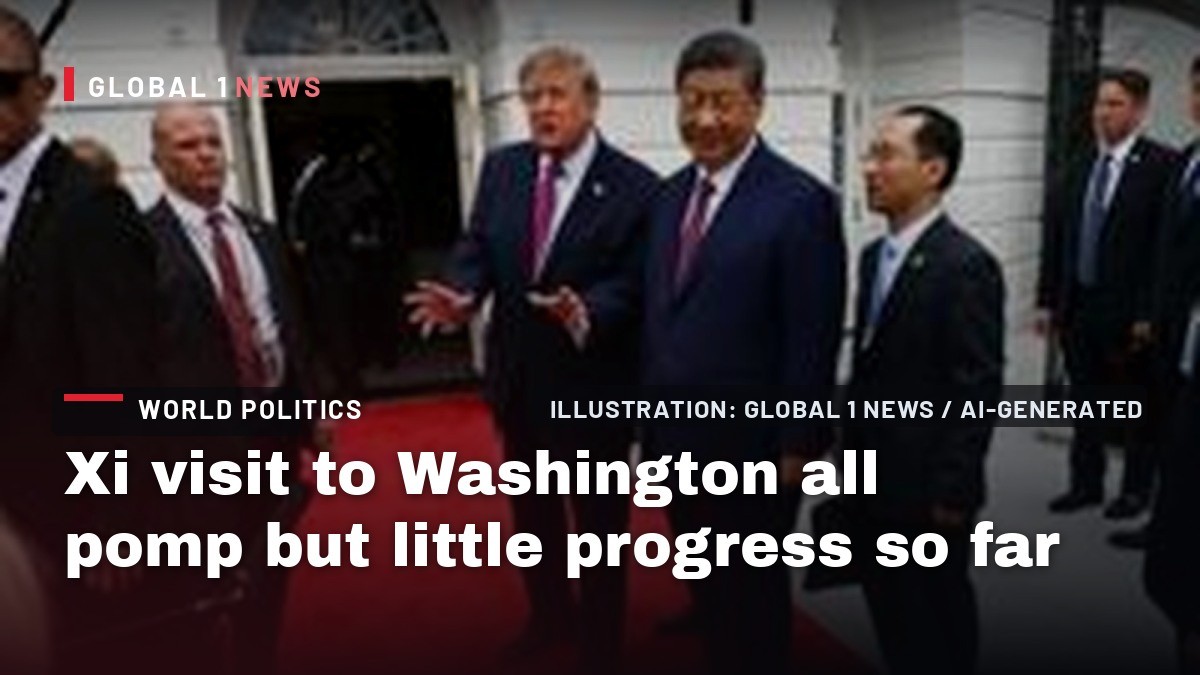
President Xi Jinping’s recent visit to Washington has been marked by elaborate ceremony and cordial rhetoric, yet substantive breakthroughs on the most pressing bilateral issues remain elusive. The summit, which began with a military‑air‑base welcome and proceeded to a White House honor‑guard arrival, underscores the symbolic importance both sides attach to the relationship. However, the underlying strategic calculus reveals a widening gap between the United States’ demand for concrete problem‑solving and China’s preference for broader, more abstract dialogue. This divergence, set against the backdrop of a fragile trade truce and an intensifying artificial‑intelligence (AI) rivalry, shapes the geopolitical stakes of the meeting.
Pageantry and the Politics of Stability
The opening days of the summit have been dominated by visual spectacle: marching bands, military flyovers and a literal red carpet laid out by President Donald Trump. According to Bloomberg Economics chief analyst Jennifer Welch, this “intentional pageantry” serves to amplify “positive vibes” and present the summit as a stabilising ballast in an otherwise turbulent US‑China relationship. The emphasis on ceremony reflects Trump’s view of the summit as a platform to signal continuity and reassurance to domestic and international audiences, even as the substantive agenda remains largely untouched.
For Xi, the ceremonial aspects also carry diplomatic weight. The Chinese leader’s public remarks have repeatedly invoked the “Thucydides trap,” a reference to the historical pattern whereby a rising power and a declining one clash. By framing the bilateral relationship in terms of “candid, in‑depth and continued dialogue,” Xi seeks to position China as a responsible stakeholder willing to manage the power transition peacefully, while simultaneously reinforcing the narrative of mutual respect that underpins his broader foreign‑policy doctrine.
Trade Truce Extension: A Temporary Bandage
The summit’s most concrete achievement to date is the extension of the year‑long trade “truce” that has kept tariffs at relatively low levels. Treasury Secretary Scott Bessent announced that the truce, originally set to expire, will be prolonged for another two months, with the possibility of a further extension before the summit concludes. This move reflects a mutual aversion to reigniting the full‑scale trade war that characterized the previous administration, yet it is fundamentally a stop‑gap measure rather than a pathway to deeper economic integration.
The extension does little to address lingering grievances. China has yet to honor its pledges to increase purchases of American agricultural products and to supply more rare‑earth minerals, while the United States remains hesitant on a proposed arms sale to Taiwan that has been on hold for months. These unresolved trade and security issues suggest that the truce is more a diplomatic convenience than a sign of converging economic interests.
AI Rivalry: Divergent Objectives and Strategic Risks
Artificial intelligence has emerged as a central flashpoint in the summit’s agenda. As President Trump highlighted “pressing issues concerning security, technology, and superintelligence,” Chinese officials have signalled a contrasting set of priorities. Kings College London political‑economy professor Robyn Klingler‑Vida explained that the United States views AI regulation through the lens of existential risk, seeking to slow the technology’s development to mitigate potential dangers. In contrast, China’s approach is oriented toward acceleration, aiming to win the AI race and embed the technology within its real‑economy sectors.
The divergent objectives are further illustrated by the presence of leading American AI executives at the White House state dinner, a move that underscores the United States’ desire to showcase its technological edge. Meanwhile, Chinese rhetoric remains abstract, focusing on the broader strategic implications of AI rather than concrete regulatory frameworks. This mismatch in priorities complicates any prospect of a joint AI governance agreement and heightens the risk of a bifurcated global AI ecosystem.
Security Calculus: Taiwan, Iran, and Ukraine
Security issues have also loomed large over the summit, though progress has been limited. The United States is monitoring whether Trump will follow through on a long‑delayed weapons sale to Taiwan, a decision that would signal a firmer stance against Beijing’s claims over the island. Conversely, China is watching the United States’ handling of its war with Iran and the ongoing conflict in Ukraine, both of which shape Beijing’s assessment of American resolve and strategic focus.
The lack of substantive dialogue on these matters reflects a broader strategic impasse. While both sides acknowledge the importance of stability, their core security interests remain at odds, with the United States prioritising containment of Chinese influence in the Indo‑Pacific and China seeking to prevent perceived encirclement. The summit’s limited ability to bridge these divergent security postures underscores the depth of the underlying mistrust.
Economic Boards: Symbolic Structures Without Teeth
When Trump and Xi met in Beijing earlier this year, they agreed to establish boards of trade and investment to oversee economic interactions. However, these mechanisms have yet to produce tangible outcomes. The boards appear to function more as symbolic institutions designed to convey a veneer of cooperation rather than as effective channels for resolving trade disputes or coordinating investment strategies.
The reliance on such symbolic structures mirrors a broader pattern in US‑China relations: the creation of high‑level forums that generate headlines but lack enforcement power. Without clear mandates, measurable targets, or dispute‑resolution procedures, these boards risk becoming bureaucratic placeholders that mask the persistence of deeper economic frictions.
Strategic Implications: A Summit of Form Over Substance
The overall tenor of the summit suggests that both Washington and Beijing are more interested in managing the optics of rivalry than in achieving decisive policy breakthroughs. The pageantry, the extension of a trade truce, and the establishment of symbolic boards all serve to project an image of engagement while preserving the status quo of strategic competition.
For analysts, this dynamic signals a continuation of the “stable rivalry” paradigm that has characterised US‑China relations since the early 2020s. The United States seeks to contain China’s rise through selective engagement, whereas China emphasizes dialogue and mutual trust to mitigate the risk of conflict. The absence of concrete agreements on AI governance, Taiwan security, or trade imbalances indicates that the underlying power contest remains unresolved, and that future crises could erupt if either side misreads the other’s intentions.
Looking Ahead: Potential Trajectories Post‑Summit
As Xi prepares to depart Washington on Friday afternoon, the summit will likely be remembered more for its ceremonial grandeur than for any substantive policy shift. The extension of the trade truce may buy both economies additional breathing room, but without progress on core grievances, the underlying trade imbalance will persist.
The AI divide, in particular, is poised to deepen. With the United States emphasizing risk mitigation and China pursuing rapid development, the likelihood of a coordinated global AI governance framework diminishes. This bifurcation could lead to separate standards, supply chains, and research ecosystems, complicating multinational cooperation on a technology that will increasingly shape economic and military power.
In the security realm, the unresolved status of Taiwan arms sales and the broader geopolitical contests in Iran and Ukraine suggest that the summit will not alter the strategic calculations of either side in the near term. Unless future dialogues translate into concrete confidence‑building measures, the risk of miscalculation remains a persistent concern.
Ultimately, the Washington summit reinforces a pattern of high‑visibility diplomacy that masks entrenched strategic divergence. As both nations navigate the complexities of a multipolar world, the ability to move beyond pageantry toward actionable agreements will determine whether the bilateral relationship can evolve from a managed rivalry to a more stable, predictable partnership.
This article was produced with AI-assisted research and editorial support. Reporting is based on the source material cited below. Sources: BBC News China; bbc.co.uk; Global1.News (27 September 2026).
By Prof. Marcus Chen, Staff Writer
What's Your Reaction?
 Like
0
Like
0
 Dislike
0
Dislike
0
 Love
0
Love
0
 Funny
0
Funny
0
 Wow
0
Wow
0
 Sad
0
Sad
0
 Angry
0
Angry
0

World Politics Analyst at Global1.News. Based in Beijing, covering US-China relations, global trade, and geopolitical strategy. Brings deep analytical perspective to the power dynamics shaping international affairs.














Comments (0)