
Colombia President Approves Rebel Extradition to US
In a decisive break from his predecessor's controversial peace strategy, Colombia's newly sworn-in President Abelardo de la Espriella has approved the extradition of five rebel and criminal leaders wanted in the United States on drug-related charges.
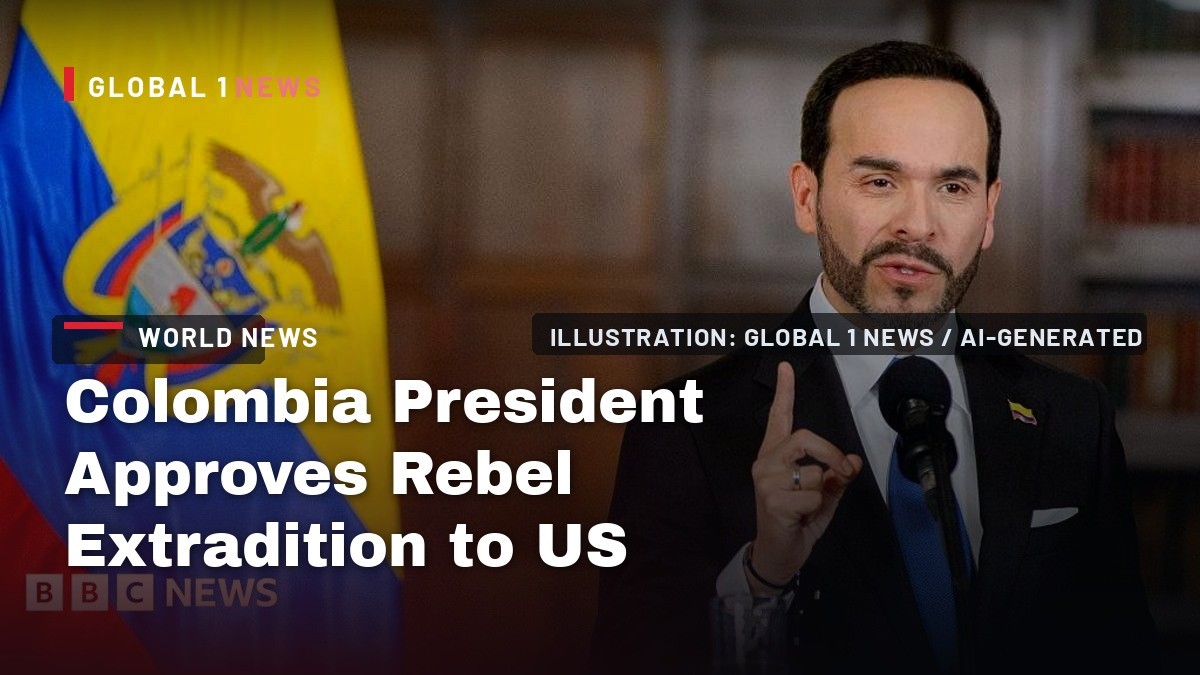
In a decisive break from his predecessor's controversial peace strategy, Colombia's newly sworn-in President Abelardo de la Espriella has approved the extradition of five rebel and criminal leaders wanted in the United States on drug-related charges. The move, announced this week, effectively dismantles the cornerstone of former President Gustavo Petro's "total peace" policy, which sought to negotiate an end to six decades of armed conflict by bringing rebel and criminal groups to the negotiating table. The decision signals a dramatic shift in Colombia's approach to its entrenched violence, prioritizing prosecution in U.S. courts over domestic dialogue, and it has already sent shockwaves through the country's fragile peace architecture.
Colombia's New President Approves Rebel Extraditions
Bogotá, Colombia — The approval, confirmed by presidential sources in recent days, targets five individuals affiliated with dissident factions of the Revolutionary Armed Forces of Colombia (Farc) and the Gulf Clan, the nation's most powerful drug trafficking cartel. They face charges in U.S. federal courts including drug trafficking, narco-terrorism, and illegal weapons possession. Of the five, only two are currently in Colombian custody; the remaining three are at large, presumably in hiding or under the protection of their armed structures. The extraditions were originally authorized by Petro in 2025 but remained suspended because the men were active participants in his peace negotiations, a protection that has now been lifted with the stroke of a pen.
A New Doctrine: Peace Without Impunity
President de la Espriella, a right-wing populist who was sworn in earlier this month, has made his position unmistakably clear. In a post on X, he declared: "Since the first day it was clear: peace cannot be a refuge for criminals nor a mechanism of impunity." Speaking later to reporters, he elaborated that Petro's plan had opened doors to criminals without securing their cooperation, a pointed critique of a policy that granted legal benefits and negotiation status to armed groups in exchange for promises of ceasefires and eventual disarmament.
The new administration's stance represents a fundamental philosophical shift. Where Petro viewed dialogue as the only viable path to ending a conflict that has killed over 450,000 people since the 1960s, de la Espriella frames it as a failed experiment that rewarded violence. His government has signaled that cooperation with Washington on drug interdiction and extradition will be the primary tool for dismantling criminal networks, a return to the hardline tactics that defined U.S.-Colombian relations for decades before Petro's tenure.
The timing is significant. De la Espriella's first day in office was marked by a reported $1 billion U.S. aid offer, a clear indication of the Trump administration's enthusiasm for the new leadership. The president has promised Donald Trump to escalate the war on drug trafficking across Latin America, aligning himself with Washington's priority of targeting traffickers at their source. This week's extradition approval is the first concrete manifestation of that promise.
The Targets: Dissidents and Cartel Leaders
The five men named in the extradition orders represent two distinct but interconnected threats to Colombian security. The first group belongs to dissident factions of the Farc—former guerrillas who rejected the 2016 peace deal that demobilized the main rebel army. These dissidents, estimated to number between 2,500 and 3,500 fighters, have evolved from ideological insurgents into sophisticated drug trafficking enterprises, controlling cocaine production in the country's southern and eastern departments. They operate under various command structures, with leaders like "Iván Mordisco" and "Gentil Duarte" (the latter reportedly deceased) having built transnational cocaine empires that stretch from the Colombian jungle to European and U.S. street corners.
The second group is the Gulf Clan, also known as the Gaitanist Self-Defense Forces of Colombia (AGC), which is widely considered the country's principal drug cartel. Unlike the Farc dissidents, the Gulf Clan has no political pretensions; it is a pure criminal enterprise that controls key smuggling routes along the Caribbean coast and the Urabá region. Its leader, known by the alias "Otoniel," was extradited to the U.S. in 2022, but the organization has proven resilient, adapting its leadership structure and continuing its operations under new commanders.
The charges of narco-terrorism are particularly significant, as they allege that the accused used violence and intimidation to protect their drug operations, a legal framework that carries severe penalties in the U.S. federal system, including mandatory minimum sentences and the possibility of life imprisonment.
The Collapse of "Total Peace"
The extradition approval is the final nail in the coffin of Petro's "total peace" policy, a sweeping initiative that sought to negotiate with every armed group in Colombia simultaneously. Launched in 2022, the policy was ambitious in scope but flawed in execution. Petro's government opened formal talks with the National Liberation Army (ELN), the Farc dissidents, the Gulf Clan, and numerous smaller criminal bands, offering legal benefits, reduced sentences, and political recognition in exchange for ceasefires and eventual disarmament.
Critics argue that the policy failed because it treated criminal organizations as political actors, granting them legitimacy they did not deserve. Members of the illegal groups repeatedly broke ceasefires, using the lulls in fighting to consolidate territorial control and expand drug production. The ELN, in particular, walked away from talks multiple times. The Farc dissidents, meanwhile, used the peace process to strengthen their military capabilities, recruiting new members and forging alliances with Mexican and Peruvian trafficking organizations.
Supporters of Petro's approach, however, contend that the policy was never given a fair chance. They also note that the 2016 Farc peace deal, which de la Espriella's party has historically opposed, successfully demobilized over 13,000 fighters and reduced violence significantly, even if dissident factions have since emerged.
The human cost of the policy's failure is measurable. According to the Independent Commission for Human Rights in Colombia, violence in rural areas has actually increased in recent years, with armed groups fighting over territory vacated by the demobilized Farc. Indigenous communities, Afro-Colombian populations, and small farmers have borne the brunt of this violence, facing displacement, extortion, and recruitment by armed groups. The extradition of leaders, while satisfying a demand for justice, does little to address the underlying conditions that allow these groups to flourish: poverty, state absence, and the lucrative economics of cocaine production.
Regional Echoes and U.S. Pressure
Colombia's decision reverberates far beyond its borders. As the world's largest producer of cocaine, with an estimated production capacity of over 1,400 metric tons per year, Colombia sits at the center of a regional drug trade that affects every country in the hemisphere. The cocaine that originates in Colombian laboratories travels through Central America and Mexico before reaching U.S. and European markets, fueling violence, corruption, and public health crises along the way.
In Mexico, the Sinaloa and Jalisco cartels rely on Colombian supply chains; in Brazil, the PCC and Comando Vermelho have established direct relationships with Colombian producers; in Peru and Bolivia, coca cultivation feeds into the same transnational networks. The extradition of Colombian leaders to the U.S. has historically been a double-edged sword: it removes powerful figures from the battlefield, but it also creates leadership vacuums that spark violent succession struggles. The capture and extradition of Pablo Escobar's associates in the 1990s, for example, led to the fragmentation of the Medellín Cartel and the rise of even more violent successor organizations.
The Trump administration has made clear its desire for a more aggressive approach. The reported $1 billion aid package, offered on de la Espriella's first day in office, is contingent on measurable results in reducing cocaine production and interdicting shipments. U.S. officials have also hinted at the possibility of direct military action against drug trafficking operations, a threat that Petro had publicly condemned. De la Espriella, by contrast, has welcomed U.S. cooperation, framing it as a necessary partnership in the fight against transnational crime.
Yet the history of U.S. intervention in Latin America is fraught with unintended consequences. Plan Colombia, the $10 billion U.S. aid package signed in 2000, succeeded in reducing Farc's military capacity but failed to eliminate cocaine production, which has actually increased in recent years. Critics of extradition argue that it treats the symptoms rather than the cause, removing individual leaders while leaving the structural conditions that produce them intact.
Justice, Victims, and the Road Ahead
For victims of Colombia's armed conflict, the extradition decision is met with mixed emotions. On one hand, there is a sense of justice: the men being sent to the U.S. are accused of crimes that have devastated communities for decades, and their prosecution in U.S. courts offers a measure of accountability. On the other hand, there is concern that extradition removes these individuals from the jurisdiction of Colombia's transitional justice system, which was designed to provide truth, reparations, and non-repetition guarantees to victims.
The 2016 Farc peace deal established a Special Jurisdiction for Peace (JEP) that offers reduced sentences to combatants who confess their crimes and participate in reparations. Extradited leaders, however, will face U.S. federal courts, where the focus is on punishment rather than reconciliation. This creates a legal and moral tension: can justice be served if it comes at the expense of truth-telling and victim participation?
Human rights organizations have also raised concerns about the due process rights of the accused. The charge of narco-terrorism, in particular, has been criticized for conflating drug trafficking with terrorism, a legal framework that has been used to justify extraordinary measures in the post-9/11 era.
De la Espriella's government has dismissed these concerns, arguing that the fight against drug trafficking requires decisive action and that those who profit from violence must face the consequences of their actions wherever justice is administered.
As Colombia navigates this new chapter, the path forward remains uncertain. The extradition of five leaders, while symbolically significant, will not dismantle the drug trade or end the violence. The Gulf Clan and Farc dissidents have demonstrated remarkable resilience, adapting to the loss of leaders and continuing their operations. The underlying drivers of the conflict—rural poverty, land inequality, state absence, and the insatiable global demand for cocaine—remain unaddressed.
What is clear is that Colombia has chosen a different path from its recent past. The era of "total peace" is over, replaced by a return to hardline tactics and close alignment with Washington. Whether this approach will yield better results than its predecessor remains to be seen. The stakes could not be higher: for the victims of violence, for the communities caught in the crossfire, and for a region that looks to Colombia as both a cautionary tale and a potential model.
This article was produced with AI-assisted research and editorial support. Sources: BBC News.
By Elena Vasquez, Staff Writer
What's Your Reaction?
 Like
0
Like
0
 Dislike
0
Dislike
0
 Love
0
Love
0
 Funny
0
Funny
0
 Wow
0
Wow
0
 Sad
0
Sad
0
 Angry
0
Angry
0

Latin America Correspondent at Global1.News. Based in Mexico City, covering politics, economics, energy, and culture across the region. Brings an on-the-ground perspective to stories spanning from the Rio Grande to Patagonia.













Comments (0)