
Brazil Ended the Six-Day Week. Now Comes the Fine Print.
Brazil's amendment ending the six-day work week is law, but on 27 October the government's leader in the Senate confirmed that rules for exceptions are still being drafted at the Ministry of Labour, as industry demands Congress reopen the change and unions defend it.
Brazil's constitutional amendment ending the six-day working week was promulgated on 16 October. On Tuesday, the government's leader in the Senate confirmed that the exceptions built into it are still being written. Senator Teresa Leitão said a supplementary law is in preparation for working patterns that do not fit five days of work and two of rest, and that the text is not finished. The amendment cuts the maximum week from 44 hours to 42 on a 60-day clock, then to 40 hours twelve months later, with two paid rest days and no cut in pay. Unions call it a historic gain. Industry confederations want Congress to reopen it. What remains unsettled is the fine print, and who gets to write it.
Brazil Ended the Six-Day Week. Now Comes the Fine Print.
Brasília, Brazil — Emenda Constitucional 141/2026 was signed at a joint session of Congress on 16 October 2026, with President Luiz Inácio Lula da Silva, Senate president Davi Alcolumbre and Chamber president Hugo Motta present. It guarantees two paid weekly rest days and forbids any reduction in pay, nominal or proportional. In play now is the machinery: a regulation to define how collective bargaining works under the new limits, a separate instrument for activities on differentiated scales, and a transition for micro and small business that depends on a supplementary law nobody has drafted.
The Leader Says the Text Is Not Finished
Teresa Leitão, the government's leader in the Senate, told SBT News on Tuesday 27 October that the executive is preparing a supplementary law to deal with exceptions to the end of the 6x1. She described the categories concerned as atypical in the organisation of work: "São jornadas muito atípicas do ponto de vista da organização do trabalho, que não se coadunam à 5 por 2. Jornadas de plantões, jornadas de aeroviários, algumas jornadas que estão citadas na própria PEC." She said the aim is to protect both sides: "Haverá uma regulamentação para que não haja prejuízo nem para os trabalhadores e nem para as empresas." The text, she said, is not finished and is under discussion at the Ministry of Labour, with the outstanding cases to be settled by the end of the year: "Acho que daqui para o final do ano todas essas excepcionalidades estarão resolvidas." The reporting does not agree on the instrument. SBT News describes a supplementary law; Guia do Investidor, covering the same interview, describes a decree requiring no new approval from Congress. Extra/Globo has reported both in preparation.
What the Amendment Actually Orders
The text requires two paid weekly rest days, one of them preferably on Sunday, with no reduction in pay of any kind, including pay floors. The maximum working week falls from 44 to 42 hours 60 days after promulgation, and to 40 hours twelve months after that, a transition of fourteen months in total. Between the second month and the fourteenth, the employer distributes the two hours above the normal eight across the week; split evenly, that is 8 hours 24 minutes on each of five days. Clauses in collective agreements on working duration and weekly paid rest that are incompatible with the new level lose validity two months after publication. The amendment also allows later ordinary laws to set conditions for differentiated regimes within the 40-hour and two-rest-day limits, including uninterrupted six-hour shift rotation.
The Regulation Waited for the Ballot
Extra/Globo reported on 22 October, in a piece by Geralda Doca datelined Brasília, that the regulation of the end of the 6x1 would be left until after the second round of the presidential election, which Lula won on Sunday 25 October. According to technicians close to the discussions, the Casa Civil was drafting a decree to clarify for unions how collective bargaining works under the new rules, and a supplementary-law bill for activities on differentiated scales. The decree was expected to clarify that unions may make addenda to existing agreements and postpone broader negotiations to each category's data-base date. The supplementary-law bill would cover the exceptions raised by legislators during the amendment's passage, such as oil workers embarked on platforms and aviation workers. The regulation must also avoid pay cuts for hourly-paid categories, by fixing a divisor: with the minimum wage at R$1,621, the hourly rate for an intermittent worker cannot fall below R$8.10, dividing monthly pay by 200 hours instead of today's 220. The normal overtime hour would be R$12.15, and Sunday overtime, at a 100 percent premium, R$16.20.
The Exception Already Written Into the Text
The amendment carries an express exception for private-sector employees with a university degree earning at or above 2.5 times the ceiling of INSS benefits, which stands at R$21,188.87 against a benefit ceiling of R$8,475.55. For those workers the working-duration and hours-control rules do not apply, by the employer's discretion or if a collective agreement says so, but the five-day, two-rest-day rule must still be observed. The rapporteur's stated reason was to discourage "pejotização", the practice of hiring a worker as a company. Separately, the text allows a compensation regime other than 5x2 by collective agreement, provided the monthly average still comes to two paid rest days per week. Agência Brasil states plainly that a worker can still be on a 6x1 if a collective agreement provides for it. Outsourced workers on public-administration contracts get twelve months rather than 60 days, and the rule does not apply to public employees of the direct and indirect administration of the Union, states, the Federal District and municipalities.
Fourteen Million People, and a Disagreement About the Share
Ministry of Labour and Employment data reported by G1 put 14.8 million CLT workers on the 6x1. Brazil has 50.2 million CLT workers in total, of whom 37.2 million work 44 hours a week and 29.7 million, or 66.8 percent, are already on a 5x2. A further 1.4 million domestic workers are on a 6x1, and the total may be higher because the count covers only CLT contracts. Dieese, in data given to the special committee that examined the proposal, puts the same 14.8 million at 33.2 percent of all occupied workers, one in three. The sectors with the highest share are air transport at 53.2 percent, accommodation at 52 percent, food services at 47.1 percent and retail at 42.2 percent. Dieese also found that workers on 41 to 44 hours a week earned an average of R$2,560 a month, against R$5,555 for those on exactly 40 hours.

What Was Asked For, and What Passed
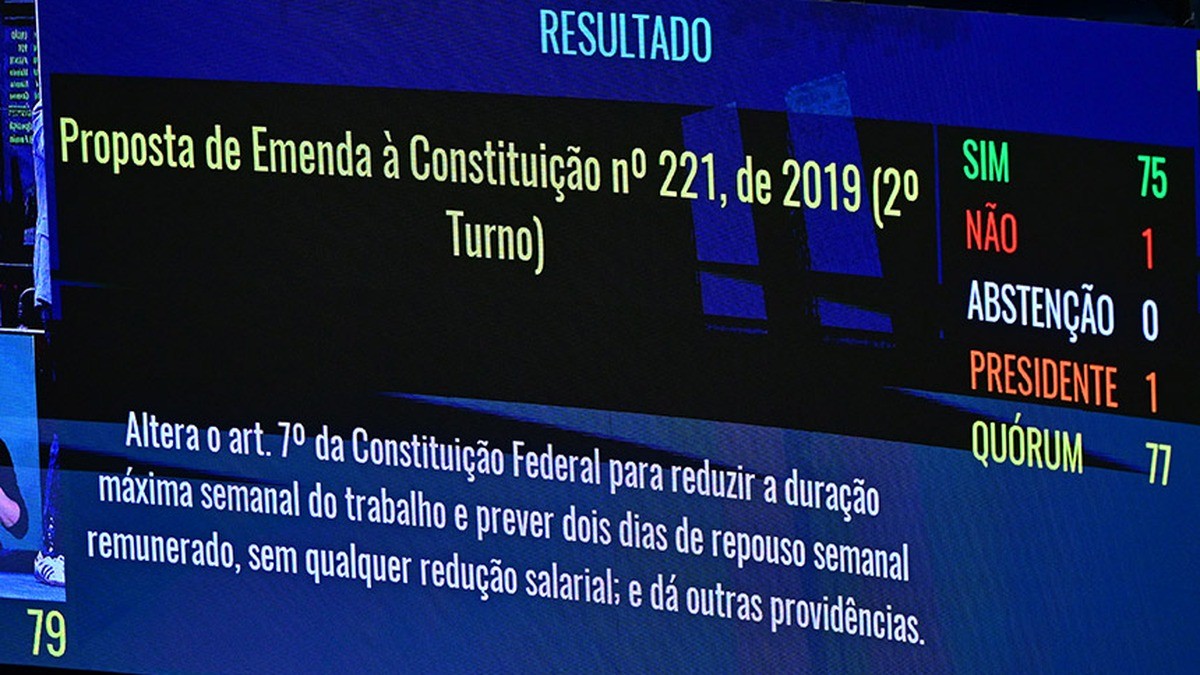
The amendment began as PEC 221/2019, whose first signatory was Deputy Reginaldo Lopes, and the text that went to the Senate was a substitute by Deputy Leo Prates merging Lopes's proposal for a 36-hour week with PEC 8/2025 by Deputy Érika Hilton for an equal week in four days. Neither of those numbers survived the negotiation. The Chamber approved it in two rounds on 27 May 2026, by 472 votes to 22 and then 461 to 19, against the 308 needed. The Senate approved it on Wednesday 14 October 2026 with the same result in both rounds, 75 in favour and one against, that vote cast by Hamilton Mourão, who did not speak in the session. Senate rapporteur Omar Aziz said: "Eu tenho certeza que, desde a Constituinte de 1988, esta é a maior conquista dos trabalhadores brasileiros."
What Industry Wants Back
The National Confederation of Industry called the amendment a "retrocesso" for a country already suffering low productivity and weak competitiveness. Its president, Ricardo Alban, asked Congress to revise the approval "após a constatação, por exemplo, da perda de competitividade e da alta inflacionária", and said: "Acreditamos que o Congresso Nacional possa abrir espaço para revisitar o tema." The confederation calculates the reduction raises production costs by up to R$267 billion, with a 0.7 percent fall in GDP and average inflation of 6.2 percent; Agência Brasil notes that studies diverge, with some finding broad negative effects and others residual damage. In transport, a CNT study estimated that cutting hours without a proportional cut in pay could raise personnel costs 8.6 percent and require about 240,000 additional workers, with 65.1 percent of hauliers already reporting difficulty hiring drivers. Gislaine Zorzin, of the dangerous-goods transporters' association ABTLP, said employed drivers are covered: "apesar de o motorista ser uma atividade essencial, ele continua sendo um trabalhador como qualquer outro."
What the Unions Won
CUT hailed the end of the "massacrante escala 6x1" as a "maiúscula" victory of "a luta, do suor e da organização da classe trabalhadora brasileira", calling it a "divisor de águas na superação de um modelo arcaico e cruel que suga as energias de quem realmente trabalha". Força Sindical president Miguel Torres said the measure will benefit "milhões de pessoas" and that international experience shows shorter hours tend to raise productivity and create jobs. Senator Paulo Paim said: "depois de 40 anos, nós estamos dando a liberdade a eles de não terem que trabalhar de segunda a sábado." He cited a study showing the reduction could generate 4.5 million jobs. Teresa Leitão, defending the proposal in the plenary, cited a study showing 72 percent of the population support ending the 6x1 and denied the proposal was being used electorally.
The Bill Waiting to Undo It
Government leader in Congress Randolfe Rodrigues named PEC 12/2026, presented by opposition leader Rogério Marinho, which would allow a flexible regime in which the employee is paid according to hours worked. "É o inverso do fim da 6x1. Eles querem é isso, é o prevalecer do negociado sobre legislado, como se houvesse uma igualdade de armas entre patrão e empregado," he said. Leitão said after the vote that vigilance would still be needed because other proposals are in progress with rules less beneficial to workers. Senator Vanderlan Cardoso voted for the amendment but defended a future "jornada flexível" with hourly pay chosen by the worker, in writing, with holiday, bonus, FGTS and pension guaranteed and the hourly rate never below the minimum wage or the category floor.
The Calendar Nobody Can Move
The 60-day clock dates the first stage to 15 December 2026 by arithmetic, while some outlets give 16 December, and the second stage falls twelve months after that. Leitão's estimate that the exceptions will be settled "by the end of the year" sits on top of that start date rather than before it, which leaves the categories she named working under rules that have not been published. On micro and small business, Leo Prates inserted a device remitting to a supplementary law the transitional rules to soften the impact on individual micro-entrepreneurs, micro-enterprises and small companies. Hugo Motta said at the promulgation that the annual revenue ceiling for MEIs rises from R$80,000 to R$110,000 in 2027 and R$140,000 in 2028, and that a MEI may hire up to two employees.
By Jessica Ali, Staff Writer
This article was produced with AI-assisted research and editorial support. Sources: SBT News; Guia do Investidor; Extra/O Globo; Agência Brasil; Agência Câmara; Agência Senado; Estadão/Estradão via Terra; G1/Globo; CUT; Dieese. Photographs: Lula Marques/Agência Brasil (cover); Agência Senado; Tomaz Silva/Agência Brasil.
What's Your Reaction?
 Like
0
 Dislike
0
 Love
0
 Funny
0
 Wow
0
 Sad
0
 Angry
0

Editor-in-Chief at Global1.News. Atlanta-based journalist who cuts through the BS and tells it like it is. Lead anchor, host, and the voice you hear when the spin stops and the truth starts.















Comments (0)