
The MND Mexico Well-being Series, Part 2: Education
Education in Mexico sits at a crossroads where hopes for the next generation meet stark realities drawn from the latest OECD “Education at a Glance 2026” data.
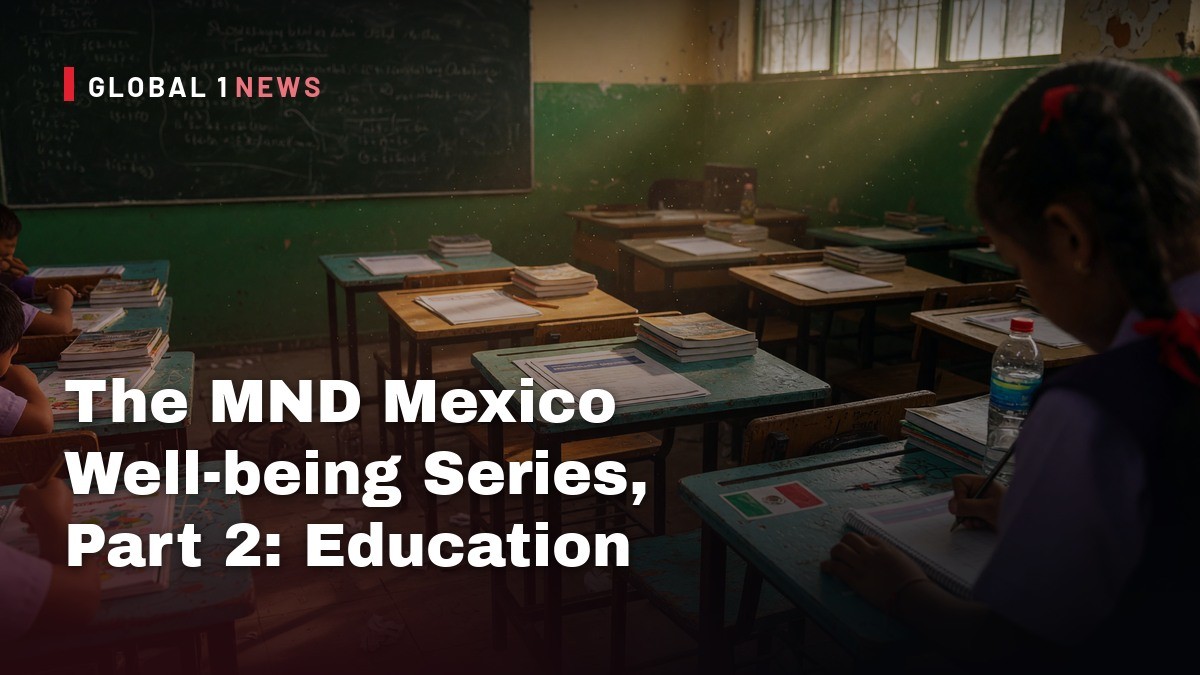
Education in Mexico sits at a crossroads where hopes for the next generation meet stark realities drawn from the latest OECD “Education at a Glance 2026” data. While the majority of children—about 84 % of primary and secondary pupils in the 2024‑25 school year—attend public schools, the quality of those experiences varies dramatically across regions, between public and private institutions, and even within the same classroom. This article walks through eight key indicators, showing where Mexico lags, where it has made progress, and how families in colonia and ejido feel the impact of each statistic on daily life.
Early childhood education: a missed foundation
UNICEF reminds us that the first three years shape a child’s lifelong health, learning and emotional well‑being. Yet Mexico’s enrollment in early childhood education and care (ECEC) tells a different story. In 2024, only four percent of two‑year‑olds were in programs that meet the International Standard Classification of Education (ISCED) criteria, compared with a 50 % OECD average. That placed Mexico at the very bottom of the ranking among 30 comparable countries.
For children aged three to the start of primary school, enrollment improves to 75 %—still well below the OECD average of 90 % and earning Mexico a spot in the lowest decile (42nd of 46). The gap has widened over the past decade: in 2015, enrollment for two‑year‑olds was five percent, and for three‑year‑olds it was 79 %. The widening gap reflects a fragmented child‑care system that serves mainly children of formal workers, leaving informal‑sector families—who make up more than half of the workforce—at a disadvantage. For many families, the lack of affordable, high‑quality ECEC means mothers must choose between work and caring for young children, a dilemma that reverberates through household budgets and future educational attainment.
Public spending on education: a shrinking share
Government spending on education fell from 4.4 % of GDP in 2015 to 2.9 % in 2023, a decline of 1.5 percentage points. This places Mexico 39th out of 42 countries, in the bottom decile, well under the OECD average of 4.2 %. In 2015, Mexico’s share was on par with the OECD average, but by 2023 it lagged by 1.3 points.
The reduction in public investment occurs at a time when the country faces rising demand for school infrastructure, teacher training, and modern learning resources. President Sheinbaum has pledged 350 billion pesos for school construction by 2030, yet the historical trend suggests that without a sustained increase in the share of GDP devoted to education, many of those funds may struggle to keep pace with inflation and the growing student population.
Upper secondary attainment: a slow climb
In 2025, 40 % of Mexicans aged 25‑34 lacked an upper secondary (prepa) qualification, far above the OECD average of 12 %. This places Mexico 44th out of 47, again in the bottom decile. However, the picture is not entirely bleak. The share without upper secondary education fell from 55 % in 2015 to 40 % in 2025—a fifteen‑point improvement that the OECD calls “significant.”
While the gap with the OECD average narrowed from 38 points in 2015 to 28 points in 2025, the absolute level remains high. Families in rural colonias often see children leave school early to help with agricultural work or household chores, perpetuating a cycle of limited formal education that hampers upward mobility.
Tertiary education: gender gaps and modest gains
In 2025, 30 % of women and 28 % of men aged 25‑34 held a tertiary qualification. Both figures sit well below the OECD average—men 12 points below, women 24 points below. Mexico ranked 39th out of 45 for tertiary attainment, placing it in the second lowest decile.
Nevertheless, the share with a university degree rose from roughly 21 % in 2015 to 29 % in 2025. The modest rise reflects expanded university capacity, such as new campuses of Rosario Castellanos University, yet the gender gap persists, and many young adults from low‑income families still cannot afford higher education without scholarships or work‑study programs.
Teacher qualifications: a downward trend
Teacher quality is a cornerstone of learning outcomes. In 2024, 82 % of pre‑primary teachers met the minimum bachelor’s‑level requirement—five points below the OECD average of 87 %. Primary teachers fared better at 92 %, four points above the OECD average of 88 %, while lower secondary teachers stood at 87 %, two points below the OECD average of 89 %. Across the three levels, Mexico ranked in the third‑lowest decile for preschool and lower secondary teachers, and fourth‑lowest for primary teachers.
From 2017 to 2024, the share of teachers meeting the minimum fell by five points at the preschool level, five points at primary, and six points at lower secondary. The decline suggests that despite pay raises—public teachers received a 9 % increase in 2024, raising average monthly salaries to about 20,351 pesos—the profession still struggles to attract and retain qualified staff, especially in remote or underserved regions.
Class sizes and learning environment
Average class sizes in 2024 were modestly higher than OECD norms: 23 students per primary class (OECD average 21) and 25 students per lower secondary class (OECD average 23). These figures place Mexico in the second‑lowest decile for primary and third‑lowest for lower secondary, indicating that while class sizes are not dramatically large, they are larger than in many peer countries.
From 2015 to 2024, primary class sizes grew from 22 to 23 students, widening the gap with the OECD average. Conversely, lower secondary class sizes fell from 28 to 25 students, narrowing the gap. Smaller classes at the secondary level may help improve learning outcomes, but the modest increase in primary class size could counteract gains, especially in schools already facing resource constraints.
PISA performance and student well‑being
Mexico’s 2025 PISA results show scores well below OECD averages: 408 in reading (53 points lower), 414 in science (68 points lower), and 388 in mathematics (75 points lower). Computational problem‑solving scored 453, 47 points below the OECD average of 500. These results placed Mexico in the sixth decile for reading, seventh for science, and eighth for mathematics, indicating performance among the lower half of participating nations.
Despite the decline in absolute scores since 2015—reading down 15 points, science down 2, mathematics down 20—the gap with OECD averages narrowed because OECD scores fell more sharply over the same period. Still, more than 41 % of Mexican students scored below the basic proficiency level, more than double the OECD average of 19.7 %.
Bullying rates in 2025 were 19.5 %, essentially on par with the OECD average (19.6 %). This marks a slight improvement from 20.2 % in 2015. While the prevalence is comparable to many other countries, the experience of being bullied can exacerbate the challenges faced by students already struggling academically.
Finally, the NEET (Not in Education, Employment, or Training) rate for 18‑24‑year‑olds stood at 19 % in 2025, five points above the OECD average. Young women were disproportionately affected, with a 29 % NEET rate versus 10 % for men. Regional disparities are pronounced, with some states far exceeding the national average. The figure represents a modest decline from 23 % in 2015, suggesting that policies like the “Youths building the future” apprenticeship scheme may be having an impact, yet the overall level remains a concern for families relying on their children’s future earnings.
Across these eight indicators, the data paint a mixed portrait. Early childhood enrollment and education spending have slipped, teacher qualification rates have fallen, and PISA scores have declined, while upper secondary attainment and tertiary enrollment have improved modestly, and class sizes at the lower secondary level have decreased. For the families that make up the fabric of Mexico—whether in bustling tianguis markets or quiet ejidos—the stakes are personal. The government's announced investments and reforms, from new textbooks to a ban on cell phones in schools, aim to address some of these gaps, but the effectiveness of each measure will be judged in classrooms, homes, and the future opportunities of Mexico’s children.
This article was produced with AI-assisted research and editorial support. Reporting is based on the source material cited below. Sources: Mexico News Daily; mexiconewsdaily.com; Global1.News (22 October 2026).
By Rosa Martinez, Staff Writer
What's Your Reaction?
 Like
0
 Dislike
0
 Love
0
 Funny
0
 Wow
0
 Sad
0
 Angry
0
Latin America/Andes Correspondent at Global1.News. Based in Bogota, covering politics, environment, energy, and social movements across the Andean region. Passionate about environmental journalism and communities protecting their land.











Comments (0)