
Beyond the Pukpuk Treaty, Australia’s Strategic Footprint in PNG Grows
In July 2026 the Pukpuk Treaty—formally titled the Papua New Guinea–Australia Defense Cooperation Agreement—came into force, marking the first formal defense alliance that Papua New Guinea (PNG) has signed with another sovereign state.
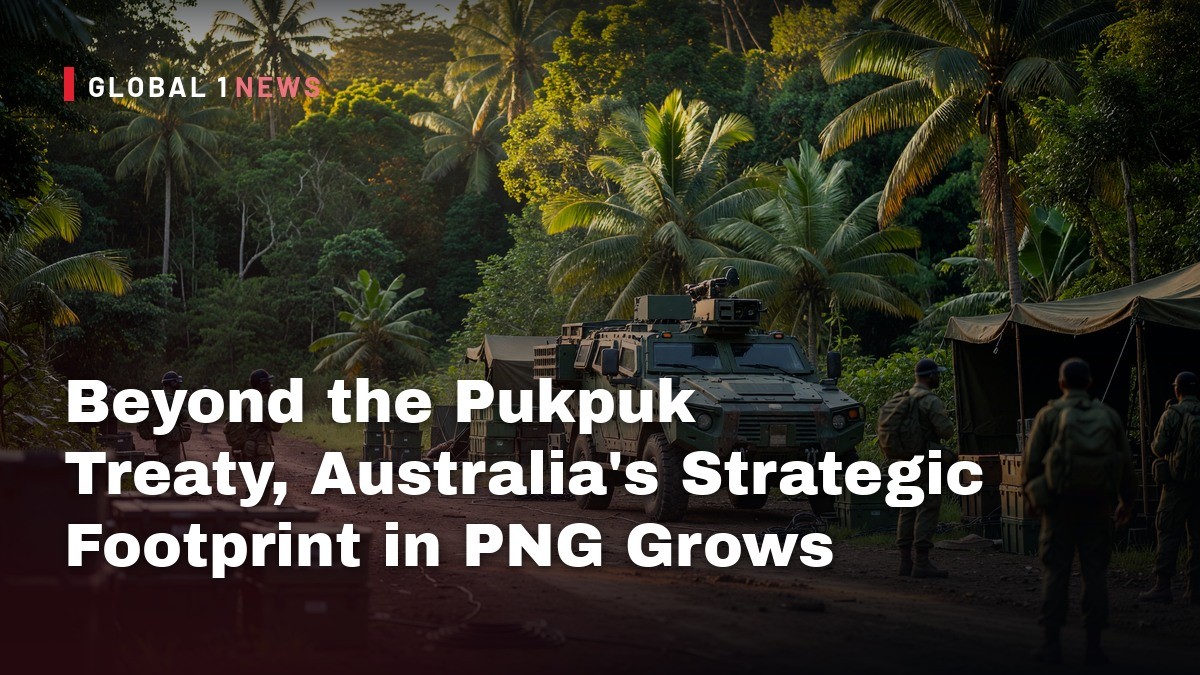
In July 2026 the Pukpuk Treaty—formally titled the Papua New Guinea–Australia Defense Cooperation Agreement—came into force, marking the first formal defense alliance that Papua New Guinea (PNG) has signed with another sovereign state. The treaty obliges both parties to deepen military collaboration, enhance defense infrastructure, and develop joint capabilities in emerging technologies. Within weeks of its entry into force, Australia’s foreign and defense ministers, Penny Wong and Richard Marles, travelled to Port Moresby for the 32nd Australia‑Papua New Guinea Ministerial Forum, the first such gathering under the new treaty framework. The forum served as a practical laboratory for translating the treaty’s high‑level commitments into concrete programs, ranging from rotational deployments of Australian troops to a pioneering recruitment pipeline for Papua New Guinean citizens.
Operationalizing the Pukpuk Treaty: The Magani Rotation
The headline initiative announced at the forum was the “Magani Rotation,” a three‑month rotational deployment of a combat group comprising 130 Australian Defence Force (ADF) personnel to PNG. Unlike ad‑hoc joint exercises, this continuous presence is intended to foster sustained working relationships, allowing Australian and PNG forces to develop a shared operational language and mutual familiarity with each other’s procedures. For PNG, the rotation promises regular access to Australian expertise in areas such as logistics, infantry tactics, and maritime surveillance. For Australia, the forward‑deployed personnel enhance the nation’s ability to operate alongside a neighbor whose geography is integral to the defence of Australia’s northern approaches.
The rotation model reflects a broader strategic shift within the Australian Department of Defence, which has increasingly emphasized “persistent engagement” as a means of building partner capacity while securing Australia’s own security interests. By embedding a stable contingent of ADF personnel, Canberra hopes to create a reliable conduit for knowledge transfer, joint planning, and rapid response coordination that occasional exercises cannot achieve.
Infrastructure Investment: Building PNG’s Defense Foundations
Complementing the Magani Rotation, Australia and PNG announced a $77 million infrastructure investment fund earmarked for the PNG Defence Force. The fund is designated to upgrade military facilities so that they can more effectively house, train, and sustain additional personnel, including the incoming Australian combat group. While the source material does not itemise specific projects, the allocation signals a clear intent to modernise PNG’s defence baselines—an essential prerequisite for any deeper bilateral military integration.
This investment aligns with the broader Australian aid architecture, which has historically combined security assistance with development financing. By strengthening PNG’s physical defence infrastructure, Australia seeks to ensure that the partnership yields durable capabilities rather than short‑term stop‑gap measures.
Human Capital Development: PNG Recruitment into the ADF
A more radical dimension of the partnership is the opening of Australian military recruitment to eligible Papua New Guineans. Applications for the inaugural intake will open on 16 November 2026, with a pilot program slated to commence in 2027. The first two cohorts will each consist of roughly 50 recruits drawn primarily from the University of Papua New Guinea, Pacific Adventist University, and the University of Technology in Lae. These candidates will train alongside Australian personnel, ultimately pursuing Australian citizenship through the standard permanent‑residency pathway.
The recruitment scheme mirrors Australia’s recent expansion of ADF enlistment to permanent residents from New Zealand, the United Kingdom, the United States, and Canada—a move designed to mitigate persistent personnel shortages. However, the PNG initiative is distinct in that it is grounded in the Pukpuk Treaty and targets citizens residing in PNG, thereby embedding the programme within the bilateral security architecture rather than treating it as a domestic recruitment drive.
Digital Governance and Emerging Technologies
Beyond kinetic defence, the forum formalised a partnership covering digital governance, network security, and emerging technologies. This agreement builds on a previously articulated “Telecommunications Blueprint” intended to improve PNG’s connectivity and digital infrastructure. Secure communications are essential for coordinated military operations, government resilience, and the protection of critical infrastructure. By shaping PNG’s digital architecture, Australia secures a strategic foothold in the information environment that underpins both civilian and defence domains.
The partnership reflects a growing recognition within the Ministry of Foreign Affairs (MOFA) and the Ministry of Education (MOE) that cyber and digital capabilities are integral to national security. Joint work on network security and emerging technologies will likely involve capacity‑building programmes, joint research, and the sharing of best practices, thereby deepening institutional linkages between the two states.
Continuity of Existing Security Assistance
The new treaty‑based initiatives sit alongside an existing bilateral security programme that began in 2023. Under that arrangement, Australia committed AU$200 million to support PNG’s police and justice institutions, funding upgrades to training facilities, police helicopters, and a National Forensic Science Center. A second phase of this assistance is slated to begin after the current programme concludes in 2027. Although separate from the Pukpuk Treaty, this ongoing support reinforces PNG’s internal security capacity, which is a prerequisite for any credible external defence partnership.
By maintaining a layered approach—combining law‑enforcement assistance, defence infrastructure upgrades, and personnel integration—Australia seeks to cultivate a comprehensive security ecosystem that can address both internal stability and external threats across the wider Pacific region.
Strategic Calculus: Benefits and Risks for PNG
For Port Moresby, the alliance offers a pathway to accelerate defence capability development, attract foreign investment, and embed PNG within a security architecture that can deter external aggression. The influx of Australian expertise, infrastructure funding, and training opportunities could enable PNG to field a more professional and better‑equipped defence force, thereby enhancing its sovereign capacity to safeguard territorial integrity.
Conversely, the partnership also raises questions about the balance of agency. The Pukpuk Treaty, while providing material benefits, inevitably draws PNG deeper into Australia’s strategic orbit. The long‑term challenge for PNG will be to ensure that the alliance translates into genuine capacity‑building rather than a dependency that primarily serves Australian strategic priorities—namely, securing the northern approaches to the Australian continent and maintaining influence over a key Pacific neighbour.
Forward‑Looking Assessment: Regional Implications and Future Trajectories
From a regional perspective, the Australia‑PNG defence partnership exemplifies a broader trend of middle‑power states leveraging bilateral treaties to shape the security architecture of the Indo‑Pacific. By institutionalising a continuous Australian military presence, expanding recruitment pipelines, and integrating digital governance, Canberra is constructing a multi‑layered engagement model that could serve as a template for future alliances with other Pacific Island nations.
Looking ahead, the effectiveness of the Magani Rotation and the PNG recruitment programme will hinge on their ability to produce measurable capability gains for PNG while fostering genuine interpersonal and institutional bonds. The success of the $77 million infrastructure fund in delivering functional, maintainable facilities will also be a critical barometer. As the 2027 pilot cohort commences training, scholars at the Asan Institute and analysts at the Korea Development Institute of Policy (KDI) will likely monitor these initiatives as case studies in alliance‑building and capacity‑development within the broader context of Northeast Asian and Pacific security dynamics.
In sum, the post‑Pukpuk Treaty era marks a decisive deepening of Australia‑PNG relations, moving from episodic assistance to a sustained, multidimensional partnership. Whether this partnership will evolve into a resilient, mutually beneficial security framework—or remain a strategic instrument primarily serving Australian interests—will be determined by the concrete outcomes of the Magani Rotation, infrastructure upgrades, and the nascent PNG recruitment pipeline over the coming years.
This article was produced with AI-assisted research and editorial support. Reporting is based on the source material cited below. Sources: The Diplomat; thediplomat.com; Global1.News (28 October 2026).
By Prof. David Park, Staff Writer
What's Your Reaction?
 Like
0
 Dislike
0
 Love
0
 Funny
0
 Wow
0
 Sad
0
 Angry
0

East Asia/Technology Correspondent at Global1.News. Seoul-based voice covering Korean politics, technology, business, and culture. Analyzes how technology and geopolitics intersect across East Asia.












Comments (0)