
Mexico’s Charlyn Corral is named Best Striker of the Year at soccer’s biggest award ceremony
When Charlyn Corral stepped onto the stage of the London Palladium on Monday night, the applause that followed was more than a celebration of a single player’s triumph.
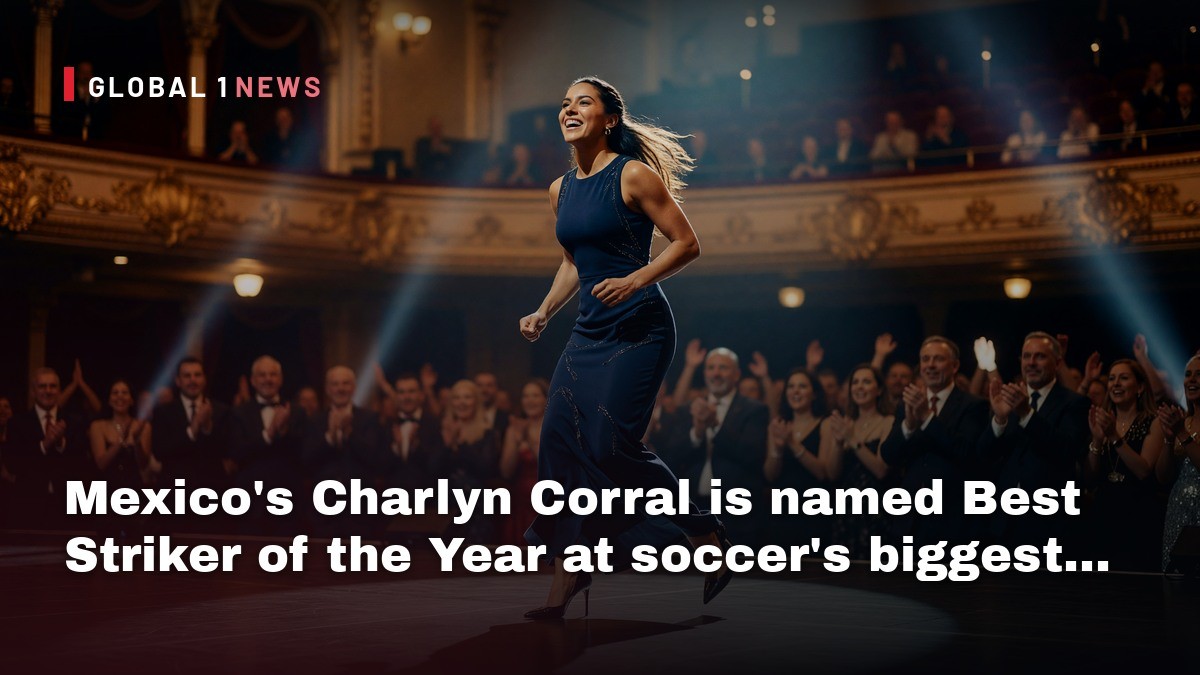
When Charlyn Corral stepped onto the stage of the London Palladium on Monday night, the applause that followed was more than a celebration of a single player’s triumph. It was a moment of collective pride for a nation that has watched its daughters fight for recognition on the dusty pitches of the ejido and the bright lights of the Liga Femenil. At 35, Corral lifted the Gerd Müller trophy for Best Striker of the Year at the 2026 Ballon d’Or ceremony, becoming the first Mexican woman to claim the coveted honor and cementing a legacy that stretches back more than two decades of dedication, discipline, and relentless effort.
From Tianguis Dreams to International Stardom
Corral’s journey began in the modest neighborhoods of her hometown, where the rhythm of daily life—market stalls, school bells, and the occasional soccer ball rolling through the alley—shaped her early love for the sport. Over a career that now spans more than 20 years, she has turned that childhood passion into a record‑setting record: 49 goals in 49 matches for Club Pachuca Femenil and the Mexican women’s national team combined. Those numbers, announced during her acceptance speech, echo the precision of a striker who has learned to read the game as naturally as a farmer reads the weather.
In her own words, the award “fills me with pride and great satisfaction,” a sentiment that resonates with the families who have watched her rise from the local tianguis fields to the grandest stages of world football. She credited the “hard work, discipline and effort” that have guided her, underscoring a truth familiar to many Mexican workers: success is rarely a flash of luck, but the result of steady, patient labor.
The Significance of the Gerd Müller Trophy
The Gerd Müller trophy, traditionally awarded to the world’s most prolific striker, has only recently opened its doors to women’s football. In 2025, Polish forward Ewa Pajor became the inaugural female recipient, scoring 48 goals to claim the honor. Corral’s 2026 win marks only the second time the award has been presented in the women’s category, highlighting the rapid evolution of recognition for female athletes on the global stage.
Sharing the spotlight with English forward Harry Kane—who also received the Gerd Müller trophy in the men’s category and took home the Golden Ball—Corral’s achievement underscores a growing parity in how the sport celebrates talent, regardless of gender. The joint ceremony at the London Palladium, a venue steeped in theatrical history, served as a symbolic bridge between the worlds of men’s and women’s football, suggesting a future where both can stand side by side on equal footing.
Club Pachuca: A Homegrown Powerhouse
Corral’s success cannot be separated from the institution that nurtured her talent: Club Pachuca Femenil. The club’s management and coaching staff earned a special mention in her speech, a nod to the supportive environment that has helped the forward flourish. Pachuca’s recent triumph in the 2025 Clausura tournament of the Liga Femenil, followed by the 2024–2025 Campeón de Campeones title, reflects a period of dominance that has coincided with Corral’s own peak performance.
Beyond the trophies, Pachuca’s commitment to women’s soccer has been evident in its investment in facilities, youth academies, and community outreach. By providing a platform where players like Corral can train, compete, and grow, the club has become a beacon for other Mexican teams seeking to elevate the women’s game. The synergy between club success and individual brilliance illustrates how collective effort can amplify personal achievement.
International Recognition and the IFFHS Accolade
Corral’s accolades extend beyond the Ballon d’Or ceremony. Earlier in 2026, the International Federation of Football History & Statistics (IFFHS) honored her as the world’s top goalscorer for the second consecutive year, a testament to her consistency and lethal finishing. The IFFHS recognized her 57 goals in 2025—a tally that included 50 for Pachuca and seven for the national team—highlighting her impact at both club and country levels.
This back‑to‑back recognition places Corral among the elite echelons of global football, joining a select group of players whose names appear on both the IFFHS list and the Ballon d’Or stage. It also signals a broader shift: Mexican women’s football is no longer a peripheral curiosity but a central narrative in the sport’s worldwide story.
Family Roots and Personal Motivation
In her heartfelt acceptance speech, Corral thanked her parents and brother, describing them as “the foundation and support of my career.” The familial bond she emphasizes reflects a cultural truth in Mexico: family is the core of personal identity and ambition. For many athletes, the encouragement of parents and siblings provides the emotional scaffolding needed to pursue demanding careers.
Corral’s dedication of the award to her family also serves as an inspiration for young girls in colonia neighborhoods who dream of wearing a national jersey. Seeing a player openly acknowledge the role of her family in her success humanizes the path to greatness, reminding aspiring athletes that behind every triumph lies a network of love and sacrifice.
Raising the Profile of Mexican Women’s Soccer
Beyond personal triumphs, Corral used her platform to spotlight the broader progress of women’s soccer in Mexico. She noted that “things in the country are being done well,” a statement that reflects recent investments in the Liga Femenil, increased media coverage, and growing fan attendance at matches. By drawing attention to fellow forward Scarlett Camberos of Club América Femenil—who was ranked among the 30 best players in the world in the Ballon d’Or nomination—Corral highlighted a rising generation of talent ready to compete on the global stage.
This collective uplift is significant for a sport that, until recently, struggled for equal footing with its male counterpart. The visibility of players like Corral and Camberos helps shift public perception, encouraging sponsors, broadcasters, and local governments to view women’s football as a viable and valuable part of Mexico’s cultural fabric.
Looking Ahead: Legacy and Future Impact
As the applause faded and the lights dimmed at the London Palladium, the reverberations of Corral’s achievement continued to echo across Mexico’s soccer fields. Her story—marked by perseverance, community support, and a relentless drive to score—offers a blueprint for future generations. Young girls watching her celebrate the Gerd Müller trophy can imagine themselves in the same spotlight, perhaps one day lifting the same award.
Corral’s legacy will be measured not only in goals and trophies but in the doors she has opened for Mexican women in sport. By breaking a barrier at the world’s most prestigious award ceremony, she has helped normalize the presence of Mexican women at the highest levels of competition. The hope is that, in the coming years, the Gerd Müller trophy will be a familiar sight on the podiums of Mexico’s tianguis‑born stars, and that the pride she felt on that night will become a shared sentiment across every colonia, ejido, and city where the love of soccer runs deep.
This article was produced with AI-assisted research and editorial support. Reporting is based on the source material cited below. Sources: Mexico News Daily; mexiconewsdaily.com; Global1.News (27 October 2026).
By Rosa Martinez, Staff Writer
What's Your Reaction?
 Like
0
 Dislike
0
 Love
0
 Funny
0
 Wow
0
 Sad
0
 Angry
0

Latin America/Andes Correspondent at Global1.News. Based in Bogota, covering politics, environment, energy, and social movements across the Andean region. Passionate about environmental journalism and communities protecting their land.









Comments (0)