
SK Hynix Earns 83 Trillion Won in a Quarter and Hands Most of It Back
SK hynix reported record quarterly revenue of 104.6 trillion won and 83.3 trillion won of operating profit, then pledged roughly 100 trillion won in shareholder returns, including its first-ever special dividend.
SK hynix sold 104.62 trillion won of memory in three months and kept 83.33 trillion of it as operating profit. That is an 80 percent margin — not on a software licence, not on a patent settlement, but on the DRAM and flash chips that make artificial intelligence run. Hours later the board announced it would hand roughly 100 trillion won back to shareholders, and a stock that had spent seven weeks in freefall went vertical.
SK Hynix Earns 83 Trillion Won in a Quarter and Hands Most of It Back
Seoul, South Korea — SK hynix published its third-quarter results before 9:00 a.m. local time on Wednesday, 28 October 2026, and the Korea Exchange spent the rest of the morning trying to keep up.
The Quarter That Broke the Scale
The headline figures are not a rounding error away from anything the company had done before. Revenue came in at 104.6155 trillion won, the first time in SK hynix's history that quarterly sales have crossed 100 trillion won. Operating profit reached 83.3338 trillion won. Net profit was 39.7756 trillion won, a net margin of 38 percent. The company's own K-IFRS table puts the operating margin at 80 percent, and the raw division agrees closely at 79.7 percent. Against the same quarter a year earlier, revenue rose 328 percent and operating profit rose 632 percent. Against the second quarter, revenue was up 32 percent and operating profit 38 percent. Yonhap reported that this is the sixth consecutive quarter of record revenue and record operating profit, a streak running back to the second quarter of last year.
An Eighty Percent Margin Is Not a Normal Number
One year ago, in the third quarter of 2025, SK hynix reported an operating margin of 47 percent. In the second quarter of this year it was 76 percent. It is now 80 percent, a 33 percentage-point climb in twelve months. A margin like that can only come from price, and the earnings call put numbers on it: average selling prices for DRAM rose by a high-20s percentage from the previous quarter, helped by conventional DRAM pricing and a rising share of the more expensive HBM4. Shipments of server DDR5, the memory that fills data-centre racks, climbed more than 40 percent sequentially. On the NAND side, sales of 321-layer TLC enterprise drives expanded. The balance sheet hardened alongside the income statement: cash and equivalents ended the quarter at 114.5 trillion won, up 26.5 trillion in three months, borrowings fell 2.8 trillion won to 15.8 trillion, and net cash reached 98.7 trillion won.
The Profit That Fell While Everything Else Rose
Net profit is where the quarter gets complicated. It rose 215.7 percent year on year, and it fell 58 percent from the second quarter, when SK hynix booked 93.9226 trillion won. That earlier figure sat 33.38 trillion won above the same quarter's operating profit, a gap only non-operating items can produce, and the company's release does not itemise them. More awkward still: Yonhap Infomax put the analysts' average estimate for net profit at 59.67 trillion won. SK hynix delivered 39.78 trillion, roughly 33 percent below consensus. Yonhap's verdict was blunt — "the earnings fell behind market expectations." CNBC's was the opposite: a record quarter that sharply beat estimates. Both are accurate about different lines, and that gap between operating profit beating and net profit missing is the part of this release that will get argued over longest.
Where the Forecasts Landed
The revenue and operating-profit beats were real and large. FnGuide's consensus, compiled before the release, was 98.2257 trillion won of revenue and 76.964 trillion won of operating profit. On the raw figures the operating result landed 8.3 percent above that mark; Seoul Economic Daily put the beat at 9.3 percent against a 76 trillion won consensus. Nobody had it precisely, and few were close. TrendForce noted that brokerage forecasts for the quarter spanned roughly 10 trillion won, from DS Investment and Securities at 70.1 trillion to Meritz Securities at 80.1 trillion. The fourth-quarter consensus already sits at 87.27 trillion won of operating profit, and Seoul Economic Daily reported a full-year projection of 263 trillion won, 4.6 times last year's level. The company itself expects to invest more heavily next year rather than coast.
One Hundred Trillion Won, Handed Back
The capital-return package is the reason the stock moved. For fiscal 2026, SK hynix will execute roughly 100 trillion won of shareholder returns: at least 30 trillion won in cash dividends and at least 60 trillion won in buybacks and cancellations, including the 40 trillion won programme announced in August. That buyback was completed last week, about a month ahead of schedule, and the shares are due for cancellation on 5 November. The company also lifted its target from "up to 50 percent" of cumulative free cash flow for 2025 to 2027 to "50 percent or more." It set out three principles: the dividend is set by operating results, windfall investment gains go back through special dividends, and buybacks continue every quarter. At Wednesday's board meeting the directors approved a 14 trillion won third-quarter dividend and a 20 trillion won buyback. Of that buyback, 10 trillion won will be cancelled outright; the other 10 trillion is earmarked for employee compensation and is deliberately excluded from the return total.
The First Special Dividend in Company History
The per-share payout is 20,000 won, and it is really two dividends. Half reflects improved earnings. The other half — 10,000 won — is the first special dividend SK hynix has ever paid, funded by gains on its stake in the Japanese memory maker Kioxia. Seoul Economic Daily computed the total third-quarter distribution at 14.1034 trillion won, a dividend yield of 1.56 percent against the average closing price of the week before the board met, and estimated the Kioxia proceeds at about 20 trillion won. Chief executive Kwak Noh-Jung framed it as doctrine rather than a one-off: "Our principle has been to share the majority of the gains from successful strategic investments with our shareholders." Seoul Economic Daily reported that the Kioxia special dividend will be split between this quarter's payout and the year-end dividend, with the year-end amount fixed once earnings are finalised.
Why They Walked Away From the Solidigm IPO
On the same call, Kwak explained why SK hynix abandoned a plan that had been expected to raise outside money. Solidigm, its United States subsidiary, had been preparing for a public listing. "The IPO was intended to raise external capital for the expansion of Solidigm's production facilities, and thereby to lighten our own investment burden and broaden our capacity for shareholder returns," he said. Then the conclusion: "after carefully considering recent financial market conditions and other factors, we concluded that proceeding at this time would not be the best way to achieve the originally anticipated outcome. We have therefore discontinued our review." CNBC reported that he cited financial market volatility and a correction in semiconductor stocks. Read those two announcements together and the logic is stark — a company that can fund its own expansion does not need public markets, so it is buying its own shares instead.
The Stock That Was Down Almost 58 Percent
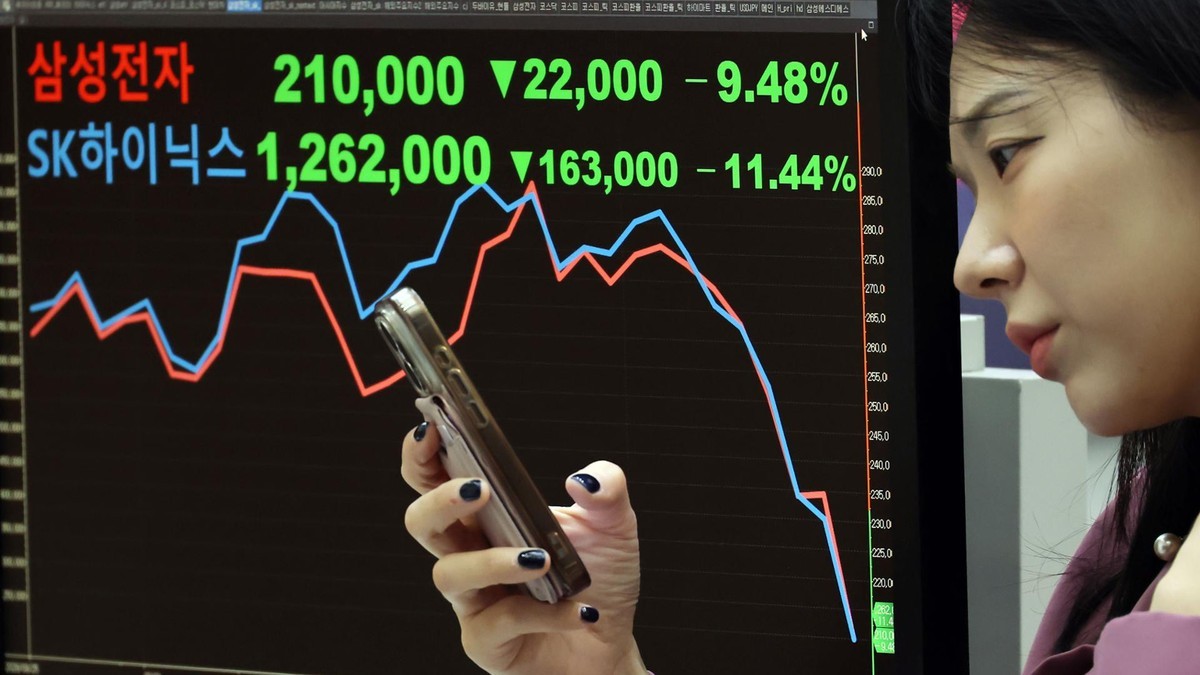
None of this was obvious on Monday. The Korea Times calculated that Samsung Electronics fell 18.2 percent between 1 September and 23 October, while SK hynix dropped 25.4 percent from 1,693,000 won to 1,263,000 won — and stood 57.9 percent below its 52-week high. On 26 October the KOSPI closed at 5,469.47, down 1.46 percent, its lowest level in seven months and its weakest close since 6 April, as foreign investors sold a net 700 billion won of Korean shares. The KOSDAQ fell 3.26 percent to 727.21 and Brent crude jumped to $116.72 a barrel, its highest since late April. Seoul Economic Daily noted that SK hynix shares were worth less than half their June peak of 2.919 million won, leaving a market capitalisation of 935 trillion won — below Micron's. That mismatch, record profits against a collapsing share price, is precisely what a 100 trillion won payout is designed to answer.
Wednesday: A Sidecar and a Six-Thousand Print
The reaction arrived in stages, and the intraday numbers moved too fast to treat any single reading as final. The stock was up 2 percent in premarket trading, 2.98 percent at 1,381,000 won by 9:17 a.m., and 6.04 percent at 1,422,000 won by 10:02 a.m. CNBC later put the gain at more than 8 percent. The Korea Exchange triggered a buy-sidecar at 9:54:24 a.m., pausing programme buying for five minutes — the mechanism fires when KOSPI200 futures hold a 5 percent gain for one minute. The index itself traded at 5,992.05, up 353.7 points or 6.28 percent, and touched 6,003.22, taking it back above 6,000 for the first time in ten sessions. At the time of writing the Korean market was still open, so no closing level is asserted here. Monday's close of 5,469.47 to Wednesday's high of 6,003.22 is a swing of nearly 9.8 percent in two sessions.
Supply Does Not Catch Up Until 2030
The company's own forecast is the boldest claim in the release: because leading-edge processes are technically hard and new fabs take years to build, "it expects the structure in which demand exceeds supply to persist through 2030." It says it has long-term agreements with 14 major customers, including leading global cloud providers, covering more than 50 percent of total production capacity for 2027 and 2028, typically on five-year terms with a mechanism that reflects market conditions inside an agreed price range. HBM4 is expected to pass HBM3E in both shipments and revenue in the fourth quarter, as the M15X line in Cheongju is pushed to maximum capacity by year end. Not every signal points the same way: TrendForce reported that Chosun Biz, citing industry sources, said HBM4 shipments may have fallen short of expectations for a second consecutive quarter amid delays in Nvidia's Rubin rollout and longer performance tuning.
Samsung Reports Thursday, and the Bar Is Now Absurd
Samsung Electronics reports on Thursday, 29 October, and its 8 October guidance already pointed at 195 trillion won of revenue and 107.4 trillion won of operating profit — a 782.5 percent year-on-year jump on Chosun Biz's figure, and enough to make it the first Korean company to clear 100 trillion won of quarterly operating profit. Chosun reported that the two chipmakers' combined quarterly operating profit should exceed 180 trillion won. Samsung's own August return plan, worth 90 trillion to 110 trillion won, disappointed investors because it kept the existing 50 percent-of-free-cash-flow policy, raised no payout ratio and announced no fresh buyback; Korean rules also cap financial institutions at a combined 10 percent stake in a non-financial company, and Samsung Life and Samsung Fire are already near that line. Hana Securities analyst Kim Rok-ho had argued for exactly what SK hynix then did: "We believe share buybacks and cancellations will play a greater role than dividends."
By Jessica Ali, Staff Writer
This article was produced with AI-assisted research and editorial support from Jessica Ali. Sources: SK hynix Newsroom, Yonhap News Agency, CNBC, Seoul Economic Daily, The Korea Times, MarketScreener, Khan.co.kr, Hankyung, AJP, TrendForce and Chosun Biz. Images: the cover is an AI-generated illustration produced by Global 1 News; inline photographs by Getty Images (via CNBC) and Yonhap (via The Korea Times).
What's Your Reaction?
 Like
0
 Dislike
0
 Love
0
 Funny
0
 Wow
0
 Sad
0
 Angry
0

Editor-in-Chief at Global1.News. Atlanta-based journalist who cuts through the BS and tells it like it is. Lead anchor, host, and the voice you hear when the spin stops and the truth starts.















Comments (0)