
Alberta teen's family sues government after nearly $200K out-of-country surgical bill
Alberta teen Vienna Pedatella’s family sues the province after a $199,074 US spinal surgery was denied funding. The case, supported by the Canadian Constitution Foundation, argues excessive wait times violated Charter rights. A judicial review is expected in 2027.

Alberta teen’s family sues government after nearly $200K out-of-country surgical bill
An Alberta family is taking the provincial government to court after being denied funding for a life-changing spinal surgery that ultimately cost nearly $200,000 and could only be performed in the United States. The case, which centres on a teenager’s deteriorating condition and a wait list that stretched beyond two years, raises fundamental questions about the limits of Canada’s publicly funded health care system and the constitutional rights of patients when that system fails them.
Tags: Alberta health care, out-of-country surgery, Charter of Rights, spinal fusion, scoliosis, wait times, Canadian Constitution Foundation, judicial review
The Story: A Curve That Wouldn’t Stop
Vienna Pedatella was 13 years old in 2021 when she was diagnosed with idiopathic scoliosis — a condition that left her spine curved like the letter S. For a teenager who loved being active, the diagnosis was only the beginning of a long and painful ordeal. Her family, concerned about surgical options, was told by medical professionals that bracing for 23 hours a day for nine months, along with physical therapy and strength training, were the better course of action.
Her mother, Janene Pedatella, recalls the frustration of watching her daughter struggle. “She would try to hide it with baggy shirts,” Janene said. “We felt really let down. I was very very gutted that day.”
Despite following the recommended regimen, Vienna’s condition progressed. She was eventually referred to BC Children’s Hospital in Vancouver to see a specialist — but the news there was not what the family had hoped. The surgeon told them Vienna had missed the window for a surgical procedure known as “tethering,” which would have corrected the issue while preserving her active lifestyle. Instead, she would need spinal fusion — a more invasive operation that connects vertebrae with metal rods, screws and bone grafts, and can cause lasting mobility and flexibility issues. In Vienna’s case, the fusion would have involved 14 levels of vertebrae, from the base of her neck to her lower back.
Adding to the frustration was the wait list: more than two years for the surgery in Canada.
The Family’s Experience: Pain, Deterioration, and a Desperate Search
As the months passed, Vienna’s condition worsened. An X-ray showed her spine curve had grown from 40 degrees to nearly 70 degrees. A May 2025 scan confirmed the curve had progressed to 67 degrees. For Janene, that was the breaking point. “It was like a trigger pulled… we can’t wait anymore,” she said.
Vienna, now a teenager, described the daily toll the condition took on her body. “I was in pain the majority of the day. I wasn’t getting enough sleep because I’d wake up in pain,” she said. “I couldn’t really stand or walk without being in pain.”
There were also deeper concerns. The curvature of her spine was so severe that it risked restricting her internal organs, and there was a real possibility the curve could continue to progress, leading to further complications.
Desperate for a solution, the family began researching alternatives. They found a doctor at St. Peter’s University Hospital in New Brunswick, New Jersey, who recommended a procedure called anterior scoliosis correction (ASC). Similar to tethering, ASC does not have the same age restrictions and could preserve mobility, allowing Vienna to return to full function. The family applied to Alberta’s Out-of-Country Health Services Regulation to fund the surgery in the United States.
In July 2025, the committee denied the request. Undeterred, the family proceeded with the surgery anyway. Vienna underwent ASC in the US in August 2025, and the hospital bill came to $199,074 US.
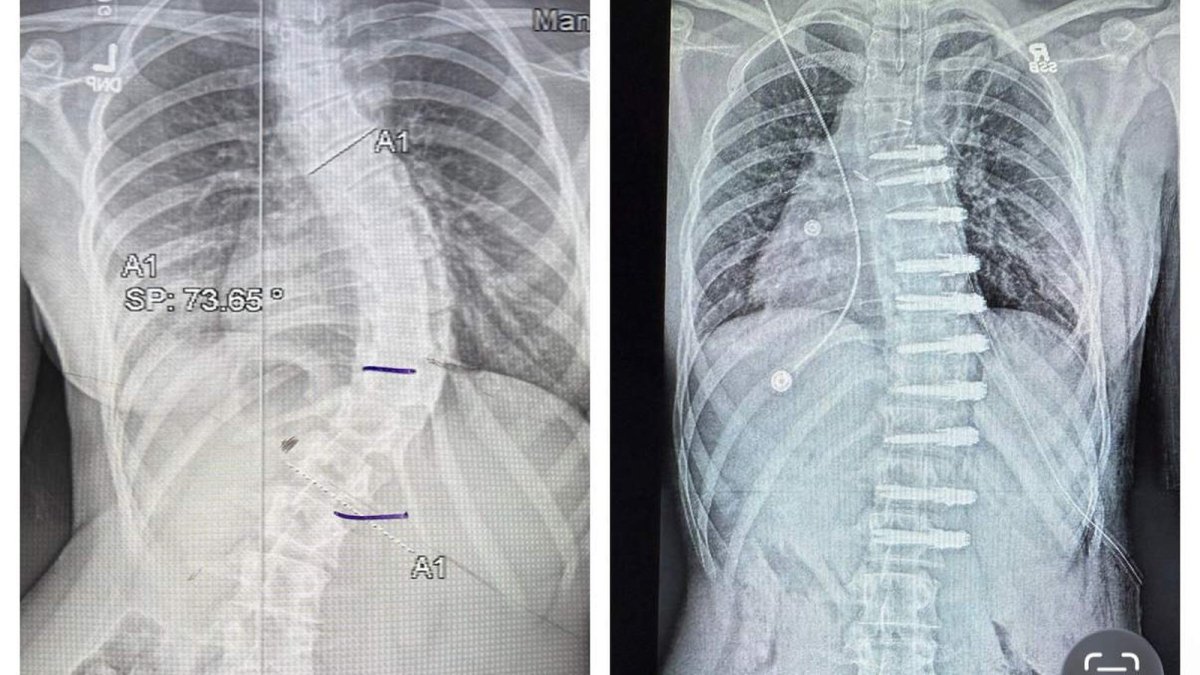
The results, by all accounts, were remarkable. Vienna quickly returned to full activity, including weightlifting and skiing, and recently graduated high school with honours. But the financial and emotional cost of that success has now become a legal battle.
The Constitutional Case: Section 7 and the Charter
After the surgery, the family appealed to an internal review committee. That appeal was rejected in February 2026, on the basis that Vienna could have kept waiting in Canada for a spinal fusion. The committee’s decision effectively dismissed the family’s argument that the wait was unreasonable and that the out-of-country procedure was a necessary alternative.
With the help of the Canadian Constitution Foundation (CCF), a national charity that describes itself as defending “the constitutionally protected rights and freedoms of Canadians,” the family has now filed a judicial review. They are seeking to overturn the committee’s decision and force the Alberta government to reimburse the cost of the surgery. The CCF is also seeking a ruling that the province violated Vienna’s constitutional rights because of the excessive wait.
Christine Van Geyn, interim executive director of the CCF, framed the case in broad constitutional terms. “We have a right in Canada under our constitution to life, liberty and security, and forcing patients to suffer in pain as their condition deteriorates because the government system can’t treat them, that engages your constitutional rights,” she said.
Van Geyn also stressed the potential wider impact of the case. “This, we hope, will serve as a precedent for other governments across Canada to honour their obligations, both their charter responsibilities, their constitutional responsibilities, but also their responsibilities that they have accepted under legislation that guarantees payment for out-of-service care when the government system fails.”
The Province’s Position: An Independent, Expert-Led Process
The Alberta government, through the Ministry of Primary and Preventative Health Services, declined to comment on the specific case, citing the fact that it is before the courts and involves personal health information. However, the ministry did provide a general defence of the existing process.
“Requests for out-of-country health care funding are decided by the Out-of-Country Health Services Committee, which is made up of physicians and medical experts, not government,” the ministry said in a statement. It also noted that treatments that are experimental, emerging, provided through a clinical trial or research study are not eligible for funding.
That point is central to the family’s argument. Court documents obtained by Global News show that Vienna’s doctor provided information to prove that ASC surgery is not “experimental.” Janene Pedatella was emphatic on this point. “We’re not talking about something that is experimental. We already do this procedure; we just don’t have anyone (in Canada) yet that has learned the technique to install multiple tethers and be able to treat any age of scoliosis,” she said.
The distinction matters. If the procedure is deemed experimental, the province’s refusal to fund it falls within its stated policy. If it is a recognised standard of care, the family’s argument that the government failed to meet its obligations gains considerable weight.
Broader Canadian Context: Wait Times and the “Safety Valve”
This case lands at the intersection of several long-standing issues in Canadian health care. Wait times for elective surgery have been a persistent problem across the provinces, and surgical backlogs were made significantly worse by the COVID-19 pandemic. For patients like Vienna, the gap between what is medically recommended and what the public system can deliver in a timely manner can be a matter of profound consequence.
Out-of-country health services programs exist in most provinces as a “safety valve” for care that is not available domestically or when waits become unreasonable. Alberta’s program is designed to fund such care, but the decision-making process is deliberately independent and expert-led, meant to ensure consistency and to guard against the erosion of the public system.
Janene Pedatella sees the program’s purpose clearly. “This is the safety valve program. It exists for when you’ve waited too long and it exists for when you have a recommended standard of care, surgical option,” she said. “What about the other Canadian kids who are on the wait list who are not getting access to the surgeries they need?”
The case also touches on the broader debate about private versus public health care in Canada. While the Canada Health Act governs federal funding and requires provinces to provide medically necessary care, the interpretation of what is “necessary” and how quickly it must be delivered is increasingly being challenged in the courts. The Charter’s Section 7 guarantee of life, liberty and security of the person has been invoked in previous health care cases, but its application to wait times and out-of-country funding remains a developing area of law.
Impact on Canadians: A Precedent in the Making
For Vienna, the fight is no longer just about her own health. She wants to become a nurse one day, and she has found a new sense of purpose in speaking out. “I think I went from hiding it a lot to wanting to tell my story and hopefully help other people,” she said.
Her mother echoed that sentiment, expressing hope that the case will force governments across the country to take their obligations more seriously. The CCF’s Van Geyn noted that the outcome could have implications far beyond Alberta, potentially influencing how other provinces handle similar requests for out-of-country care when domestic wait times are excessive.
The Alberta government, for its part, has said it is reviewing the out-of-country health services program to ensure it “continues to meet the needs of Albertans as patient needs, medical knowledge and treatment options evolve.” The review, the government said, “will help us determine what changes are needed to better support patients while maintaining a consistent, independent and expert-led approach to decision-making.”
What Happens Next: A 2027 Court Date and a Program Under Review
The family expects the judicial review to go before the courts in 2027. The case will likely hinge on two key questions: whether the wait for spinal fusion in Canada was unreasonable, and whether ASC surgery should be considered a standard treatment rather than an experimental one. If the court rules in the family’s favour, it could set a significant precedent for patients across the country who find themselves in similar situations.
For now, Vienna is living proof that the surgery worked. She is active, pain-free and looking toward a future in health care. But the $199,074 bill remains unpaid, and the principle at stake — whether a government can force a patient to suffer and deteriorate while waiting for a procedure that may not fully restore their quality of life — is far from settled.
As the case moves toward the courts, it serves as a stark reminder of the limits of Canada’s public health care system and the difficult choices that patients and families face when those limits are reached. The outcome of this judicial review will be watched closely by patients, health policy experts and governments across the country.
This article was produced with AI-assisted research and editorial support. Sources: Global News Canada.
By Alex Thompson, Staff Writer
What's Your Reaction?
 Like
0
Like
0
 Dislike
0
Dislike
0
 Love
0
Love
0
 Funny
0
Funny
0
 Wow
0
Wow
0
 Sad
0
Sad
0
 Angry
0
Angry
0
Canada Correspondent at Global1.News. Based in Toronto, covering Canadian politics, energy, trade, and US-Canada relations. Provides the Canadian perspective on North American and global affairs.












Comments (0)