
US 'Burden Sharing' Push Reshapes Indo-Pacific Security
Washington's push for Indo-Pacific allies to share the defence burden is lowering the political temperature even as China and Russia deepen ties, analysts say.
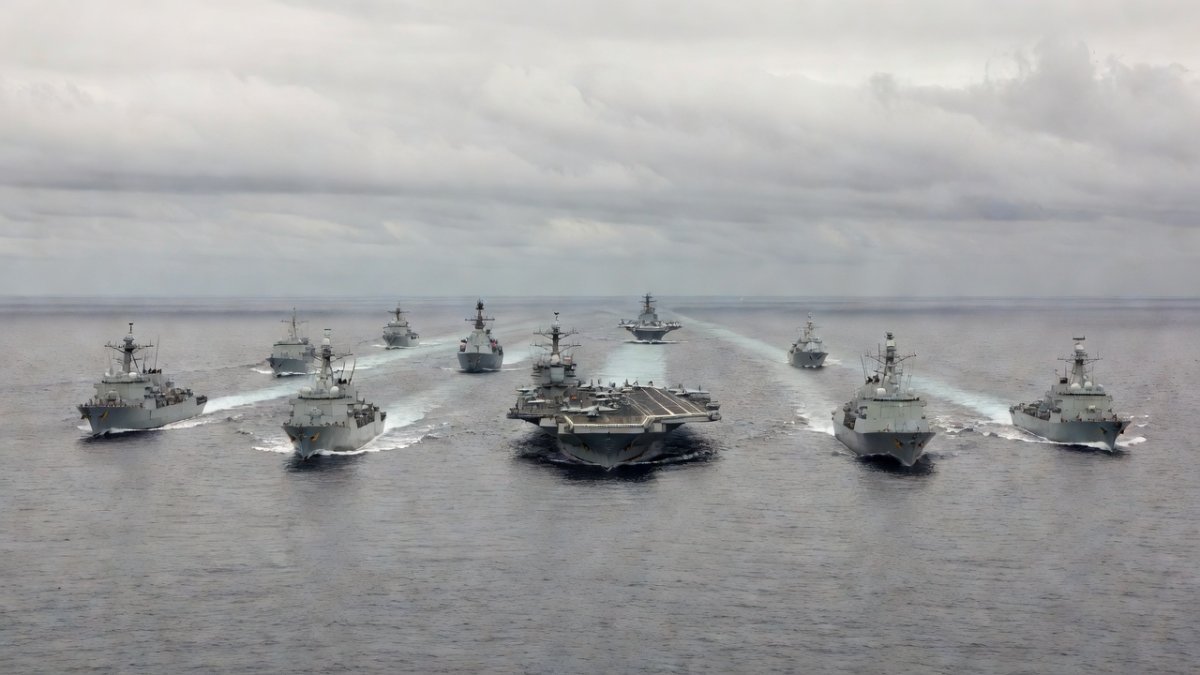
Burden-Sharing Push Reframes US Indo-Pacific Strategy
The United States is recalibrating its Indo-Pacific security posture around a single idea: allies should carry more of the load. Defence Undersecretary for Policy Elbridge Colby carried that message through the Philippines, Thailand, Indonesia and Cambodia this month, telling a Manila forum that Washington wants "partners, not protectorates" and urging Asian capitals to boost defence spending.
The tour marked a deliberate shift in tone as much as substance. In an online press briefing on Thursday, Colby said the United States was prioritising "burden sharing" rather than shaping its military for regime change, because Washington now realised its allies "can and are prepared to do more." He added that the Trump administration's approach was "all about quietly, relentlessly increasing deterrent strength and capability."
Tags: Indo-Pacific, burden sharing, Elbridge Colby, US-China rivalry, Pentagon, Japan defence, Quad, AUKUS, Southeast Asia, deterrence, China-Russia ties, RIMPAC, regional security, Xi Jinping
Partners, Not Protectorates: What Washington Is Asking
The request is not simply for larger cheques. According to Sun Chenghao, a fellow at Tsinghua University's Centre for International Security and Strategy, Colby's comments suggested the United States would keep its security guarantees in place while pressing allies to improve their ability to conduct air defence, anti-ship and reconnaissance operations, and to use base infrastructure to provide logistics support.
In practice, that means asking Japan, South Korea, the Philippines and other partners to field the capabilities that make a networked defence credible - radars, coastal strike systems, air-defence interceptors and the command structures to integrate them with US forces. Sun described the model as "more pragmatic," but warned that it "also heightens regional concerns about being drawn into major-power military conflict."
Why the Shift: Resource Constraints and a Shrinking Industrial Base
The pivot stems from both military necessity and fiscal pressure. The United States "cannot indefinitely shoulder Asia's security costs" while managing its war in the Middle East and other international commitments, Sun said. Xiang Haoyu, a special research fellow at the China Institute of International Studies, a think tank affiliated with Beijing's foreign ministry, added that Washington is operating from a shrinking defence industrial base even as China's military expands rapidly.
Xiang, writing in the Journal of Asia-Pacific Security and Maritime Affairs in May, described the result as an "alliance-centred" deterrence model that shifts from Cold War-style umbrella protection to a networked defence system shared with key alliances and partnerships such as the Quad and AUKUS. The goal, he wrote, is to "transform fragmented ally and partner resources into a composite, networked force of denial" - translating what are often political declarations into institutionalised joint operational planning and crisis-response mechanisms.
Japan at the Centre of the Networked Alliance
No ally embodies the burden-sharing model more than Japan. Tokyo is in the middle of a five-year defence build-up that will roughly double its spending toward 2 per cent of GDP by fiscal 2027, the largest expansion since the Second World War, and it has taken on new roles - from long-range counterstrike missiles to a joint counterstrike framework with Washington, formalised as the United States reorganised its Japan-based forces into a joint task force headquarters in Tokyo.
Japan's centrality cuts both ways. Its defence white paper, approved by Tokyo's Cabinet on Aug 4, framed China as "an unprecedented and the greatest strategic challenge," language Beijing has repeatedly condemned. Yet Tokyo is also the clearest proof of what Washington's networked model is designed to achieve: an ally that hosts tens of thousands of US troops, funds a large share of their basing costs, and is steadily acquiring the strike and sensor capabilities that US planners want partners to field.
Southeast Asia's Dilemma: Cooperation Without Choosing Sides
The harder audience is Southeast Asia. Sun said most nations in the region seek enhanced security cooperation with Washington but "strongly resist being forced to pick sides between Washington and Beijing." A loud framing of regional cooperation as "containing China," he argued, "would actually undercut these nations' willingness to participate."
Colby appeared to calibrate for exactly that risk. A long-time China hawk, he avoided mentioning China in both his speech and his briefing; when asked about the omission, he said the White House was not interested in "peacocking" or "unnecessarily pressurising the rhetorical environment." Washington has also signalled reassurance through scale: this year's Balikatan exercise with the Philippines was the largest on record, and the biennial Rim of the Pacific exercise that wrapped up last month brought together 30,000 personnel from an unprecedented 30 nations.
The reassurance is being tested against a contested maritime backdrop. Beijing and Manila traded blame again this week after renewed clashes at Scarborough Shoal, where China has tightened its control through stepped-up law enforcement patrols and scientific expeditions, and where Beijing approved the creation of a national nature reserve last September. US Secretary of State Marco Rubio, meeting Chinese Foreign Minister Wang Yi on the margins of Asean gatherings in Manila, described the disputes between Beijing and Manila as "very negative and benefiting no one" - even as Washington keeps expanding the training and exercise calendar.
China's Reading: Toned-Down Rhetoric, Heightened Vigilance
Beijing's analysts are watching the shift with a mixture of relief and wariness. Sun suggested Beijing might interpret the toned-down rhetoric as a sign that the US-China military competition is being "deliberately toned down politically, which helps to mitigate the security dilemma and reduce the risk of crisis escalation."
But Xiang cautioned that the substance of US strategy is pushing the region in the opposite direction. "As the US-China strategic rivalry deepens, the targeted military deterrence posture deployed by the US and its allies along the Asia-Pacific frontline has not only heightened China's vigilance and defensive precautions, but also driven an upgrade in China-Russia strategic coordination and strengthened alliance-style cooperation between Russia and North Korea," he wrote. "In effect, this is pushing the regional security architecture in the Asia-Pacific towards major-power competition and bloc confrontation."
The axis is real: China and Russia conduct regular joint exercises and patrols, Moscow and Pyongyang have deepened defence ties with North Korea supplying troops and weapons for the war in Ukraine, and President Xi Jinping made his first visit to North Korea since 2019 in June. Even so, Xiang stressed that the situation cannot be compared with the Cold War, because Beijing has no intention of engaging in bloc confrontation with Washington and the three countries have not built a formal military alliance.
What to Watch For
The coming weeks will test whether Washington can keep the political temperature low while the hardware keeps flowing. The expected Xi-Trump summit, now set against weeks of White House turbulence, will be the clearest gauge of whether the two sides can manage the security dilemma even as both build up their militaries. Japan's continued push on counterstrike capability - including its upgraded Type 12 missile, tested for the first time this month - will be closely watched in Beijing, as will the scale of next year's Balikatan and RIMPAC iterations.
For Japan and the wider Asia-Pacific, the burden-sharing era is a double-edged proposition: it makes the US commitment to regional defence more sustainable, but it also spreads the risk of great-power conflict to the very capitals Washington is asking to share the load. The question is not whether the model holds, but whether the quiet diplomacy that Colby is practising can outlast the next crisis - or the next provocation in the South China Sea or across the Taiwan Strait.
This article was produced with AI-assisted research and editorial support. Sources: South China Morning Post (Fan Chen, Aug 15, 2026), Defense News (Aug 10, 2026), The Diplomat (Aug 11, 2026), RIMPAC 2026 official exercise materials.
By Kenji Tanaka, Staff Writer
What's Your Reaction?
 Like
0
Like
0
 Dislike
0
Dislike
0
 Love
0
Love
0
 Funny
0
Funny
0
 Wow
0
Wow
0
 Sad
0
Sad
0
 Angry
0
Angry
0

Japan Correspondent at Global1.News. Tokyo-based voice covering Japanese politics, technology, economy, and culture. Tracks the intersection of tradition and innovation in one of the world's most dynamic societies.














Comments (0)