
South Korea Recalls Ambassador, Demands Public Apology From Ukraine
South Korea’s decision on October 8 to recall Ambassador Park Ki‑chang from Kyiv marks the first ambassadorial recall by Seoul since 2008, when it withdrew its envoy from Japan over the Dokdo islets dispute.
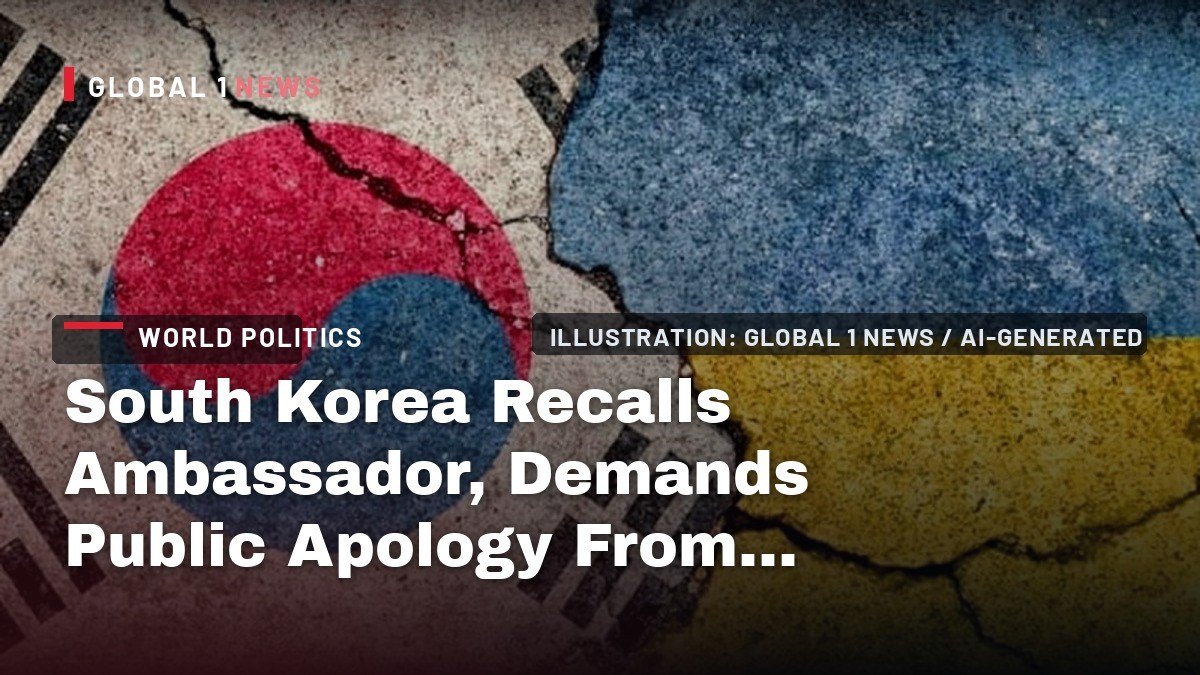
South Korea’s decision on October 8 to recall Ambassador Park Ki‑chang from Kyiv marks the first ambassadorial recall by Seoul since 2008, when it withdrew its envoy from Japan over the Dokdo islets dispute. The recall follows a diplomatic row sparked by Ukraine’s public disclosure of a confidential transfer of two North Korean soldiers captured in Russia. The episode has exposed deep mistrust between the two allies and raised questions about the broader strategic calculus of both nations in the context of the Russia‑Ukraine war and the North Korean involvement on the Eastern Front.
Background to the prisoner transfer
The two North Korean soldiers were captured in January 2025 in the Kursk region of Russia, where Pyongyang had deployed troops to support Moscow’s invasion of Ukraine. After their capture, the soldiers expressed a desire to settle in South Korea and were transferred to Seoul in mid‑September 2026. According to South Korean officials, the transfer was meant to remain confidential, a condition allegedly agreed upon by both governments.
Ukrainian President Volodymyr Zelenskyy broke the confidentiality on October 1 during a speech to the United Nations General Assembly, announcing the arrival of the two soldiers. The revelation contradicted Seoul’s expectation that the matter would stay out of the public eye, prompting an immediate diplomatic backlash.
Seoul’s reaction and demands
President Lee Jae‑myung responded on September 24 via a post on the social platform X, describing the disclosure as “deeply regrettable” and warning of the problems that could arise from the public exposure. The South Korean presidential office subsequently issued a statement on September 27 expressing strong regret over both the disclosure and Ukraine’s denial of any confidentiality agreement, demanding an official explanation and a public apology.
Seong Ghi‑hong, senior presidential secretary for public relations, asserted that Ukraine had itself sought secrecy and that the denial of the agreement constituted a breach of trust. He also suggested that Kyiv had missed an opportunity to exchange the North Korean soldiers for Ukrainian prisoners held by Russia, a point that underscored the strategic stakes of the incident.
Ukrainian denial and diplomatic maneuvering
Ukrainian officials initially denied the existence of any confidentiality arrangement. Dmytro Lytvyn, a communications adviser to Zelenskyy, rejected Seoul’s account on September 25, while Foreign Minister Andrii Sybiha described the matter on October 1 as a “diplomatic misunderstanding,” stopping short of offering the public apology demanded by Seoul.
In the days that followed, Ukraine’s diplomatic tone shifted slightly. On October 6, Foreign Minister Cho Hyun reported that a message from Kyiv contained words of apology, though he characterized it as falling short of Seoul’s expectations. Ukraine’s foreign ministry spokesperson Heorhii Tykhyi later framed the Ukrainian message as an expression of regret over the public criticism, attributing the dispute to differing interpretations of the confidentiality arrangement rather than an outright denial.
Escalation of rhetoric and broader tensions
President Lee escalated the rhetoric on October 2, accusing Ukraine of making the South Korean head of state a “liar” by denying the agreement. He also linked Kyiv’s statements to a broader narrative about rising inter‑Korean tensions, referencing remarks by Kyrylo Budanov, head of the Ukrainian presidential office, who warned of increasing tension along the Korean Peninsula on September 27. Lee suggested that Budanov’s comments implied a desire for conflict, a charge that resonated with domestic concerns after suspected North Korean mines exploded in the Demilitarized Zone, injuring three South Korean soldiers.
The South Korean foreign ministry, represented by First Vice Foreign Minister Park Yoon‑joo, summoned Ukraine’s acting ambassador in Seoul, Andrii Vieshkin, on September 28, reiterating the demand for an apology and a clear acknowledgment of the confidentiality agreement. The summons underscored Seoul’s intent to press the issue through formal diplomatic channels.
Parallel disputes: sanctions and fuel shipments
Complicating the diplomatic fallout, a separate dispute emerged on October 6 when Vladyslav Vlasiuk, Ukraine’s presidential commissioner for sanctions policy, claimed that fuel shipments from South Korean ports had helped Russia offset refinery losses caused by Ukrainian strikes. Seoul rejected the allegation on October 7, emphasizing that petroleum products are not listed among controlled exports.
The fuel claim, while distinct from the prisoner‑transfer controversy, added another layer of tension. South Korean officials noted that the allegation muddied the primary dispute and suggested that it should be addressed through the appropriate sanctions‑compliance channels rather than conflated with the confidentiality issue.
Strategic implications for South Korea’s security posture
Seoul’s insistence on secrecy stemmed partly from concerns for the families of the two North Korean soldiers, who remain in the North and could face reprisals for their relatives’ defection. The National Intelligence Service warned that the public disclosure might be aimed at rallying domestic support for South Korean arms supplies to Ukraine, a policy area where Seoul has been cautious. While South Korea has provided financial and humanitarian aid to Kyiv, it has refrained from supplying lethal weapons, even as North Korea has deployed tens of thousands of soldiers to support Russia.
The episode highlights the delicate balance Seoul must maintain between supporting Ukraine and managing its own security environment, particularly given the volatile situation on the Korean Peninsula. The public nature of the dispute has strained trust, and South Korean officials have indicated that the damage may be irreparable through private diplomatic channels alone.
Future prospects and conditions for reconciliation
In its announcement of the ambassadorial recall, South Korea’s foreign ministry expressed a willingness to resolve pending issues through continued consultations, but it set clear preconditions for any potential restoration of diplomatic normalcy. Seoul demands three concrete steps from Kyiv: an acknowledgment that a confidentiality agreement existed, a public apology, and a commitment to mechanisms that prevent a recurrence of such disclosures.
Park Ki‑chang’s return to Kyiv is contingent on Ukraine meeting all three demands. Until then, the recall stands as a tangible symbol of the rift, and the broader relationship between the two nations remains under strain. The episode serves as a cautionary tale about the fragility of diplomatic understandings in a multipolar conflict environment, where missteps can quickly escalate into public confrontations that reverberate across regional security calculations.
This article was produced with AI-assisted research and editorial support. Reporting is based on the source material cited below. Sources: The Diplomat; thediplomat.com; Global1.News (15 October 2026).
By Kenji Tanaka, Staff Writer
What's Your Reaction?
 Like
0
Like
0
 Dislike
0
Dislike
0
 Love
0
Love
0
 Funny
0
Funny
0
 Wow
0
Wow
0
 Sad
0
Sad
0
 Angry
0
Angry
0

Japan Correspondent at Global1.News. Tokyo-based voice covering Japanese politics, technology, economy, and culture. Tracks the intersection of tradition and innovation in one of the world's most dynamic societies.












Comments (0)