
Vietnam to Build Memorial to North Korean War Dead Outside Hanoi
Vietnam's government has announced plans to construct a memorial honoring North Korean soldiers killed during the Vietnam War, reviving attention to a long-obscured chapter of military cooperation between Hanoi and Pyongyang. State media reported that the project emerged from a Defense Ministry meeting chaired by Deputy Defense Minister Nguyen Truong Thang, with North Korean Ambassador Ri Sung Guk in attendance, underscoring the enduring symbolic weight of wartime assistance that once remained h
A Forgotten Chapter of the Vietnam War
The decision to dispatch North Korean forces to Vietnam originated in 1965 and received formal endorsement at a Workers' Party meeting the following year. Approximately 100 North Korean pilots arrived in the mid-1960s to train Vietnamese counterparts before engaging directly in combat missions. These airmen flew Soviet-made MiG-17 jets against U.S. aircraft, with 14 pilots, including two officers, killed between September 1965 and early 1968. Their deployment formed part of a larger contingent of roughly 1,000 North Koreans sent secretly between 1966 and 1971, encompassing mechanics, engineers, and psychological operations specialists.
Kim Il Sung's decision to commit pilots reflected North Korea's broader strategy of asserting an independent anti-imperialist posture amid the Sino-Soviet split. By supporting Vietnam's struggle, Pyongyang could signal solidarity with the socialist camp without subordinating itself to either Beijing or Moscow, thereby preserving room for maneuver in a divided communist world. This approach allowed the regime to burnish its revolutionary credentials while avoiding direct entanglement in the ideological disputes that fractured the alliance system.
For North Korea's modest air force, participation in MiG-17 operations offered rare combat experience that could strengthen operational readiness and institutional knowledge. The secrecy surrounding the deployment served to shield the mission from potential escalation with the United States and to maintain plausible deniability within the wider Cold War theater. Such concealment also protected the domestic narrative of self-reliance by limiting public exposure of foreign entanglements.
The Cemetery at Bac Ninh
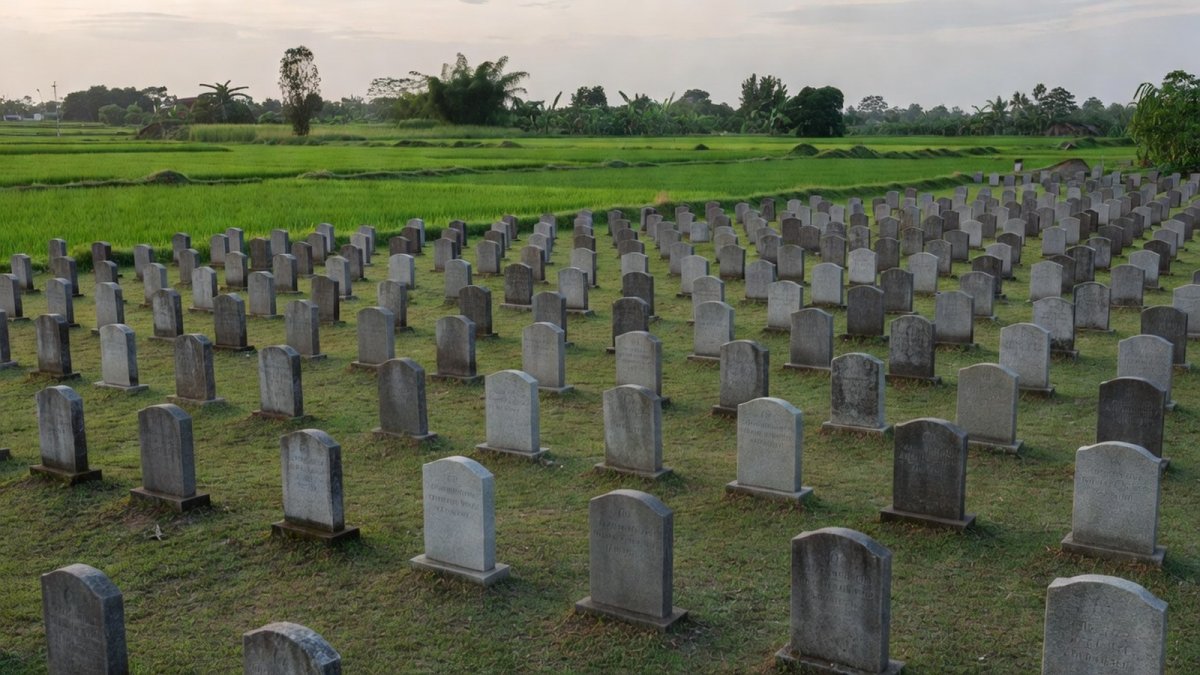
The memorial will occupy an existing cemetery in Bac Ninh province north of Hanoi that already holds headstones for the 14 fallen pilots. These markers face northeast toward Korea, preserving the original orientation chosen at the time of burial. A stone marker at the site reads, "Here used to lie 14 North Korean comrades." Although the pilots' remains were repatriated to North Korea in 2002, the headstones remain in place. The Defense Ministry intends to refurbish the entire cemetery as part of the current initiative.
The orientation of the headstones toward the northeast embodies a lasting symbolic link between the fallen and their homeland, transforming the site into a focal point of transnational remembrance. In North Korean state culture, the commemoration of martyrs reinforces collective identity and legitimizes sacrifice in service of revolutionary causes, turning physical graves into enduring political symbols even after remains have been repatriated.
Across Northeast Asia, war cemeteries frequently operate as diplomatic instruments that states use to manage historical memory and bilateral relations. Comparable practices can be observed in how South Korea and the United States maintain Korean War graves abroad, where upkeep of burial grounds sustains narratives of alliance and shared struggle. Vietnam's refurbishment of the Bac Ninh site thus participates in this regional pattern of using memorial spaces to recalibrate past alliances within contemporary diplomacy.
Decades of Silence, Gradual Acknowledgment
For decades after the war, North Korea's military role in Vietnam stayed shrouded in secrecy on both sides. A Vietnamese official first publicly confirmed active North Korean participation only in 2000. North Korean state media followed with its own acknowledgment in 2001, stating that the country had supplied weapons, ammunition, and two million sets of uniforms. Before the pilots departed, President Kim Il Sung instructed them to fight "thinking of Vietnam's sky as your own sky, Hanoi as Pyongyang and Ho Chi Minh as your own leader." In July 2001, Kim Yong Nam, then North Korea's second-most-senior leader, visited the Bac Ninh cemetery to pay respects.
The timing of these public acknowledgments in 2000 and 2001 coincided with North Korea's brief opening to engagement diplomacy following the inter-Korean summit, when Pyongyang sought to cultivate ties across Southeast Asia as a means of offsetting isolation after the Cold War. For Hanoi, the decision to confirm the earlier military cooperation reflected a calculated reassessment of historical alliances at a moment when Vietnam was consolidating its regional position through diversified partnerships rather than ideological exclusivity. Pyongyang's subsequent confirmation similarly served to project continuity in its revolutionary credentials while testing the possibilities of limited diplomatic outreach. Together, these moves illustrate how both governments adjusted their post-Cold War strategies, balancing residual ideological affinities against pragmatic needs for broader international space and economic stabilization.
Two Koreas in One War
North Korea's contribution stood in sharp contrast to South Korea's extensive involvement on the opposing side. Roughly 320,000 South Korean troops fought alongside U.S. forces to defend the Republic of Vietnam, suffering more than 5,000 fatalities. Although North Korean personnel never encountered their southern counterparts directly, psychological warfare specialists distributed leaflets aimed at South Korean soldiers. One such leaflet urged, "South Korean soldiers in Vietnam! Seek hundred, thousand vengeances against the American imperialist aggressors!"
The participation of both Koreas on opposing sides of the Vietnam conflict underscores the globalized character of the Cold War, in which local struggles became arenas for divided nations to project influence and test alignments. This mirrored dynamic highlights how the Korean peninsula's own partition shaped external engagements, extending the logic of ideological confrontation far beyond East Asia.
South Korea's deployment to Vietnam facilitated economic and industrial gains that later supported its post-authoritarian development and eventual diplomatic normalization with Hanoi. The planned memorial in Bac Ninh introduces new complexities for Seoul's memory politics, as it must navigate recognition of North Korean wartime roles while sustaining its own narrative of alliance with the United States and pragmatic ties with Vietnam.
Hanoi's Delicate Balancing Act
Relations between Hanoi and Pyongyang cooled after Vietnam's 1978 invasion of Cambodia, a country that had also received North Korean support. Ties deteriorated further when Vietnam established diplomatic relations with South Korea in 1992. Today Vietnam maintains formal ties with both Koreas, navigating a complex regional environment shaped by those earlier wartime alignments and subsequent geopolitical shifts.
Vietnam's bamboo diplomacy, with its emphasis on flexibility and resilience in multiple directions, provides the doctrinal framework for the memorial initiative as an expression of calibrated historical recognition. By honoring North Korea's wartime contributions, Hanoi sustains symbolic continuity with a former socialist partner without constraining its deepening economic and strategic engagement with South Korea. This approach allows Vietnamese leadership to project autonomy from any single alignment while navigating the competitive dynamics of Northeast Asia. The gesture thus exemplifies the multi-vector hedging that defines contemporary Vietnamese foreign policy, preserving room for maneuver amid shifting regional power balances and ensuring that historical memory functions as a diplomatic asset rather than a constraint on pragmatic diversification.
What the Memorial Signifies
The planned memorial reflects Vietnam's selective approach to historical memory, elevating a specific episode of North Korean assistance while broader bilateral relations have fluctuated. By refurbishing the Bac Ninh site under Deputy Defense Minister Nguyen Truong Thang's oversight, Hanoi signals continuity in its recognition of past sacrifices even as it sustains pragmatic engagement with Seoul. For North Korea, the gesture offers a rare public affirmation of its historical role, potentially useful in contemporary diplomatic signaling. In the wider Korean context, the project underscores how wartime alliances continue to shape inter-Korean narratives and Vietnam's position within Northeast Asian security dynamics decades after the conflict ended.
Vietnam gains a low-cost diplomatic instrument that signals autonomy from any single patron while extending a modest gesture toward Pyongyang. This move reinforces Hanoi's capacity to manage multiple relationships in a multipolar environment without incurring significant political or economic obligations.
North Korea receives symbolic validation of its anti-imperialist legacy at a moment of sanctions and isolation, allowing the regime to invoke historical contributions in its broader diplomatic messaging. Within Northeast Asian competition, the project subtly influences inter-Korean narratives and complicates the United States–South Korea alliance by highlighting alternative historical alignments that persist in regional memory.
By Prof. David Park, Staff WriterThis article was produced with AI-assisted research and editorial support. Reporting is based on sources cited in the article.
What's Your Reaction?
 Like
0
Like
0
 Dislike
0
Dislike
0
 Love
0
Love
0
 Funny
0
Funny
0
 Wow
0
Wow
0
 Sad
0
Sad
0
 Angry
0
Angry
0

East Asia/Technology Correspondent at Global1.News. Seoul-based voice covering Korean politics, technology, business, and culture. Analyzes how technology and geopolitics intersect across East Asia.











Comments (0)