
SpaceX returned its Starship rocket on Saturday—but there's a catch
SpaceX pulled off a milestone that could reshape the economics of spaceflight, snagging the Starship upper stage with its launch tower on Saturday evening at Starbase, Texas.
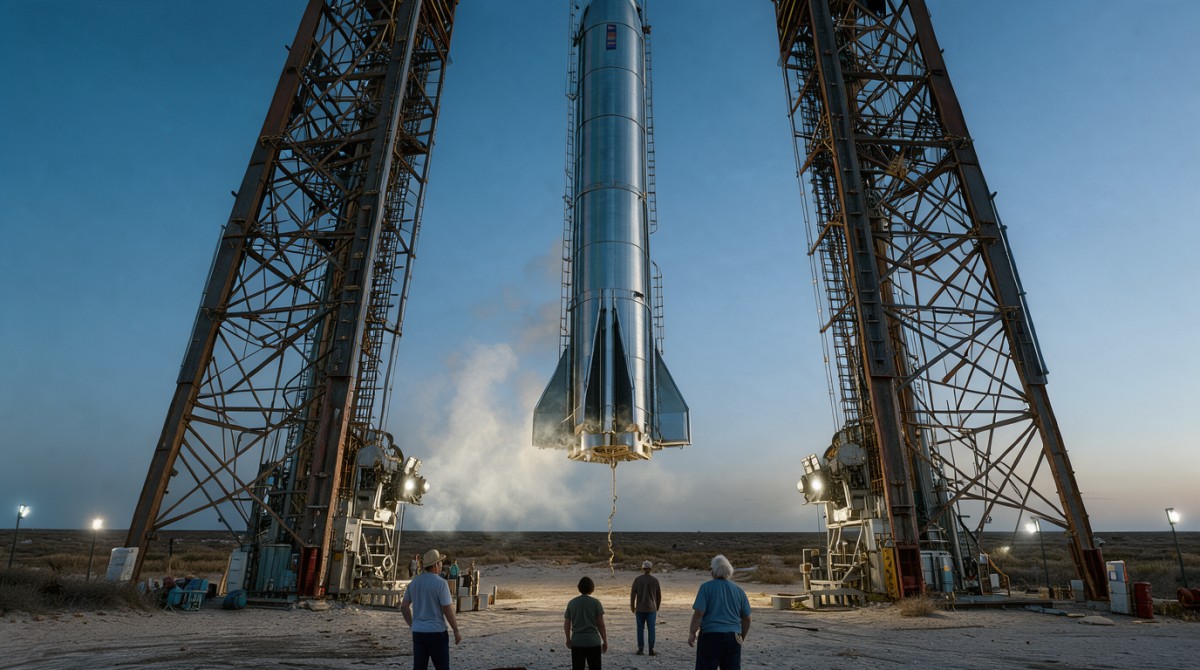
SpaceX pulled off a milestone that could reshape the economics of spaceflight, snagging the Starship upper stage with its launch tower on Saturday evening at Starbase, Texas. The scene was almost cinematic: the black‑and‑silver vehicle emerged from the cloud deck, flew horizontally, then three Raptor engines fired to pitch it upright before it was gently guided into the waiting arms of the launch tower. Within a minute of appearing, the rocket was locked in place by two one‑foot‑long nubs that served as the only points of contact. The capture was clean, precise, and, according to on‑site observers, “snagged…as snug as you like.” This was not a routine touchdown; it was the first time the full Starship stack—both booster and upper stage—has been recovered intact to the launch complex under its own power.
How the capture unfolded
The descent began with the Starship upper stage falling out of orbit and re‑entering the atmosphere. Instead of a traditional vertical plunge, the vehicle glided horizontally until the final seconds of flight. At that moment, three of its Raptor engines ignited, giving the craft a brief thrust that rotated it into a vertical orientation. The maneuver was deliberate, designed to line up the rocket with the tower’s capture arms.
Two arms extended outward from the launch tower, each bearing a small nub roughly a foot long. These nubs were the only purchase points the rocket would have on the arms, meaning the margin for error was incredibly narrow. As the vehicle eased toward the tower, the arms made contact, and within less than a minute the Starship was secured. The entire sequence was captured on video and described by witnesses as “slowly, gently, haltingly,” underscoring the delicate nature of the operation.
Why this matters for reusable launch systems
Reusable rockets have been a goal of the aerospace industry for decades, but the scale of Starship pushes the concept into a new realm. The vehicle is massive, carrying a huge amount of kinetic energy on return from orbit. Capturing it with what the source likened to “outsized chopsticks” required a level of precision engineering that surpasses earlier attempts at reusability.
SpaceX’s achievement builds on prior milestones, such as landing boosters on barges and returning crewed capsules with Crew Dragon. However, those earlier systems involved smaller stages and less demanding thermal loads. Starship’s heat shield—described as the “most difficult aspect of rapid reuse”—must survive re‑entry from orbital velocities before the vehicle can be safely recovered. The successful capture demonstrates that the hardware can be returned intact, opening the door to rapid refurbishment cycles that could dramatically lower launch costs.
Comparisons with the Space Shuttle
The article draws a direct line between Starship and the NASA Space Shuttle, noting both the similarities and the stark differences. The Shuttle, introduced in the 1970s, was a partially reusable system: solid rocket boosters were recovered from the ocean, while the external fuel tank was discarded after each flight. The orbiters themselves glided back to a runway without firing engines, relying on aerodynamic lift and a delicate heat shield that required extensive refurbishment after each mission.
Cost projections for the Shuttle were overly optimistic. Early estimates suggested a payload cost of $25 per pound, but reality saw that figure balloon to around $25,000 per pound. Moreover, the Shuttle fleet never exceeded a crew capacity of seven astronauts, far short of the “dozens of humans” NASA once envisioned. By contrast, SpaceX’s Starship aims for a fully reusable launch system capable of rapid turnaround, with a long‑term goal of flying hundreds to thousands of missions per year.
Production capacity and the path to rapid launch cadence
SpaceX’s manufacturing capabilities are a critical factor in achieving high launch frequencies. The company currently operates five Starships in an advanced state of development at Starbase, with components for a dozen more on hand. The South Texas Starfactory can produce a Starship upper stage every three weeks, though the facility was originally sized for a production rate of one ship every three days. This discrepancy highlights the rapid scaling ambition of the company.
Elon Musk, the founder of SpaceX, once discussed these aggressive build targets in an interview five years ago, acknowledging the audacity of the goal. While the current output falls short of the three‑day cadence, the infrastructure is in place to accelerate production as processes mature. The ability to manufacture and refurbish ships quickly is essential if the company hopes to achieve the “135 times a year” launch cadence it aspires to, a stark contrast to the Space Shuttle’s 135 flights over three decades.
Technical challenges that remain
Even with the successful capture, significant hurdles remain before Starship can become a routine, low‑cost launch vehicle. The heat shield, which protects the vehicle during re‑entry, is singled out as the most demanding component to perfect. The article notes that perfecting this element will be a gradual process, implying that early flights may still require extensive inspection and refurbishment.
Additionally, the narrow margin of error in the capture process underscores the need for highly reliable guidance, navigation, and control systems. The “two nubs” that secured the rocket were the only contact points, meaning any misalignment could have resulted in a miss or a damaging impact. Scaling this operation to a high launch cadence will demand robust automation and redundancy to maintain safety and reliability.
Implications for the future of space access
If SpaceX can refine the capture and refurbishment cycle, the economics of spaceflight could shift dramatically. The company’s vision is to “fundamentally change the relationship between humanity and the heavens,” beginning with the recovery of the entire rocket. By reducing the cost per launch, a broader range of customers—from satellite operators to scientific missions—could access space more frequently and affordably.
The article suggests that what was once “breathtaking” and “almost unreal” could become routine. As the technology matures, the public may come to expect regular Starship launches and landings, much like commercial air travel today. This shift would not only lower costs but also enable new mission architectures, such as rapid deployment of constellations, on‑demand cargo delivery to orbital platforms, and perhaps even point‑to‑point suborbital travel.
Looking ahead: from proof of concept to routine operations
Saturday’s successful capture is framed as a proof of concept rather than a finished product. The article emphasizes that “the landings will come with increasing frequency; and so will the launches.” This suggests a roadmap where each successful recovery informs iterative improvements in heat shield materials, guidance algorithms, and ground handling procedures.
In the long term, the goal is for Starship’s return and reuse to become as commonplace as a commercial jet’s turnaround at an airport. Achieving that vision will require not only technical mastery but also operational discipline to ensure safety and reliability at scale. As SpaceX continues to refine the process, the aerospace community—and the broader public—will be watching closely, because the transition from experimental to routine could herald a new era of accessible, sustainable spaceflight.
This article was produced with AI-assisted research and editorial support. Reporting is based on the source material cited below. Sources: Ars Technica; arstechnica.com; Global1.News (17 November 2026).
By Jessica Ali, Staff Writer
What's Your Reaction?
 Like
0
 Dislike
0
 Love
0
 Funny
0
 Wow
0
 Sad
0
 Angry
0

Editor-in-Chief at Global1.News. Atlanta-based journalist who cuts through the BS and tells it like it is. Lead anchor, host, and the voice you hear when the spin stops and the truth starts.















Comments (0)