
Egypt starts production at new Mediterranean gas field
Egypt’s latest offshore gas development, the Mina West field, entered production on Sunday, marking a notable step in the country’s effort to expand domestic energy supplies.
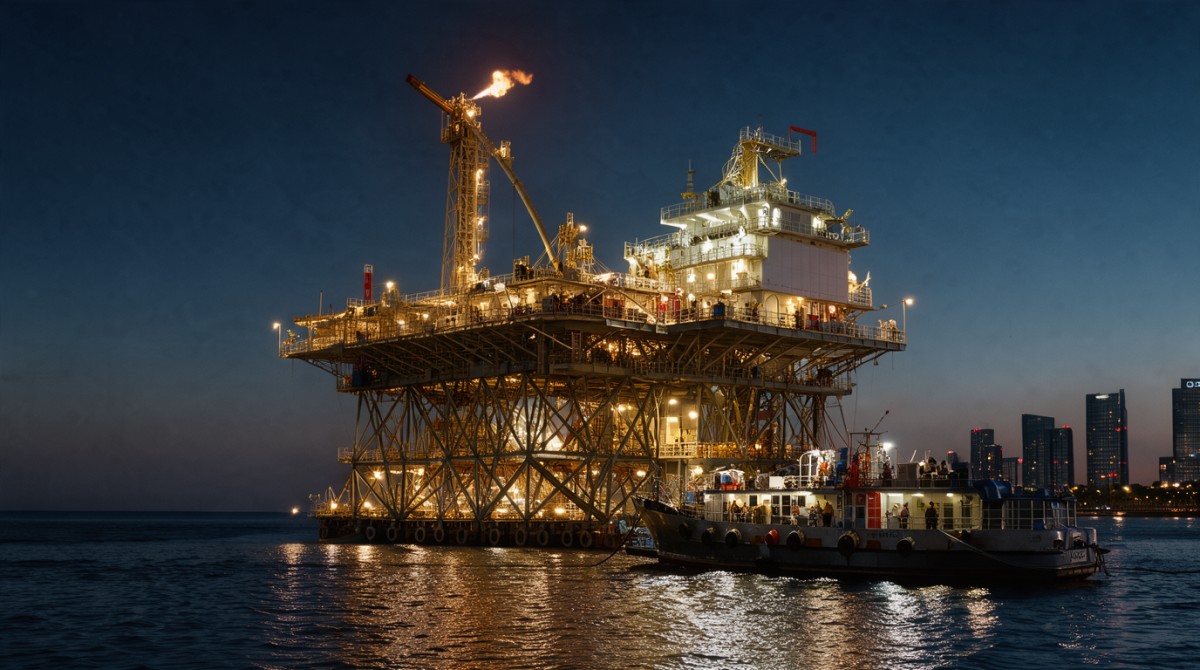
Egypt’s latest offshore gas development, the Mina West field, entered production on Sunday, marking a notable step in the country’s effort to expand domestic energy supplies. The field, located in the North East El Amriya concession in the Mediterranean Sea, is expected to deliver up to 160 million standard cubic feet of natural gas per day, according to the Anadolu Agency. The announcement, made jointly by Shell Egypt and the Kuwait Foreign Petroleum Exploration Company (KUFPEC), underscores a collaborative model that brings together multinational expertise and regional investment to address Egypt’s growing energy demand.
From discovery to production: a rapid timeline
The Mina West project moved from discovery to operational status in just three years, a pace that the partners highlighted as evidence of effective coordination. The field was discovered three years prior to the start of production, and the development plan received formal approval in June 2025. This swift progression was facilitated by the use of existing offshore infrastructure, a strategy that Shell emphasized as a key factor in accelerating the timeline.
Shell Egypt’s vice president and country chair, Dalia Elgabry, credited early and sustained cooperation with Egypt’s Petroleum Ministry, the Egyptian Natural Gas Holding Company, and KUFPEC for the rapid advancement. By aligning objectives from the outset, the partners were able to streamline regulatory processes and technical planning, allowing the field to come online without the delays that often accompany new offshore projects.
Ownership and partnership structure
The ownership of Mina West reflects a balanced partnership between a global energy major and a regional petroleum firm. Shell holds a 60 percent stake in the field, while KUFPEC’s Egyptian subsidiary owns the remaining 40 percent. This split ensures that both parties share in the operational risks and benefits, while also aligning their interests with Egypt’s broader energy strategy.
The collaboration illustrates how foreign investment can be paired with regional expertise to develop resources that might otherwise remain untapped. By involving KUFPEC, the project benefits from the company’s familiarity with local market dynamics and regulatory frameworks, complementing Shell’s technical capabilities and global experience.
Infrastructure linking offshore production to the domestic grid
A critical component of the Mina West development is a new seven‑kilometre (approximately 4.34‑mile) pipeline that connects the offshore field to the existing West Delta Deep Marine infrastructure. This link enables the extracted gas to be transported to the Burullus processing facility, where it undergoes treatment before entering Egypt’s domestic gas grid.
The use of pre‑existing offshore facilities not only shortened the development schedule but also reduced the capital outlay required for new construction. By integrating Mina West into the established West Delta network, the project leverages proven technology and operational expertise, minimizing the potential for technical setbacks.
Egypt’s broader gas production targets
The Mina West field is part of a wider national ambition to boost domestic natural gas output. Egypt aims to reach approximately 4.2 billion cubic feet per day of gas production by the close of the 2026–2027 fiscal year. This target reflects a concerted policy push to narrow the gap between domestic supply and the country’s escalating energy demand.
Increasing domestic production is intended to lessen Egypt’s reliance on imported gas, a strategic priority that carries both economic and geopolitical implications. By expanding its own resource base, Egypt seeks to enhance energy security, reduce foreign exchange outflows linked to imports, and position itself as a more self‑sufficient energy consumer.
Economic and social implications for Egyptian households
While the Mina West field’s daily output of up to 160 million cubic feet represents a modest share of the national production goal, its contribution is nonetheless significant for households that depend on affordable gas for cooking, heating, and electricity generation. By adding a domestic source of supply, the government hopes to stabilise domestic gas prices and mitigate the volatility that can arise from reliance on external markets.
Moreover, the development aligns with broader social objectives, such as supporting the energy needs of displaced populations and refugees. Egypt’s ongoing efforts to secure reliable energy for vulnerable communities underscore the humanitarian dimension of expanding domestic gas production, a factor that resonates deeply within the country’s civil society.
International law and regional energy dynamics
The offshore location of Mina West in the Mediterranean Sea places the project within a complex legal and geopolitical context. International law, particularly the United Nations Convention on the Law of the Sea (UNCLOS), governs the rights of coastal states to explore and exploit natural resources within their exclusive economic zones. Egypt’s development of Mina West adheres to these principles, reinforcing its sovereign entitlement to offshore hydrocarbons.
At the same time, the Mediterranean region hosts a mosaic of overlapping claims and competing interests, especially concerning maritime boundaries and resource extraction. By pursuing a transparent, partnership‑based approach, Egypt signals its commitment to lawful and cooperative resource development, a stance that can help defuse potential tensions with neighboring states.
Looking ahead: sustainability and future prospects
As Egypt moves forward with Mina West and other gas projects, the balance between meeting immediate energy needs and pursuing long‑term sustainability will be paramount. Natural gas, while cleaner than coal or oil, remains a fossil fuel whose combustion contributes to greenhouse gas emissions. The country’s energy policy will need to integrate renewable alternatives and efficiency measures to align with global climate commitments.
Nevertheless, the successful launch of Mina West demonstrates that strategic partnerships, effective coordination with national authorities, and the judicious use of existing infrastructure can accelerate energy development. If replicated across other concessions, such an approach could help Egypt achieve its 2026–2027 production target while laying the groundwork for a more diversified and resilient energy future.
This article was produced with AI-assisted research and editorial support. Reporting is based on the source material cited below. Sources: Middle East Monitor; middleeastmonitor.com; Global1.News (17 November 2026).
By Fatima Al-Rashid, Staff Writer
What's Your Reaction?
 Like
0
 Dislike
0
 Love
0
 Funny
0
 Wow
0
 Sad
0
 Angry
0

Gulf/MENA Correspondent at Global1.News. Based in Doha, covering Gulf politics, energy markets, diplomacy, and development across the Middle East and North Africa. Tracks the economic transformation of the Gulf states.











Comments (0)