
South Africa's Food Price Crisis Deepens: Stats SA Data Shows Continued Inflation Squeeze
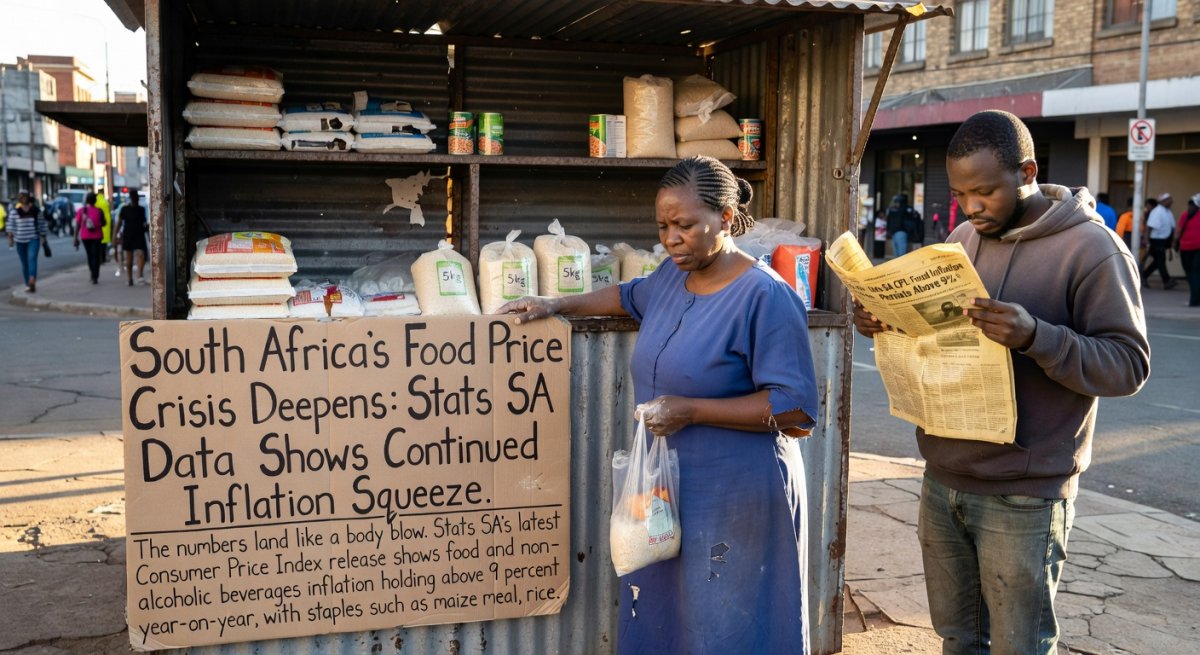
South Africa\'s Food Price Crisis Deepens: Stats SA Data Shows Continued Inflation Squeeze The numbers land like a body blow. Stats SA\'s latest Consumer Price Index release shows food and non-alcoholic beverages inflation holding above 9 percent year-on-year, with staples such as maize meal, rice and cooking oil still climbing even as overall headline inflation eases. For hous
South Africa\'s Food Price Crisis Deepens: Stats SA Data Shows Continued Inflation Squeeze
The numbers land like a body blow. Stats SA\'s latest Consumer Price Index release shows food and non-alcoholic beverages inflation holding above 9 percent year-on-year, with staples such as maize meal, rice and cooking oil still climbing even as overall headline inflation eases. For households earning under R6,000 a month, the squeeze is no longer a talking point; it is the difference between one meal and two.
In Johannesburg\'s Alexandra township, 42-year-old domestic worker Thandiwe Molefe now skips breakfast three days a week so her two children can eat after school. "The 5 kg bag of maize meal jumped R12 in one month," she says, standing outside the local Shoprite. "I used to buy bread and milk every day. Now it is a treat." Her story is repeated across every province, from Durban\'s informal settlements to rural Eastern Cape villages where pensioners stretch grants further each quarter.
The crisis is not sudden. It is the cumulative result of years of load-shedding damage to cold chains, rand weakness against the dollar, and policy drift on agricultural input costs. Stats SA data confirms the pattern: food prices have risen faster than wages for 18 consecutive months.
Stats SA Data: The Cold Numbers Behind Empty Plates
According to the October 2024 Stats SA CPI release, the food and non-alcoholic beverages index rose 9.4 percent year-on-year. Bread and cereals climbed 11.2 percent, meat 8.7 percent, and oils and fats 13.1 percent. The South African Reserve Bank\'s own Quarterly Bulletin for the third quarter notes that imported inflation remains the dominant driver, with the rand averaging R18.15 to the dollar over the period.
Treasury\'s Medium Term Budget Policy Statement, tabled in November, allocates no new targeted relief for food inflation beyond the existing social grants. Economists at the University of Cape Town\'s Development Policy Research Unit calculate that the poorest 20 percent of households now spend 35 percent of their income on food, up from 28 percent in 2019.
Everyday South Africans: Who Pays the Highest Price
Visit the Marabastad market in Pretoria on any weekday and the evidence is visible. Small traders report turnover down 22 percent since March. "People buy half the volume they used to," says vegetable vendor Ahmed Ebrahim. "They take two tomatoes instead of four."
Farm workers in the Western Cape\'s Boland region face a different pressure. Wage negotiations at the Commission for Conciliation, Mediation and Arbitration stalled in October when employers cited rising diesel and fertiliser costs. Seasonal picker Maria Fortuin says her weekly packet has not kept pace. "R1,200 a week now buys what R900 bought last year."
Government Response: Silence Where Action Is Needed
Minister of Agriculture, Land Reform and Rural Development Thoko Didiza has pointed to the summer grain harvest as a future stabiliser. Yet the Crop Estimates Committee\'s October forecast shows white maize production 4 percent below the five-year average after late planting caused by erratic rains. No emergency import tariff relief has been announced.
Opposition parties in the National Assembly have called for a temporary zero-rating of VAT on additional staple foods. The ruling party has so far resisted, citing fiscal constraints. The South African Reserve Bank governor has repeated that monetary policy cannot solve supply-side food shocks, leaving the burden on fiscal and agricultural policy that has yet to materialise.
Retailers, Processors and Farmers: Following the Margin
Multiple perspectives reveal uneven pain. Large retailers report stable or slightly improved gross margins on private-label staples, while independent spaza shops in townships absorb supplier price hikes without passing them on fully, eroding their already thin profits. Maize millers cite electricity tariffs that rose 18 percent in July as a key cost driver.
Commercial farmers in the Free State, meanwhile, face fertiliser prices still 40 percent above 2021 levels despite a modest drop in urea costs this season. The Agricultural Business Chamber warns that any further rand depreciation will quickly feed back into input costs for the 2025 planting cycle.
Regional and Global Context: Not an Isolated Storm
South Africa\'s food inflation sits above the Sub-Saharan African average of 7.8 percent reported by the African Development Bank in its October 2024 outlook. Neighbouring Zambia and Zimbabwe have seen even sharper spikes linked to drought and currency collapse. Globally, the FAO Food Price Index remains 5 percent higher than pre-pandemic levels, with ongoing Red Sea shipping disruptions adding freight costs to imported grains.
These external pressures compound domestic weaknesses. Unlike Kenya, which introduced targeted fertiliser subsidies earlier this year, or Nigeria\'s recent removal of fuel subsidies without compensatory food support, South Africa has yet to deploy a coherent package that shields the poorest while addressing structural supply constraints.
Impact and Reaction: Anger, Adaptation and Calls for Accountability
Community organisations in Gauteng have begun rolling out "people\'s fridges" and bulk-buying cooperatives. Trade unions affiliated with Cosatu have scheduled nationwide demonstrations for December, demanding that the National Treasury ring-fence R15 billion for immediate food relief. Consumer advocacy group the Black Sash reports a 37 percent increase in queries about social grant adequacy since August.
Economists warn that continued erosion of purchasing power risks pushing more households below the food poverty line, currently R760 per person per month. Without swift policy intervention, the human cost will be measured not only in empty stomachs but in lost schooling days and rising malnutrition statistics expected in the next Demographic and Health Survey.
Key Takeaways
- Stats SA\'s October 2024 data shows food inflation at 9.4 percent year-on-year, with oils and cereals leading the surge.
- Households earning under R6,000 monthly now allocate over a third of income to food, up sharply since 2019.
- No new targeted fiscal relief appears in Treasury\'s November Medium Term Budget Policy Statement.
- Retailers and farmers both cite electricity and import costs, yet margins remain uneven across the value chain.
- Regional peers have deployed fertiliser subsidies and import measures that South Africa has not yet matched.
The data is unambiguous. The lived experience is brutal. South Africa\'s food price crisis will not resolve itself through hope or harvest forecasts alone. It requires deliberate policy choices that place the dignity of ordinary citizens above fiscal caution and political inertia.
This is Dante Williams for Global1 News, reporting from Johannesburg. 🇿🇦
This article was produced with AI-assisted research and editorial support. Reporting is based on sources cited in the article.
What's Your Reaction?
 Like
0
Like
0
 Dislike
0
Dislike
0
 Love
0
Love
0
 Funny
0
Funny
0
 Wow
0
Wow
0
 Sad
0
Sad
0
 Angry
0
Angry
0

Breaking News and Investigations Correspondent at Global1.News. Based in London, covering global breaking news, security, and investigative stories. Known for digging deeper and connecting the dots across continents.












Comments (0)