
Protests in the Bahamas: Faith Groups and Pride March on University Drive
On Saturday, October 14, 2025, University Drive outside the University of The Bahamas in Nassau became the scene of a tense yet respectful standoff between religious protesters and LGBTQI+ advocates. About fifteen demonstrators led by Prophetess Patrice Smith and Pastor Carol Moss faced off against Pride Bahamas' second annual Human Rights March, highlighting the deep divisions
On Saturday, October 14, 2025, University Drive outside the University of The Bahamas in Nassau became the scene of a tense yet respectful standoff between religious protesters and LGBTQI+ advocates. About fifteen demonstrators led by Prophetess Patrice Smith and Pastor Carol Moss faced off against Pride Bahamas' second annual Human Rights March, highlighting the deep divisions within Bahamian society over faith, family and human rights.
Faith Groups and Pride Bahamas Face Off on University Drive in Nassau
Nassau, Bahamas – October 2025 — The air was thick with hymns on one side and rainbow flags on the other as two groups gathered metres apart on University Drive outside the University of The Bahamas. Religious protesters, led by Prophetess Patrice Smith and Pastor Carol Moss, arrived with about fifteen supporters carrying banners that declared "The Bahamas belongs to God." Across the road, Pride Bahamas prepared for its second annual Human Rights March under the theme "Be Bold, Be You, Live With Pride," marking the organisation's sixth anniversary in collaboration with the British High Commission.
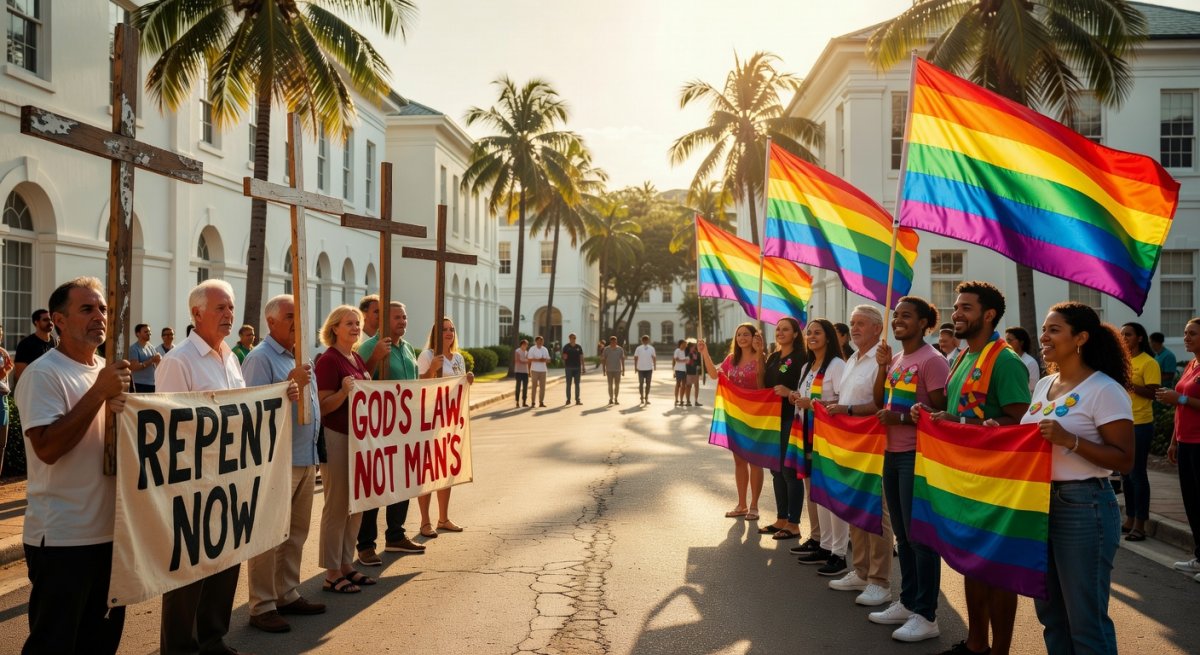
Overview of the standoff on University Drive
On Saturday, October 14, 2025, University Drive outside the University of The Bahamas in Nassau became the scene of a tense yet respectful standoff between two groups who both claim to speak for the future of the country. About fifteen religious protesters gathered with banners declaring "The Bahamas belongs to God," while nearby Pride Bahamas prepared for its second annual Human Rights March under the theme "Be Bold, Be You, Live With Pride." The air was thick with hymns on one side and rainbow flags on the other, yet voices remained measured as each side sought to be heard.
Caribbean people know well how family, faith and community often sit at the same table, sometimes in harmony and sometimes in sharp disagreement. This gathering felt like one of those Sunday afternoon discussions that spill over into the yard, where everyone has a strong opinion yet nobody wants to break the bonds that hold us together. The presence of the British High Commission as a collaborator with Pride Bahamas added an extra layer of regional and international interest to what was unfolding on that Nassau street.
Both sides acknowledged the civility of the exchange even as the messages clashed. Passers-by, students and ordinary Bahamians stopped to watch, some nodding in agreement with the protesters and others waving support toward the marchers. In true Caribbean fashion, the moment carried the weight of larger questions about belonging, identity and what it means to protect the next generation in small island societies where everyone knows everyone else.
Religious protesters' message and personal stories
Leading the group of faith demonstrators were Prophetess Patrice Smith and Pastor Carol Moss, who positioned themselves as gatekeepers called to speak over the nation. Prophetess Smith stated clearly, "We're here as the church, as the body of Christ, representing God. We're here to decree and declare that the Bahamas belongs to God." Their banners and songs framed the protest as a spiritual stand rather than a personal attack, insisting that the Bahamas must remain under divine protection.
Pastor Moss reinforced this position with equal conviction. She said, "We refuse to allow a curse to come to this Bahamas. We refuse to allow that to happen here as the gatekeepers of this country and so the church will stand." For many in the crowd, these words echoed long-held beliefs about moral leadership in Caribbean societies where the church has historically shaped education, social norms and even political discourse.
Prophetess Smith then shared a deeply personal revelation that shifted the tone. She disclosed that she has a lesbian daughter and added, "I love her with all of my heart. Every Sunday we have family dinner." This admission highlighted the complex reality many Caribbean families navigate, where love for a child coexists with strong religious convictions. The moment reminded onlookers that behind every banner stands a parent, a neighbour or a friend wrestling with these same tensions in their own homes.
Pride Bahamas' march and specific quotes from Farrington and DeMarco
Pride Bahamas marked its sixth anniversary with the Human Rights March, drawing attention to ongoing struggles for acceptance across the islands. Committee member McTair Farrington addressed the religious protest directly, suggesting a different focus. He remarked, "They could have done maybe a campaign or a march to say, 'protect the kids in our churches,' rather than adding light to something that they said they don't want to see the light of day."
Co-organiser Alexis DeMarco spoke movingly about the young people the march seeks to uplift. She explained, "When parents cannot accept their children being LGBTI, they throw them to the streets. We are marching for those children and those young adults that are being thrown out by their parents when they find out that they're LGBTI." Her words brought the human cost of rejection into sharp focus for everyone listening on University Drive.
Farrington also highlighted the invisible members of the community who could not join openly. He noted, "They can't come out because they can't be visible, because they can either be kicked out or condemned." This reality resonates across the Caribbean, where fear of family expulsion or social ostracism keeps many young people silent even as they yearn for connection and safety within their own neighbourhoods.
The issue of family rejection and LGBTQI+ youth homelessness in the Caribbean
Family remains the bedrock of Caribbean life, yet rejection of LGBTQI+ youth continues to fracture that foundation in painful ways. When young people are asked to leave their homes after revealing their identities, the ripple effects touch schools, churches and entire communities. In Nassau that Saturday, the Pride marchers made clear they were walking for those displaced youth who have nowhere else to turn.
Stories like these surface regularly from Trinidad to Jamaica and beyond, where the warmth of extended family can sometimes turn cold when expectations about marriage and gender roles are challenged. The result is often hidden homelessness, with young people couch-surfing or relying on informal networks while trying to finish their education. Caribbean societies pride themselves on looking out for one another, yet these cases reveal gaps that demand honest community conversation.
The debate on University Drive underscored how faith and family values intersect with these realities. Many protesters emphasised protection of children, while marchers stressed that protection must include those already pushed to the margins. Finding common ground requires recognising that every young person, regardless of identity, still belongs to the broader Caribbean family that values resilience and care.
The wider week of protests in Nassau
The face-off on University Drive formed part of a busier week of public action across Nassau. Taxi drivers had taken to the streets to protest new parking fees at the popular Margaritaville resort, highlighting economic pressures on ordinary workers trying to make ends meet. At the same time, union action led to the closure of six schools, affecting families already stretched thin by rising costs.
These overlapping demonstrations painted a picture of a nation grappling with multiple fronts of discontent. Economic grievances over tourism-related fees sat alongside social questions about rights and belonging, all unfolding against the backdrop of a small island economy where tourism remains the lifeblood. Caribbean people understand that protests often signal deeper calls for fairness and stability.
Despite the different causes, the spirit of public engagement remained consistent with the region's tradition of vocal civic participation. Whether drivers, teachers or faith and pride groups, Bahamians showed they were willing to stand up for what they believe matters. The challenge lies in ensuring these parallel movements can inform rather than divide the national conversation.
Regional CARICOM context
Similar tensions have played out across CARICOM nations in recent years. In Trinidad, debates around gender recognition and family acceptance continue in both churches and community centres. Jamaica has seen growing calls for dialogue even as conservative voices remain strong, while Barbados and Guyana have witnessed youth-led initiatives pushing for greater inclusion alongside traditional values.
The Bahamas decriminalised same-sex relations back in 1991, yet cultural attitudes have evolved more slowly, much like in neighbouring islands where legal change often precedes shifts in everyday behaviour. These regional patterns suggest that Nassau's University Drive moment is part of a wider Caribbean reckoning with identity, faith and the meaning of family in modern times.
Leaders across the region increasingly recognise that economic survival and social cohesion depend on addressing these issues without fracturing communities. The civil tone maintained in Nassau offers a model for other CARICOM capitals where similar standoffs have sometimes turned more heated. Shared Caribbean values of respect and neighbourliness may yet guide these conversations forward.
Tourism, international pressure, and economic considerations
Tourism drives the Bahamian economy, and international eyes watched the events on University Drive closely. The collaboration between Pride Bahamas and the British High Commission signalled how global partnerships can influence local discourse. Visitors from Europe and North America often expect destinations to reflect progressive standards on human rights, creating both opportunities and pressures for island nations.
At the same time, Caribbean governments must balance these external expectations with the deeply held beliefs of their own citizens. Economic considerations around visitor numbers, investment and development grants frequently intersect with social policy debates. The protesters and marchers alike understand that the image of the Bahamas matters for jobs and livelihoods that sustain families across the islands.
Yet many locals argue that true progress cannot be dictated solely by tourism dollars. The conversation must remain rooted in Caribbean realities, where communities decide together how to honour both tradition and the dignity of every citizen. Finding that balance continues to test leaders from Nassau to Port of Spain and beyond.
Looking ahead - community dialogue and next steps
As the groups dispersed from University Drive, the call for sustained dialogue grew louder. Both faith communities and Pride organisers expressed willingness to continue speaking, even if full agreement remains distant. Caribbean people have long excelled at round-table discussions that stretch late into the night, fuelled by shared meals and mutual respect.
Next steps could include joint community forums focused on protecting all young people, whether inside churches or within marginalised groups. Such efforts would build on the civility already demonstrated and address root concerns around family support, mental health and economic opportunity. The goal remains a society where no child feels forced to choose between love and authenticity.
In the weeks ahead, Nassau residents will likely continue these exchanges in homes, schools and places of worship. The strength of Caribbean society has always rested on its ability to hold difficult conversations without losing the bonds that unite us. That same spirit, if nurtured, can help the Bahamas and the wider region move toward greater understanding for everyone.
By Sharon Sahatoo, Staff WriterThis article was produced with AI-assisted research and editorial support. Reporting is based on sources cited in the article.
What's Your Reaction?
 Like
0
Like
0
 Dislike
0
Dislike
0
 Love
0
Love
0
 Funny
0
Funny
0
 Wow
0
Wow
0
 Sad
0
Sad
0
 Angry
0
Angry
0

Editor-in-Chief at Global1.News. Atlanta-based journalist who cuts through the BS and tells it like it is. Lead anchor, host, and the voice you hear when the spin stops and the truth starts.












Comments (0)