
Pokemon Card Scam Leaves 20 Thai Collectors Out More Than 5 Million Baht
Twenty Thai Pokemon card collectors have filed a complaint with the Economic Crime Suppression Division after losing more than 5 million baht in an elaborate pre-order scam, including a 15-year-old boy who lost 140,000 baht.
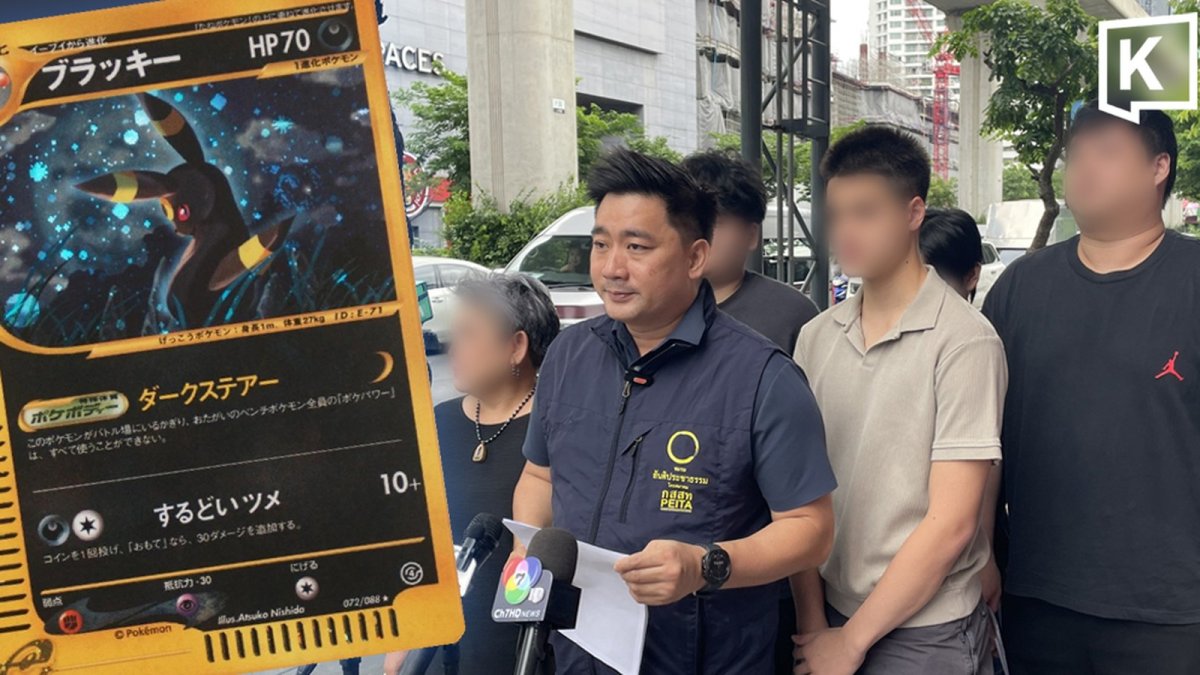
BANGKOK — A group of 20 victims has filed a formal complaint with the Economic Crime Suppression Division (ECSD) of the Central Investigation Bureau today after losing more than 5 million baht in an elaborate Pokemon trading card scam that began with friendly pre-orders at a Bangkok gaming event. The alleged suspect, who built trust over months of successful small transactions before vanishing with large payments, has reportedly closed both personal Facebook and Instagram accounts and can no longer be contacted.
Tankhun Jitt-itsara, the former Democrat Party MP for Don Mueang and well-known consumer protection advocate, accompanied the victims to the ECSD offices to ensure the case receives full legal attention. The complaint marks the latest chapter in a growing regional problem that has also struck collectors in Singapore, where police arrested a 25-year-old man in February 2026 for similar Pokemon card pre-order scams.
A 15-Year-Old Collector Who Trusted the Wrong Friend
The youngest victim, identified only as "A," is a 15-year-old boy who first met the suspect at a gaming and trading card event in Bangkok. What began as a casual acquaintance quickly developed into a business relationship that seemed almost too good to be true — and tragically, it was.
For approximately four months, A regularly ordered Pokemon trading cards from the suspect and received them without issue. By reselling the cards, the teenager earned an average profit of around 10% per transaction. The consistent deliveries and steady profits built a foundation of trust that would ultimately prove devastating.
"The suspect appeared credible, was known among card sellers and buyers, and had connections with adults and others in the trading card community," A told investigators. The suspect communicated exclusively through a personal Facebook account rather than a business page, and all payments were directed to a single bank account — details that may have seemed unremarkable at the time but now stand as red flags.
When the latest orders failed to arrive, the suspect offered a series of increasingly implausible explanations, including claims that products were being held by immigration authorities or that overseas shipments had been delayed. The suspect also borrowed approximately 10,000 baht from the teenager. In total, A lost around 140,000 baht — a staggering sum for a 15-year-old.
The Rare Umbreon Card That Cost 640,000 Baht
Another victim, identified as "L," 23, was already an active member of the trading card community when he was introduced to the suspect through another victim. The suspect made a point of becoming close to L, initially contacting him to offer Pokemon card trades.
The suspect sent photographs of graded Pokemon cards — professionally assessed and certified for condition and quality — and offered them for sale or exchange at around 65,000 baht. When the suspect's cards were worth more than L's, L agreed to pay the difference. Through repeated transactions, the two became close, and L's trust in the suspect grew with each completed deal.
Then came the offer that proved too tempting to resist. L wanted an Umbreon "Split Earth" card, which had a market price of around 500,000 baht. The suspect allegedly offered to obtain the card for 410,000 baht — a significant discount below market value. L was eventually defrauded in the same manner as the other victims, suffering losses of around 640,000 baht.
Tankhun noted that the alleged suspect had also targeted other collectible cards, not just Pokemon cards, and believes more victims could come forward to report similar cases. The total number of affected individuals may grow as the investigation progresses.
How the Scam Worked: Building Trust Before the Fall
The pattern emerging from the victims' accounts reveals a calculated strategy of long-term trust-building. The suspect befriended victims at trading card events, established credibility within the community, and completed numerous legitimate transactions before executing the fraud.
Key warning signs that victims now recognize include the use of a personal Facebook account rather than a business page, payments directed to a single bank account, and the suspect's practice of borrowing money from victims outside of card transactions. The suspect's explanations for failed deliveries — immigration holds and overseas shipping delays — were designed to sound plausible while buying time.
For the 15-year-old victim, the scam represents not just a financial loss but a profound betrayal of trust. The teenager had invested months of effort and savings into building a small trading business, only to have it destroyed by someone he considered a friend and mentor in the collecting community.
Thailand's Booming Collectible Card Culture
The rapid growth of trading card culture in Thailand has created fertile ground for scammers. Pokemon cards have become among the most popular collectibles among young Thai collectors, with trading card events drawing enthusiastic crowds in Bangkok and other major cities. The community's growth has been organic and passionate, but it has also outpaced consumer protection awareness.
Thai authorities are urging collectors to exercise caution when dealing with sellers, particularly those who operate exclusively through personal social media accounts. The Royal Thai Police's ECSD, which handles financial fraud cases, has encouraged victims to come forward and report suspicious activity promptly.
Tankhun's involvement in the case highlights the seriousness with which Thai society views these scams. As a former MP and consumer protection advocate, he has a track record of championing the rights of ordinary citizens against fraud and exploitation. His presence at the ECSD today signals that this case will not be quietly forgotten.
A Southeast Asia-Wide Pattern: Singapore's Pokemon Card Scams
The Bangkok case is not isolated. Across the region, similar Pokemon card pre-order scams have been making headlines throughout 2026. In February, Singapore police arrested a 25-year-old man following 35 reports from victims cheated by a seller advertising pre-orders of limited edition cards, with losses exceeding S$135,000.
Another Singapore case involved more than 100 victims losing over S$700,000 in alleged Pokemon card pre-order scams. The striking similarity between the Singapore and Bangkok cases — pre-orders, limited edition cards, social media communication, and single bank account payments — suggests a regional pattern that collectors across Southeast Asia should take seriously.
For Thai collectors, the regional dimension is a warning. Scammers may operate across borders, and the methods used in Bangkok mirror those that have already been documented in Singapore. The ASEAN community's interconnected nature means that a scammer exposed in one country may simply relocate operations to another.
What Thai Collectors Should Watch For
Consumer protection experts recommend several precautions for Thai collectors navigating the trading card market. First, verify sellers through multiple channels — check for business registrations, look for reviews from independent sources, and be wary of sellers who operate exclusively through personal social media accounts.
Second, be suspicious of deals that seem too good to be true. The Umbreon "Split Earth" card offered at 410,000 baht against a market price of 500,000 baht was a classic bait. Scammers often offer below-market prices to lure victims into larger transactions.
Third, avoid making payments to a single bank account for repeated transactions. Legitimate businesses typically have multiple payment channels and formal invoicing systems. The use of a single account for all transactions is a common red flag in financial fraud cases.
Finally, collectors should maintain documentation of all transactions, including screenshots of conversations, payment receipts, and delivery confirmations. This documentation is essential for police investigations and can significantly strengthen a victim's case when filing complaints with the ECSD.
Police Action and the Road Ahead
The ECSD has accepted the complaint and investigators are now pursuing the case. Tankhun stated that he brought all the victims to file complaints so that legal proceedings could be pursued to the fullest extent. The closure of the suspect's social media accounts suggests an attempt to evade detection, but investigators have experience tracking financial fraud cases through bank records and digital footprints.
For the 20 known victims, the road to recovery will be long. The 5 million baht in combined losses represents real money — savings and, in the case of the 15-year-old boy, the fruits of months of careful trading. While legal proceedings may eventually recover some funds, the emotional toll of the betrayal is likely to linger far longer.
The case serves as a sobering reminder that even passionate hobbies can attract predators. As Thailand's collectible card culture continues to grow, so too must the community's vigilance. The trading card events that brought victims and suspect together are vibrant, exciting spaces — but they are also spaces where trust must be earned carefully and verified thoroughly.
This article was produced with AI-assisted research and editorial support. Sources: Khaosod English, Singapore Police Force, The Straits Times.
By Ann Srisawat, Staff Writer
What's Your Reaction?
 Like
0
Like
0
 Dislike
0
Dislike
0
 Love
0
Love
0
 Funny
0
Funny
0
 Wow
0
Wow
0
 Sad
0
Sad
0
 Angry
0
Angry
0

Southeast Asia Correspondent at Global1.News. Based in Bangkok, covering Thai and Southeast Asian politics, economy, technology, and culture. Deep regional perspective on one of the world's most dynamic regions.















Comments (0)