
Amazon Prime Refunds Expand to Millions More Under Revised FTC Order
The FTC says Amazon will expand and accelerate refunds under its $2.5 billion Prime settlement, raising the maximum payment to $200 and sending automatic payouts to millions more consumers from October 1, 2026.
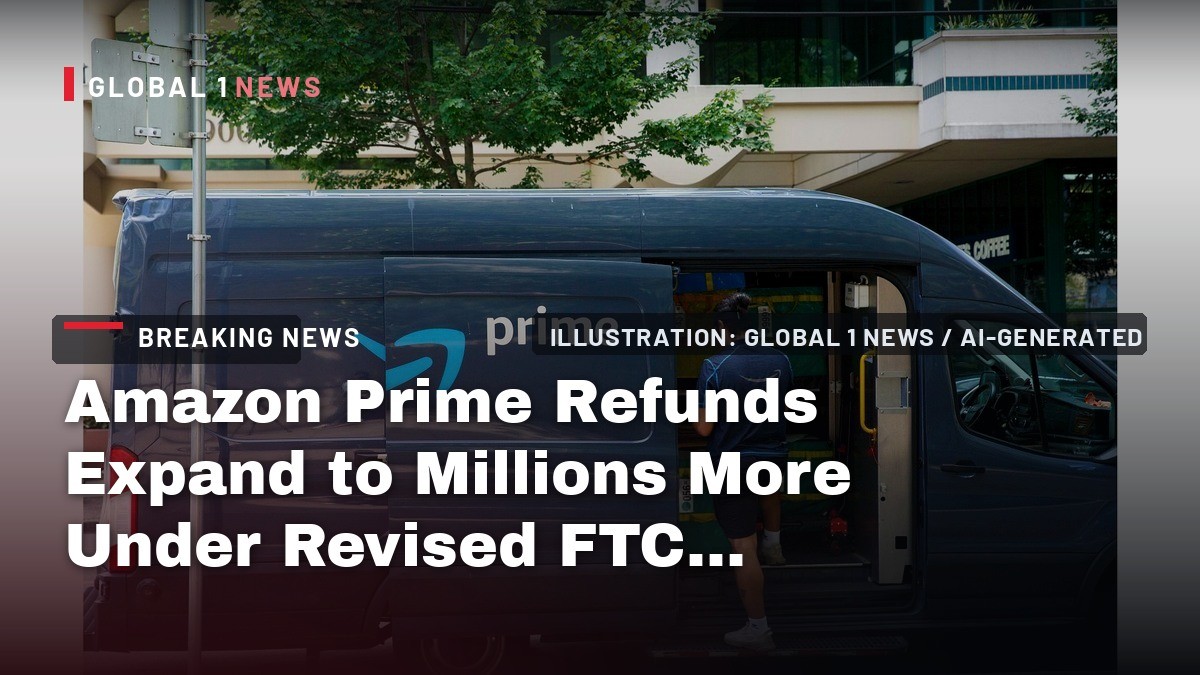
Starting October 1, millions of Amazon Prime customers will begin receiving automatic refunds tied to the Federal Trade Commission's $2.5 billion settlement with the retail giant. The money arrives without a claim form, without a phone call, and without any paperwork sent to Amazon. For consumers who used between 11 and 20 Prime benefits in a year, this is the first time they qualify at all.
Amazon Prime Refunds Expand to Millions More
Washington, United States - The Federal Trade Commission announced on 17 September that a federal court had approved a joint motion expanding and accelerating refund payments under the agency's Amazon Prime settlement. The revised order raises the maximum payment from $51 to $200 and opens automatic refunds to millions of consumers who were previously left out. The stipulated motion carried a motion-calendar note of 11 September 2026.
Money Starts Moving on October 1
Amazon will begin issuing automatic redress payments on October 1, 2026, to consumers who used between 11 and 20 Prime benefits during a one-year period, according to the FTC. Those consumers were not included in earlier payment phases. The FTC said the payments will be made by electronic transfer through Venmo or PayPal, or by mailed check. No claim, no notice response, and no form is required. The agency described the change as part of a revised order approved by a federal court the same week as its 17 September announcement. The FTC also confirmed that Amazon is responsible for administering the redress program, not the government. That distinction matters for anyone watching their inbox for official correspondence. The timeline behind the program stretches back further than the October start date. Automatic refunds were first sent to eligible Prime customers in November and December 2025, and Amazon began mailing claim notices in January 2026. The claims window closed on 27 July 2026. Anyone who receives a payment should accept or cash it within 60 days of its issue date.
What the FTC Said Amazon Did
The September 2025 settlement resolved FTC allegations that Amazon enrolled millions of consumers in Prime without their consent and knowingly made it difficult for them to cancel. The case is Federal Trade Commission v. Amazon.com, Inc., et al., No. 2:23-cv-00932-JHC, in the U.S. District Court for the Western District of Washington at Seattle. The individual defendants named alongside Amazon are Neil Lindsay and Jamil Ghani, and the settlement order was entered on 25 September 2025. The FTC alleged Amazon enrolled tens of millions of customers in Prime subscriptions without their knowledge or consent and made cancellation difficult for those same customers. In its own words, the agency said Amazon "knowingly duped millions of consumers into unknowingly enrolling in Amazon Prime" and made cancellation "exceedingly difficult," and it estimated that about 35 million customers were affected. Amazon agreed to pay up to $1.5 billion in redress to harmed consumers, plus a $1 billion civil penalty, and to cease the challenged enrollment and cancellation practices. The FTC said the $1 billion penalty was the largest ever in a case involving a violation of one of its rules, and that Amazon's conduct violated both the FTC Act and the Restore Online Shoppers' Confidence Act. Christopher Mufarrige, director of the FTC's Bureau of Consumer Protection, said the revised order will ensure more consumers harmed by Amazon's deceptive enrollment and cancellation practices benefit from the settlement.
The Checkout Screens the Government Challenged
The FTC's case centers on four specific enrollment paths it calls challenged enrollment flows. According to the agency's consumer page, those are the universal Prime decision page, the shipping selection page, the single page checkout, and the Prime Video enrollment flow. Consumers who signed up through any of those paths between June 23, 2019, and June 23, 2025, fall inside the relevant time period. An annual Prime membership costs $139. The order's own eligibility definition also covers consumers who "unsuccessfully attempted to cancel" and who "inadvertently" took a "Save Offer" during the cancellation process. KCRA reported the agency said customers faced a lengthy unsubscribe path that employees reportedly called the Iliad, a reference to the long Greek epic, for the number of pages and clicks required to cancel. Amazon denied wrongdoing.
Three Phases and a One Billion Dollar Trigger
The court order lays out three payment phases. Phase 1 was the automatic payout to consumers who enrolled through a challenged enrollment flow and used no more than three Prime benefits in any 12-month period. Phase 2 was the claims process, which covered consumers who used no more than 10 Prime benefits and who either signed up through a challenged flow or tried and failed to cancel. Phase 3 provides for "additional rounds of automatic payments" if "less than $1,000,000,000 in funds have been paid out" from the consumer fund. That residual-payout mechanism was written into the 2025 order rather than created in September 2026, and its billion-dollar threshold is the trigger now driving the expansion.
Fifty-One Dollars Becomes Two Hundred
Under the original order, refunds topped out at $51 for consumers who used fewer than 10 Prime benefits in a one-year period. The revised order raises the maximum payment cap from $51 to $200 total. The FTC said that if consumer-accepted payments do not reach the required threshold by February 2027, Amazon will provide additional automatic payments to consumers who previously received refunds. Those consumers will be eligible for an additional $149, bringing the total to $200. That last round of supplemental payments will start by April 2027 and will also be distributed automatically. An annual Prime membership is $139, so the new $200 maximum is roughly one and a half years of membership fees. The $200 figure is a ceiling, not a flat amount, and individual payments will vary from recipient to recipient.
No Claim, No Form, No Paperwork
The FTC said all future payments will be distributed automatically, eliminating the need for consumers to submit claims or additional paperwork to Amazon. That language appears in the agency's 17 September release and was repeated by CNBC Select. The change matters because the earlier claims process required eligible consumers to submit valid forms before the July deadline. The FTC's Christopher Bissex said at the time of the original settlement that some consumers would receive automatic payments within 90 days while the rest would get a notification from Amazon and the chance to submit a simple claim form. The revision removes that second step going forward. Recipients can take payment by check, PayPal or Venmo, according to AARP, and free Prime Video and Prime Music content counts toward the benefit limits that decide eligibility. The agency's consumer page lists a support contact for the program at Amazon, reachable at [email protected].
Amazon Admits Nothing
Amazon denied any wrongdoing and did not admit liability in the settlement, according to AARP and KCRA. Amazon said in a statement that it agreed to the settlement because it "allows us to move forward and focus on innovating for customers." Amazon spokesperson Alisa Carroll said at the time that the settlement "largely requires us to maintain the sign-up and cancellation process that has been in place for several years - not to make additional changes," and said there was no admission of guilt in the settlement by the company or any executives. Amazon did not respond to a request for comment on the September 2026 revision, CNBC Select reported.
The Scammers Already Know
The FTC is warning consumers directly about fraud tied to this case. The agency's consumer page states plainly that the FTC is not contacting people about refunds in the Amazon matter, and that anyone who gets a call from someone claiming to be from the FTC is dealing with a scam. The FTC says it will never demand money, make threats, tell anyone to transfer money, or promise a prize. It also warns that no one from Amazon will ever ask for money to get a refund. Only scammers say they can get you special access or a guaranteed refund, according to the FTC. Complaints can go to ReportFraud.ftc.gov.
Dark Patterns Are the Whole Case
The FTC's lawsuit described what it called dark patterns, design tricks that made it deceptively easy to enroll in Prime and frustratingly difficult to cancel, according to KCRA. The agency alleged Amazon buried the option to avoid Prime during checkout and required customers to navigate a lengthy unsubscribe path. The same enforcement theory has been pursued against subscription businesses well beyond e-commerce, including streaming services and gym memberships. Mufarrige said the action underscores the FTC's commitment to ensuring companies return money to consumers harmed by unlawful and deceptive business practices. FTC Chairman Andrew N. Ferguson had called the original settlement a "record-breaking, monumental win for the millions of Americans who are tired of deceptive subscriptions that feel impossible to cancel." In this matter, the FTC's own running tally of redress went from more than $825 million as of 9 September to more than $845 million by its 17 September announcement. The FTC's consumer page on the case describes it as the "Trump-Vance FTC's historic $2.5 billion settlement."
Who Still Gets Nothing
The expansion does not cover everyone. Consumers who used more than 20 Prime benefits in a 12-month period remain outside the eligibility criteria described by the FTC and CNBC Select. The agency's three-part test requires a U.S. consumer who signed up for Prime between June 23, 2019, and June 23, 2025, used no more than 20 Prime benefits in a 12-month period, and either unintentionally enrolled through a challenged enrollment flow or tried to cancel through one. Eligibility is limited to the United States market, so Prime members elsewhere are outside this program. Consumers who enrolled outside those dates, or through flows the agency did not challenge, are not covered. The FTC has not said how many people will be paid on October 1 beyond describing them as millions of additional consumers.
By Jessica Ali, Staff Writer
This article was produced with AI-assisted research and editorial support. Sources: the Federal Trade Commission, the U.S. District Court for the Western District of Washington, AARP, KCRA, CNBC Select and WIRED.
What's Your Reaction?
 Like
0
Like
0
 Dislike
0
Dislike
0
 Love
0
Love
0
 Funny
0
Funny
0
 Wow
0
Wow
0
 Sad
0
Sad
0
 Angry
0
Angry
0

Editor-in-Chief at Global1.News. Atlanta-based journalist who cuts through the BS and tells it like it is. Lead anchor, host, and the voice you hear when the spin stops and the truth starts.











Comments (0)