
Ontario Court of Appeal Rules Province Can Remove Toronto Bike Lanes, Reversing Charter Ruling
In a recent CBC News report, Ontario's Court of Appeal ruled on Friday that Premier Doug Ford's government can proceed with removing 19 kilometres of protected bike lanes in Toronto, reversing a lower court decision that had deemed the move unconstitutional.
In a recent CBC News report, Ontario's Court of Appeal ruled on Friday that Premier Doug Ford's government can proceed with removing 19 kilometres of protected bike lanes in Toronto, reversing a lower court decision that had deemed the move unconstitutional. The ruling settles, at least for now, a legal battle that has pitted provincial authority against municipal autonomy, and it carries significant implications for how transportation decisions are made in Canada's largest city.
Ontario Court of Appeal Rules Province Can Remove Toronto Bike Lanes, Reversing Charter Ruling
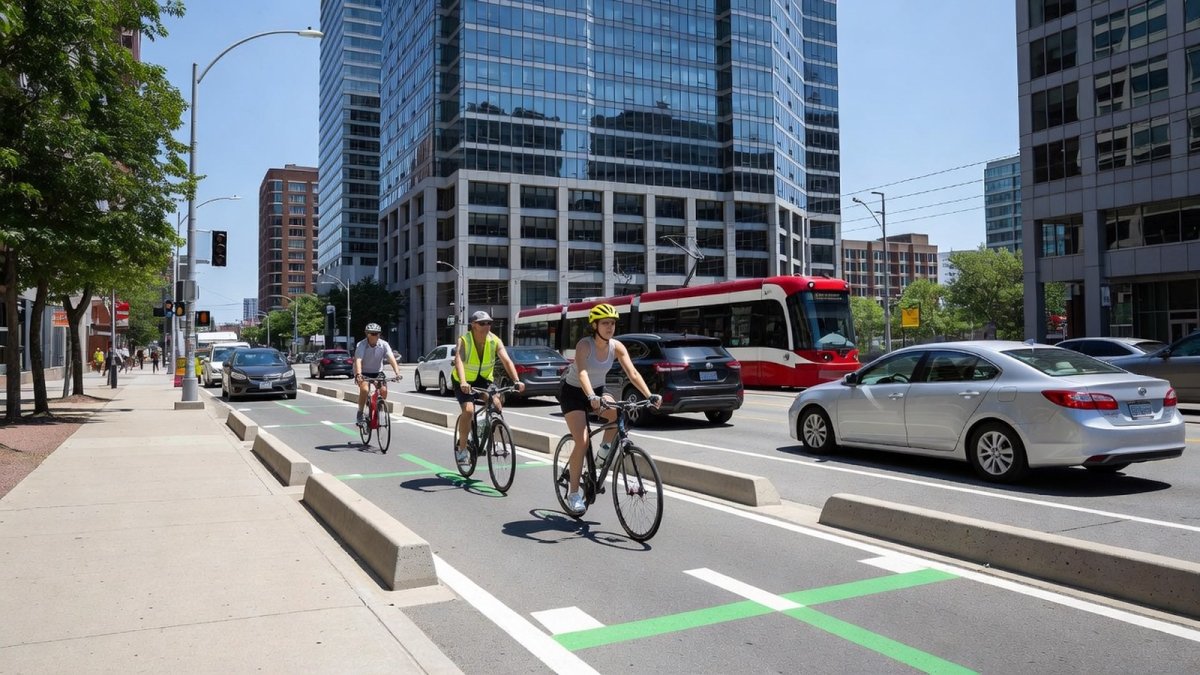
Toronto, Ontario – August 14, 2026 — A three-judge panel of the Ontario Court of Appeal has ruled that the provincial government has the constitutional authority to remove protected bike lanes on Bloor Street, Yonge Street and University Avenue, overturning a July 2025 Superior Court decision that found the removal would violate cyclists' Charter rights to life and security of the person.
The Legal Battle Over Bill 212
The dispute centres on Bill 212, the Reducing Gridlock, Saving You Time Act, which was passed at Queen's Park on November 25, 2024. The legislation empowers the province to remove bike lanes where a traffic lane was previously eliminated, and it also requires municipalities to obtain provincial approval before installing new bike lanes that remove a lane of vehicle traffic.
In July 2025, Ontario Superior Court Justice Paul Schabas ruled that the removal would be unconstitutional because it would put cyclists at increased risk of harm and death, engaging the right to life and security of the person under Section 7 of the Canadian Charter of Rights and Freedoms. That decision was a significant victory for cycling advocates and the City of Toronto, which had argued the province was overstepping its jurisdiction.
But the appeal panel disagreed, writing that "the legislature is free to legislate to remove a bicycle lane from a road — indeed, it may remove a road entirely — without implicating the Charter." The judges also criticised Schabas's ruling for what they described as inflating the negative impacts of removing the lanes, noting the original decision was "talking of injuries and deaths that will occur only if the bicyclists choose to ride on the roads that have no bicycle lanes."
Province's Victory and Municipal Autonomy
The appeal court's reasoning was blunt about the limits of judicial oversight over legislative policy choices. The judges wrote that "legislative policy is not arbitrary just because some or even many advisors, experts, and citizens predict that it will not work," adding that "legislation is not unconstitutional for failing to satisfy the preferences of experts whose advice the government was not required to accept."
Justice Huscroft wrote in the decision that "neither the government nor the legislature is under any obligation to accept policy advice." This framing places the case squarely within a broader Canadian constitutional reality: under Section 92(8) of the Constitution Act, municipalities are creatures of the province, and their powers exist only to the extent provincial legislatures choose to grant them.
Ontario Transportation Minister Prabmeet Sarkaria welcomed the ruling, calling it "a victory for common sense and for respecting the appropriate division of roles between duly elected legislatures and the courts." Premier Doug Ford posted on X, the social media platform, that "common sense wins."
What the Evidence Shows About Congestion
Despite the government's framing, hundreds of pages of internal ministry documents, reports and emails made public during the court challenge tell a more complicated story. An engineering report commissioned by the government itself found that the congestion benefits of removing the bike lanes would be negligible or short-lived. Internal briefings obtained by The Trillium found that the province's own staff reported bike lane removal would not reduce congestion and could make it worse.
Those same briefings warned that Ontario's actions could be seen as encroaching on municipal decision-making, a concern that has proven prescient given the political fallout. The government has long blamed protected bike lanes for Toronto's traffic congestion in the Greater Toronto Area, a position Ford has repeated publicly for years, but the evidence gathered during the court challenge suggests the relationship between bike lanes and gridlock is far more complex than the province's messaging suggests.
Michael Longfield, executive director of Cycle Toronto, one of the groups that launched the legal challenge, pushed back against the government's rationale. "I want to be clear that bike lanes do not cause traffic congestion," he said. "Removing them will put people's lives at risk." Longfield also noted that the original ruling found Ontario's plans were pushed through despite its own advisers and external experts broadly agreeing the move wouldn't accomplish its stated goal of reducing traffic congestion.
Impact on Toronto's Streets and Taxpayers
The practical consequences of the ruling are substantial. A city report estimated that ripping up the lanes would cost taxpayers an additional C$48 million, while The Trillium reported a figure closer to $50 million. The province has not yet announced when removals will begin — the Ministry of Transportation did not respond to CBC's request for a timeline — but The Trillium earlier reported that removals could start as early as March.
The affected routes are among the busiest cycling corridors in the city. Bloor Street's protected lanes, installed in stages since 2016, have become a critical east-west connection for cyclists. The Yonge Street and University Avenue lanes serve commuters heading into the downtown core. Removing them will force cyclists onto roads without dedicated infrastructure, a prospect that safety advocates say will increase collision risks for everyone who uses the roads.
Longfield emphasised that the impact extends beyond cyclists themselves. "This isn't just about keeping people on bikes safe. It helps pedestrians. It helps other drivers. It has a very strong traffic calming effect that we need in major cities," he said.
Political Reactions and the 2026 Mayoral Race
The ruling lands in the middle of a heated municipal election year. Toronto's mayoral election is scheduled for 2026, and the bike lane file has become a defining issue in the race. Mayor Olivia Chow's office responded to the ruling through spokesperson Braman Thillainathan, who said the city has been working with the province to reach an agreement that brings back vehicle lanes while still keeping cyclists safe. "She resists any argument that pits road users against each other because it makes everyone less safe," Thillainathan said.
Work has already been done to restore a car lane and maintain a bike lane for a stretch of Bloor Street West between Kipling Avenue and Islington Avenue, suggesting a compromise may be possible on at least some segments. But Chow's tone on social media was less conciliatory. She posted on X that it was "disappointing to see a member of Council undermine the City's right to determine its own future and repeatedly side with provincial overreach."
That comment appeared to be aimed at Brad Bradford, the councillor for Beaches-East York since 2018 and a candidate for mayor. Bradford has positioned himself as the candidate who will work with the province rather than fight it. "The best people to decide what happens on Toronto's streets are still Torontonians," he said, while also criticising Chow's approach. "For almost two years, the future of Toronto's streets sat in legal limbo. Drivers sat in gridlock. Businesses on Bloor West watched their sales fall."
Bradford committed earlier this week to removing bike lanes from part of Bloor Street West from South Kingsway to Resurrection Road if elected, and he accused Chow of having "spent those two years cheering on a courtroom fight instead of fixing the street." The Ontario Liberals also weighed in on X, noting the broader pattern: "Whether it's Billy Bishop or bike lanes, Doug wants to control city-planning. If only he'd apply the same interest to the rest of the province."
What Happens Next
The legal question may not be fully settled. The groups that launched the original challenge, including Cycle Toronto, could seek leave to appeal to the Supreme Court of Canada, though such applications are discretionary and often unsuccessful. The Charter arguments raised in the original case — that removing bike lanes puts cyclists at increased risk of death or serious injury — could find a more sympathetic hearing at the country's highest court, but there is no guarantee the court will take the case.
In the meantime, the province is expected to move forward with the removals. The Ministry of Transportation has not provided a specific timeline, but the legal green light means work could begin within months. The city and province have already demonstrated an ability to negotiate on at least one stretch of Bloor Street, and further compromises may emerge as the practical details of removal are worked out.
The ruling also has implications beyond Toronto. Bill 212's requirement that municipalities obtain provincial approval before installing new bike lanes that remove a traffic lane applies across Ontario, meaning cities like Hamilton, Ottawa and Kitchener will need to consider provincial preferences when planning cycling infrastructure. The case has become a live test of municipal autonomy versus provincial authority, and the appeal court's decision suggests that, at least in Ontario, the province holds the stronger hand.
For Canadian readers, this case raises fundamental questions about the balance of power between levels of government and the role of courts in reviewing legislative policy choices. The appeal court's message is clear: legislatures are entitled to make policy decisions that experts disagree with, and judges should not substitute their own views for those of elected officials. Whether that principle holds in the Supreme Court of Canada remains to be seen, but for now, the province has won the right to remake Toronto's streets according to its own vision.
The coming months will reveal whether the government's promised congestion relief materialises, whether the safety concerns raised by cycling advocates prove justified, and whether Toronto voters reward or punish the political actors who shaped this outcome. What is certain is that the bike lanes on Bloor, Yonge and University Avenue will look very different by this time next year, and the debate over who controls the city's streets is far from over.
By Alex Thompson, Staff Writer
This article was produced with AI-assisted research and editorial support. Reporting is based on sources cited in the article.
What's Your Reaction?
 Like
0
Like
0
 Dislike
0
Dislike
0
 Love
0
Love
0
 Funny
0
Funny
0
 Wow
0
Wow
0
 Sad
0
Sad
0
 Angry
0
Angry
0

Canada Correspondent at Global1.News. Based in Toronto, covering Canadian politics, energy, trade, and US-Canada relations. Provides the Canadian perspective on North American and global affairs.














Comments (0)