
Nvidia Just Anchored 8,000 Miles of Fiber — and Rural America Got the Off-Ramp Blocked
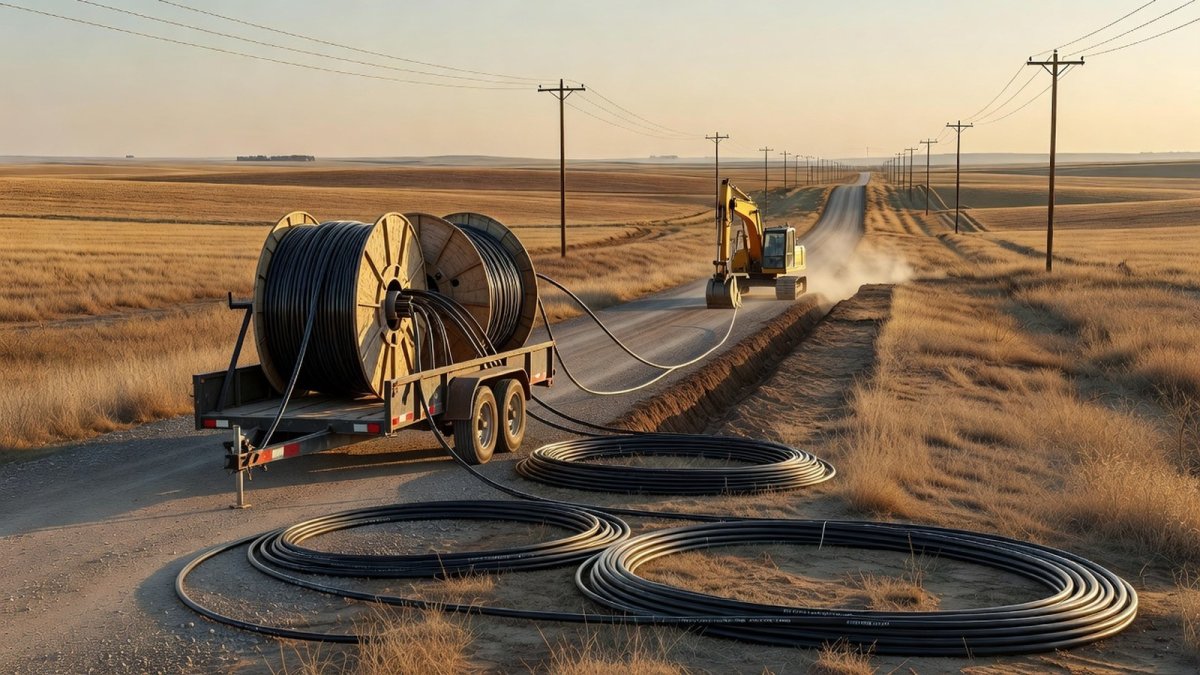
Nvidia is the anchor tenant on Zayo's 8,000-mile long-haul fiber buildout connecting emerging AI corridors, while some hyperscalers quietly block off-ramps to rural towns. A hosting founder on why the network is the AI buildout's next bottleneck and the off-ramp fight nobody's talking about.
Nvidia Just Anchored 8,000 Miles of Fiber — and Rural America Got the Off-Ramp Blocked
Let me tell you something that's been nagging me all week. I've run hosting infrastructure for over a decade, and for most of that time the network was the boring part of the business. Power, cooling, hardware, staffing — those got the budgets and the headaches. The fiber in the ground was just... there. You plugged into a carrier, paid the bill, and got on with your life.
That era just ended. On August 6, Zayo — one of the biggest privately held fiber backbones in North America — announced it's building more than 8,000 miles of new long-haul fiber with Nvidia as the anchor tenant. Six brand-new routes across what they're calling "emerging AI corridors," plus capacity upgrades in ten high-demand markets. The whole program now spans more than 15,000 route miles. And the same week, reporting out of Denver's Mountain Connect conference surfaced something uglier: some hyperscalers are putting clauses in their fiber contracts that block off-ramps to rural towns along the route.
Here's why that matters to every independent hosting provider still reading this. The network just became the AI buildout's next bottleneck — and the fight over who gets on it will shape where all of us can do business for the next decade.
The News — an Anchor Tenant for the Network Layer
Let's get the deal straight. Zayo builds, owns, and operates the network. Nvidia gets significant access to capacity on the new routes — which makes it an anchor customer, not an owner. The rest of the capacity goes on the open market to AI developers, cloud providers, neoclouds, and enterprises. Smart play: one anchor tenant de-risks the build, and the leftover capacity becomes a product for everyone else in the AI food chain.
This isn't Zayo's first rodeo. It spent 18 months expanding its AI footprint, then swallowed Crown Castle's Fiber Solutions business — 90,000 metro route miles and 40,000 on-net enterprise locations — specifically to support AI inference workloads. Zayo CEO Steve Smith put it plainly: "AI is fundamentally reshaping where and how network infrastructure needs to be built across the U.S."
And Nvidia isn't just the anchor tenant on Zayo's routes. Per Wolfe Research, it's been buying up long-haul dark fiber across the country, with fiber counts up to 100 pairs. Do the math — 800 gigabit per pair, a DWDM system splitting each fiber into 96 channels, 100 pairs — and you get a theoretical capacity around 7.6 petabits per second. That's not a side project. That's a company quietly building the nervous system for distributed AI factories.
Why the Network Just Became the Bottleneck
Here's the thing people keep missing. We spent two years treating AI infrastructure as a collection of buildings — big campuses, megawatts, GPU count. But frontier AI training doesn't run in one building anymore. It runs across clusters spanning regions, synchronizing data between geographically separated facilities. Inference puts compute closer to users. Both of those create a data center interconnect requirement that doesn't exist inside a single campus. The campus is done, powered, and full of GPUs, and it still can't do its job if the wide-area network between it and its peers isn't there.
Ron Westfall of HyperFrame Research said the quiet part out loud: existing fiber routes were designed around legacy data center topologies, and as AI factories move into new markets to chase available power, wide-area optical capacity is becoming the rate-limiting dependency. The biggest gaps, he says, are along secondary corridors where high-capacity long-haul fiber doesn't exist — which is exactly where these new Zayo routes are going.
And it's not just the fiber in the ground. Dell'Oro's Jimmy Yu says the optical equipment itself is constrained — pump lasers in amplifiers and coherent transponders are tight, with Ciena and Nokia quoting lead times beyond twelve months and backlogs growing. New routes take one to two years to build, about the same as a data center. Yu's warning should scare every AI developer with a lease: "Providers need to begin building these new fiber plants now otherwise data centers will sit idle."
The Two Readings — AI's Nervous System, or a 1990s Echo
I keep coming back to two ways of reading this buildout, and both are true at once. That's what makes it uncomfortable.
Reading one: this is the AI factory's nervous system. Compute without connectivity is a warehouse full of very expensive doorstops. Nvidia knows its chips only earn money when they're moving data, so locking down dark fiber the way it locks down wafer capacity is just vertical integration with a shovel. If the buildout is real — and the capex numbers say it is — the network layer was always going to need its own wave of investment. Zayo building ahead of demand isn't froth; it's the same land-grab logic every hyperscaler is already running on power and land.
Reading two: we've seen this exact movie before. In the late 1990s, the telecom industry laid hundreds of thousands of miles of fiber on the promise of internet traffic that took a decade to arrive. Companies like Level 3 and Global Crossing went bankrupt on fiber nobody was using. The term "dark fiber" exists because of that hangover. Today, analysts are already split — Yu says providers are building ahead of anticipated demand, Westfall says existing routes are already hitting capacity. When the people who sell you the network can't agree on whether we're overbuilding or underbuilding, that's a signal. I wrote about the overbuild correction two weeks ago — Meta admitting it overcommitted, Microsoft pulling back leases, 75 blocked projects — and the fiber layer has the same shape. Plenty of 1990s fiber eventually got lit and became the backbone we still use. But plenty of companies died waiting for that to happen.
Both readings are true. The network is essential. And the network is also the easiest place for a hype cycle to leave a graveyard.
The Fight Nobody's Talking About — the Off-Ramp Clauses
Now the part that actually kept me up. Fierce Network reported, and wccftech amplified this week, that some hyperscalers are putting clauses in their fiber contracts that preclude off-ramps to rural towns lying on the route. Not just off-ramps — some are also prohibiting contractors from installing shadow conduits that could eventually fiberize underserved communities. The stated rationale is technical: every splice is a potential node of failure, and hyperscalers running multi-site training runs don't want third-party traffic tapping their ultra-low-latency path.
I get the engineering logic. I don't accept the outcome. Here's why this is a business-risk story and not just a moral one: the AI buildout is already facing the worst community backlash in the history of the industry — utility rate fights, water disputes, moratoriums in New York and beyond, 300-plus local restrictions. Every developer is spending millions on community relations. And then some of the same players are quietly running fiber through rural America while contractually refusing to let rural America on it. That is how you convert a skeptical public into an organized enemy. SpaceXAI figured this out — it's offering up to 50 percent off Starlink plans and free hardware rentals to residents near its Colossus data centers in Memphis and Southaven. One hyperscaler is giving communities a reason to say yes while others are making sure the passing train doesn't stop.
To be fair: Zayo has vehemently denied having any such clause and says it actively hunts for opportunities to fiberize rural towns. So the rot, if it exists, is in the hyperscaler contracts, not the fiber builder. That this is even a rumor credible trade press runs with tells you everything about the trust deficit this industry has built.
What This Means for Independent Hosting Providers
If you run a hosting business or a colo that moves data between regions, here's what I'd do with this story.
First, stop treating connectivity as a commodity you can ignore. The era of "plug into any carrier and it's fine" is ending in AI corridors. Route diversity is about to become a real competitive factor. If your region sits on a single backbone path the hyperscalers are buying up, your latency and your resilience are both at risk. Map your routes now.
Second, watch the optics lead times like you watch GPU lead times. Twelve-month-plus quotes from Ciena and Nokia mean capacity upgrades on existing fiber are going to lag demand. If you're planning a new region or a new cluster, order your optical gear before you sign the space, not after.
Third, get adjacent to the new routes. When Zayo or anyone else builds 8,000 miles of fiber, the towns at the endpoints become interesting for hosting again. Land too remote for a campus becomes viable for a regional colo that peers with the AI corridor. Same arbitrage I keep telling people about on power — the network version is coming.
Fourth, do not bet your business on the demand curve staying vertical. If the AI buildout bends the way my overbuild piece predicted, a lot of this new fiber will be dark for years. That's actually good news for independents — cheap backbone capacity when the desperate sellers show up — but it's a death sentence for anyone who financed expansion on today's prices. Stay capital-light, stay flexible, and don't sign ten-year commitments based on a press release.
The Bottom Line
The AI buildout just grew a new layer. Power was the bottleneck, then transformers, then copper, then water, then the grid itself — and now the network is stepping up to the plate. Eight thousand miles of fiber with an anchor tenant is the industry finally admitting that AI factories are networks, not buildings. That part is progress.
But the same week that buildout got announced, somebody in Denver was telling trade press about contract clauses that keep rural America off the highway while the trucks roll through. That's not just a public relations problem. That's a structural one. Every community that gets burned by this buildout becomes a data point for the next moratorium, the next tax, the next ban — and we all pay for that, no matter whose name is on the fiber.
Build the network. Light the fiber. But for the love of everything, leave the off-ramps open. Because the industry that connects the country while excluding the country won't get to finish the job.
— Allan Ali, Founder
This article was produced with AI-assisted research and editorial support. Sources: Zayo/Nvidia announcement (Aug 6, 2026), Data Center Knowledge (Aug 13, 2026), Fierce Network (Aug 14, 2026), wccftech (Aug 14, 2026), Broadband Breakfast (Aug 6, 2026), Wolfe Research note.
What's Your Reaction?
 Like
0
Like
0
 Dislike
0
Dislike
0
 Love
0
Love
0
 Funny
0
Funny
0
 Wow
0
Wow
0
 Sad
0
Sad
0
 Angry
0
Angry
0

Publisher of Global1.News. Automation architect, systems builder, and the guy making sure the truth gets published.












Comments (0)