
NHTSA Opens Audit Into Tesla Cybercab After Wheel-Free Austin Launch
On Thursday, September 3, 2026, Tesla began charging fares for driverless rides in its two-seat, gold-hued Cybercabs in Austin, Texas, marking the company’s first commercial deployment of a vehicle built without a steering wheel, brake pedals, or side mirrors. The same day, the U.S.
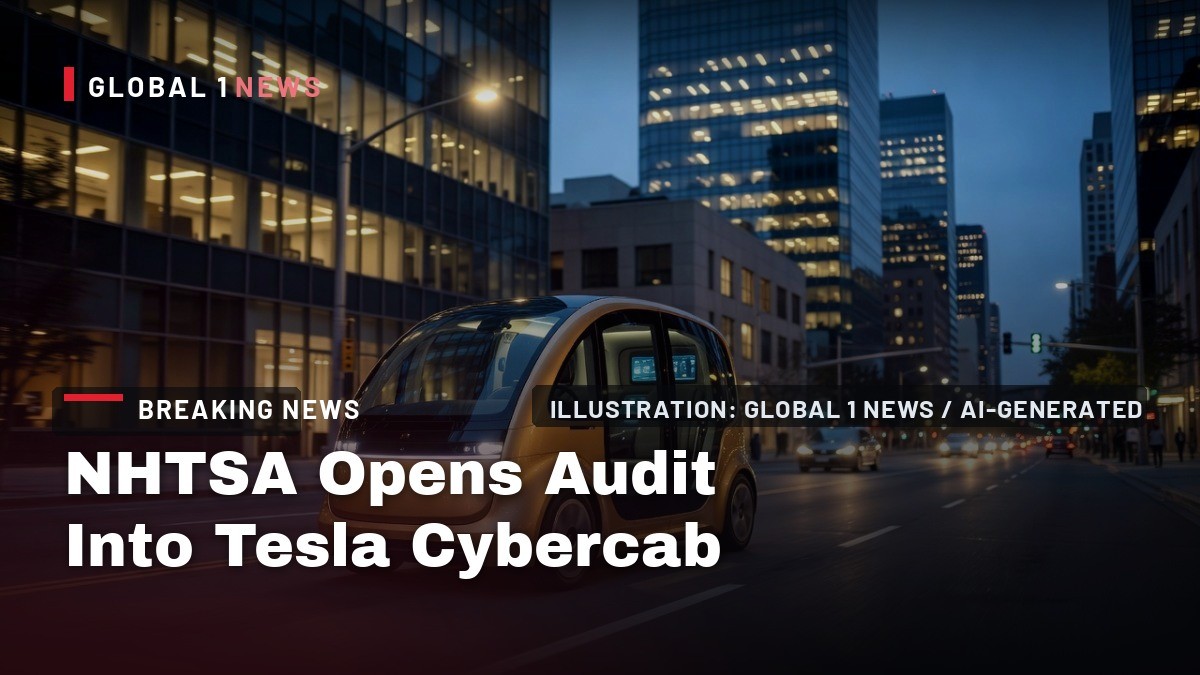
On Thursday, September 3, 2026, Tesla began charging fares for driverless rides in its two-seat, gold-hued Cybercabs in Austin, Texas, marking the company’s first commercial deployment of a vehicle built without a steering wheel, brake pedals, or side mirrors. The same day, the U.S. National Highway Traffic Safety Administration opened a formal audit into how Tesla certified that those vehicles meet federal safety standards — a move that puts the company’s self-certification process under direct federal scrutiny as it launches a product unlike anything else on American roads.
The audit, designated AQ26002, covers roughly 1,000 Cybercabs operating in Austin. NHTSA announced the action in a press release dated September 4, 2026, from Washington, D.C. The audit does not test how well the Cybercab drives. Instead, NHTSA said it will review whether Tesla’s self-certification “depended on determinations that certain FMVSS are inapplicable” to a vehicle lacking traditional human controls. Federal Motor Vehicle Safety Standards cover items like steering columns, mirrors, and brake pedals — components that simply do not exist on the Cybercab.
What NHTSA is examining
NHTSA Administrator Jonathan Morrison framed the audit as a routine but essential check on a novel vehicle design. “NHTSA fully supports the safe development and deployment of automated vehicles,” Morrison said in the agency’s statement. “But as the federal regulator, we need to ensure that all of our laws are followed.” He added that the approach of “balancing innovation with safety oversight” will allow the United States to maintain global leadership in automated vehicle development.
The audit is not an accusation of wrongdoing. It is a review of paperwork — specifically, Tesla’s certification that the Cybercab complies with every applicable Federal Motor Vehicle Safety Standard. Tesla says it considers the Cybercab compliant with every standard that applies to a car without those parts. NHTSA will now test that logic, examining whether the company’s determinations that certain standards are “inapplicable” hold up under federal law.
The timing is notable. Tesla began charging passengers for Cybercab rides on the same day the audit was opened. The company’s Robotaxi app is now live in Austin, and Tesla said rides were open to everyone. Executives described pricing plans and said the company wants to expand Cybercab service to more vehicles and more cities in the coming months.
How self-certification works — and why Tesla didn’t need Washington’s sign-off
Under U.S. rules in 49 CFR Part 571, automakers certify their own compliance with federal safety standards. They build the vehicle, declare it meets FMVSS, and sell it without advance NHTSA approval. NHTSA audits that paperwork after the fact and can open defect investigations, demand exemptions, order recalls, or pursue enforcement if it finds problems.
This self-certification system is how every car on American roads gets to market. But it takes on new significance with the Cybercab, because the vehicle lacks the physical controls that many federal standards were written around. NHTSA has stressed that existing standards still apply in full to automated vehicles until it writes new rules. There is no separate rulebook for driverless cars yet.
Under the Trump administration, NHTSA says it is working on eight rulemakings — including standards related to brake pedals, windshield wipers, lighting, and rearview mirrors. But until that work is complete, existing standards remain in force. That means Tesla must either meet those standards as written, argue they do not apply to a vehicle without the relevant parts, or seek an exemption.
Tesla chose self-certification instead of seeking a formal exemption. That decision has consequences. Consider the comparison with Amazon’s Zoox, which self-certified its steering-wheel-free shuttle and then secured a temporary safety exemption capped at 2,500 exempt vehicles per year through July 31, 2028. Tesla’s engineering chief, Lars Moravy, said earlier this year on X that the Cybercab would not be subject to that 2,500-vehicle cap. NHTSA previously said Tesla had not applied for an exemption.
The fleet race: Tesla vs. Waymo
The Cybercab launch is part of a broader push by Tesla to scale its driverless operations. Tesla has operated a driverless Model Y robotaxi service in Austin since June 2025, but those cars retained manual controls. The Cybercab is different — it is purpose-built for autonomy, with no way for a human to take the wheel.
According to tracking site RobotaxiTracker, Tesla now operates more than 200 “unsupervised” taxis without safety drivers across five cities in Texas and Florida. By comparison, Waymo runs more than 4,000 driverless vehicles across 14 cities. Tesla’s fleet is still small relative to its rival, but the company is moving quickly. Tesla started manufacturing the Cybercab in April 2026, and Elon Musk has promised production would grow “exponentially” later this year or next.
Investors took notice. Tesla shares rose more than 5% on Thursday, September 3, on expectations the robotaxis could gain traction. The Austin Cybercab rollout followed a robotaxi bollard crash in Austin that had drawn attention to the service — a reminder that the technology is still maturing in public view.
Musk unveiled the Cybercab in 2024 and promised it would sell for less than $30,000. The vehicle is now on Austin streets, but the broader question of how it was certified — and whether that certification survives federal scrutiny — is just beginning to unfold.
Broader FSD scrutiny: 3.2 million vehicles under investigation
The Cybercab audit is not the only federal action involving Tesla’s driver-assist technology. NHTSA has upgraded probes into Tesla’s Full Self-Driving system covering roughly 3.2 million Tesla vehicles, including the unsupervised robotaxi services in Texas and Florida. These are separate from the Cybercab audit and focus on how the software performs in real-world conditions.
NHTSA has multiple open inquiries into Tesla driver-assist systems. One probe covers crashes in reduced-visibility conditions — fog, sun glare — including a collision that killed a pedestrian. Another involves incidents where Teslas using partial self-driving ran red lights or drove on the wrong side of the road. A third probe is examining whether Tesla breached rules by failing to report crashes in a timely manner.
The crash-reporting question is significant. Under a 2021 NHTSA Standing General Order, automakers must report crashes where a Level 2 driver-assist system was engaged within 30 seconds of impact and someone was hurt, killed, or a vehicle was towed. Tesla accounts for roughly 85% of the entire industry’s reports — nearly 4,000 crashes. Tesla logged a record 207 crashes in May 2026, its highest single-month total, more than all of 2021 combined, which stood at 157.
Redacted reports and fatal crashes
Investigative outlet Electrek reports that Tesla redacts the crash narrative, software version, and operating-area field on virtually all of its reports as “confidential business information.” Electrek says 99.9% of narratives have been blacked out every year since 2019. By contrast, GM, Ford, Honda, and Toyota redact essentially none of that information.
Electrek has matched redacted reports to fatal crashes previously reported as ordinary accidents. One case involved a 2020 Model 3 stopped at 0 mph in a live lane of Interstate 4 near Lake Mary, Florida, rear-ended by a semi, with the driver killed in October 2025. Another involved a near-identical 2020 Model 3 stopped on Loop 202 in Mesa, Arizona at 3 a.m. on Halloween 2025, rear-ended by a Ford F-350 pickup, with the driver killed.
In Clute, Texas, a Model 3 left the road and hit a park pool, killing 23-year-old Steven Alvarez. Tesla data showed driver-assist verified engaged at 104 mph. And in Batavia, Illinois, a 2026 Model Y made a left turn at about 24 mph and struck a Dodge pickup with the right of way, killing Maggie Espinosa, a teacher and mother of five. Electrek reported FSD was “verified engaged” in that crash.
The pattern, according to Electrek, is that Tesla’s heavily redacted reports make it difficult for regulators and the public to understand the circumstances of crashes involving its driver-assist systems. The company’s practice stands in sharp contrast to other automakers, which provide far more detail in their filings.
Tesla’s safety claims and the criticism
Tesla says its Full Self-Driving software — a version of which runs the Cybercabs — is up to 10 times safer than human drivers. The company also says its Austin service has operated without a fatal accident. Those claims are central to Tesla’s marketing of its autonomous technology and its push to expand driverless operations.
But the claims have drawn skepticism. Reuters has reported interviews with multiple former Tesla employees who trained the company’s self-driving software and said it continued to struggle with basic maneuvers. Tesla’s own AI trainers have criticized the company’s safety statistics as misleading, according to those reports.
The legal environment is also shifting. A California court ruled in December 2025 that Tesla’s Autopilot marketing was deceptive. That ruling could have implications for how Tesla describes its driver-assist and autonomous capabilities going forward, including the claims it makes about the Cybercab’s safety.
What comes next
The NHTSA audit of the Cybercab certification is just the beginning of what could be a lengthy process. The agency can open defect investigations, demand exemptions, order recalls, or pursue enforcement if it finds Tesla’s self-certification was improper. Any of those outcomes would have significant implications for Tesla’s robotaxi ambitions.
The Zoox comparison is instructive. Zoox self-certified its steering-wheel-free shuttle and then secured a temporary safety exemption capped at 2,500 exempt vehicles per year through July 31, 2028. Tesla has not applied for an exemption, and Moravy has said the Cybercab would not be subject to that cap. If NHTSA determines that Tesla’s self-certification was flawed, the company could be forced to seek an exemption or halt operations.
NHTSA’s eight rulemakings — covering brake pedals, windshield wipers, lighting, and rearview mirrors, among other standards — are still in progress. Until those rules are finalized, existing standards remain in force, and Tesla must navigate them as written. The company says it considers the Cybercab compliant with every standard that applies to a car without those parts. Federal regulators will now test that assertion.
Tesla wants to expand Cybercab service to more vehicles and more cities. The company’s production timeline calls for exponential growth later this year or next. But the federal audit, the broader FSD investigations, and the questions raised by redacted crash reports all hang over that expansion. For now, the Cybercab is on Austin streets, carrying paying passengers — and carrying the weight of a federal review that will help determine whether vehicles without steering wheels can legally operate on American roads.
This article was produced with AI-assisted research and editorial support. Sources: NHTSA press release (Sept. 4, 2026), Reuters, The Associated Press, Electrek, Motor1.
By Jessica Ali, Staff Writer
What's Your Reaction?
 Like
0
Like
0
 Dislike
0
Dislike
0
 Love
0
Love
0
 Funny
0
Funny
0
 Wow
0
Wow
0
 Sad
0
Sad
0
 Angry
0
Angry
0

Editor-in-Chief at Global1.News. Atlanta-based journalist who cuts through the BS and tells it like it is. Lead anchor, host, and the voice you hear when the spin stops and the truth starts.









Comments (0)