
Why Trump gave Xi an ornate bald eagle statue at the state dinner
During a lavish state dinner in Washington on Thursday, U.S. President Donald Trump presented Chinese President Xi Jinping with a sculpted bald eagle, the national bird of the United States.
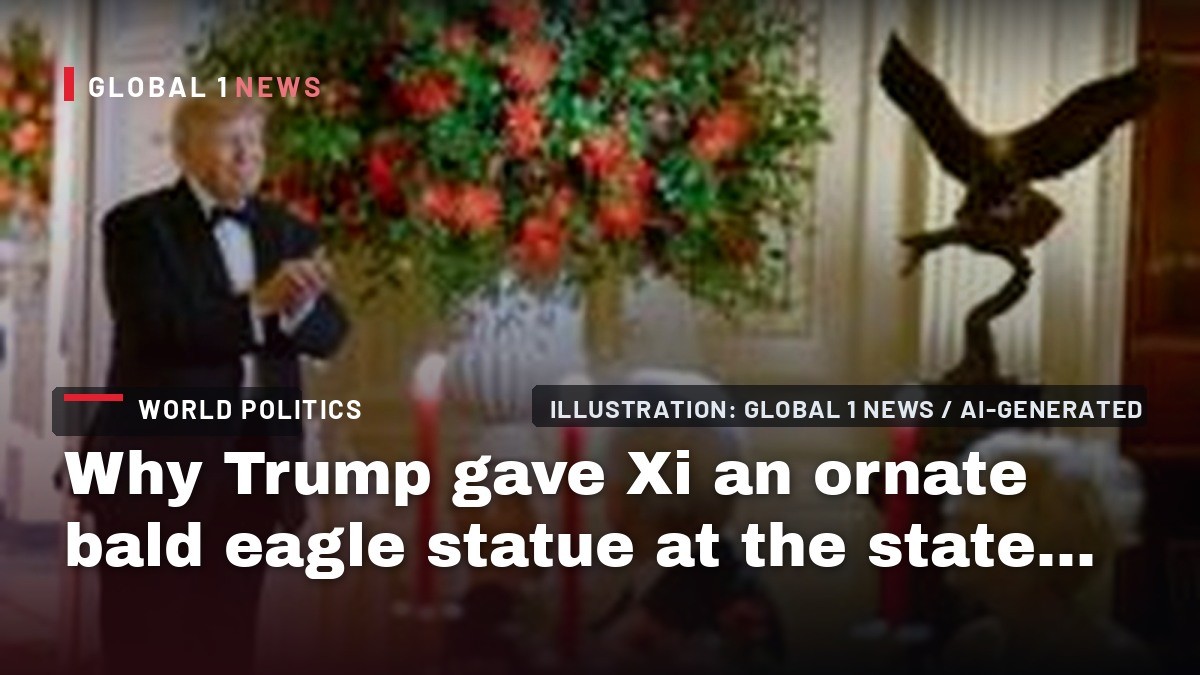
During a lavish state dinner in Washington on Thursday, U.S. President Donald Trump presented Chinese President Xi Jinping with a sculpted bald eagle, the national bird of the United States. The gift, described by Trump as embodying “the free and soaring spirit of America,” was unveiled before a circle of diplomatic VIPs and formed part of a broader diplomatic choreography that underscores the personal dimension of the three‑day summit between the two world leaders.
The Symbolic Weight of the Eagle
The bald eagle statue, a bird native to North America, carries a clear symbolic resonance for the United States. By framing the sculpture as a representation of America’s “free and soaring spirit,” Trump linked the gift to a narrative of national identity that is familiar to both domestic and foreign audiences. The president also noted that he and First Lady Melania Trump participated in the design, adding a personal touch that aligns with the tradition of leader‑level diplomacy where gifts serve as extensions of the giver’s personality and values.
Such symbolism is not accidental. As Daniel Kritenbrink, a partner at The Asia Group and former U.S. diplomat, observes, the exchange of gifts is a “key part” of the personal relationship that underpins the “most complex and the most consequential relationship in the world.” In the context of a summit that tackles trade, technology and security, the eagle functions as a visual reminder that, beyond policy, there remains a human connection between the two heads of state.
Reciprocity: Pandas and Student Exchanges
In a parallel gesture, President Xi announced the donation of two giant pandas—Ping Ping and Fu Shuang—to Zoo Atlanta, accompanied by a new student exchange programme that will bring 100,000 U.S. students to study in China over five years. Xi framed the pandas as “envoys of friendship” between the two nations, echoing a long‑standing diplomatic tradition in which the beloved animal serves as a soft‑power bridge.
The scale of the student exchange, while not quantified in monetary terms, signals a substantial cultural investment. By linking the pandas with a massive educational flow, Xi paired a symbolic gift with a concrete, long‑term people‑to‑people initiative, reinforcing the notion that diplomatic overtures extend beyond ceremonial moments to tangible exchanges that shape future bilateral ties.
The Historical Context of Gift‑Giving in U.S.–China Relations
Gift‑giving has long been a feature of high‑level diplomacy, but the practice varies markedly across political systems. According to Morten Skumsrud Andersen, co‑author of a study on diplomatic gifts, autocratic regimes such as China tend to present more expensive items, whereas democratic societies have instituted “guardrails” that limit the value of gifts. In the United States, the Constitution’s emoluments clause caps the dollar value of gifts a president may receive from foreign governments at $525, with higher‑valued items becoming federal property unless the president purchases them personally.
These restrictions shape how gifts are negotiated and presented. Ole Jacob Sending of the Norwegian Institute of International Affairs notes that the process involves “a lot of thought and process” and can take weeks of behind‑the‑scenes coordination. The eagle statue, therefore, reflects a carefully choreographed exchange that respects both American legal constraints and the diplomatic expectations of the Chinese side.
Comparative Cases: Obama, Brown and Earlier Exchanges
Past U.S. state visits illustrate the nuanced balance between symbolism and practicality. In 2013, President Barack Obama presented President Xi with a redwood bench, a piece of Californian timber that evoked the location of their earlier meeting. The bench was a modest yet meaningful token that facilitated a photo‑op where the two leaders sat together, underscoring a shared moment of camaraderie.
Earlier, in 2009, then‑British Prime Minister Gordon Brown gave Obama an ornamental desk pen holder made from timbers of a historic anti‑slave ship, while Obama’s reciprocal gift—a set of DVDs—was reportedly incompatible with UK players. Sending describes that exchange as “embarrassing,” highlighting how mismatched gifts can create diplomatic friction, especially when leaders are rivals rather than allies.
Strategic Stakes Behind the Ceremony
The current summit occurs against a backdrop of heightened strategic competition. Both the United States and China are racing to dominate the rapidly expanding artificial‑intelligence industry, a rivalry that fuels concerns about an “AI‑led apocalypse.” Simultaneously, the two economies are emerging from a bitter trade war that has only been paused by a temporary truce extended during this visit.
In this environment, the ceremonial aspects—military flyovers, state dinner pageantry, and the exchange of gifts—serve a stabilising function. Kritenbrink emphasizes that “protocol and optics and gift‑giving all as a means to an end, which is stable US‑China relations.” By smoothing over tensions through visible symbols of goodwill, the leaders aim to preserve a fragile peace that could otherwise dissolve into a “white‑hot trade war.”
The Role of Personal Diplomacy in Leader‑Level Relations
Both Trump and Xi place a premium on personal rapport as a conduit for broader policy outcomes. Kritenbrink, drawing on his three decades of diplomatic experience in Asia, argues that the “direct Trump‑Xi bond” is the glue holding together the bilateral relationship. This perspective aligns with the broader view that leader‑level diplomacy can bypass bureaucratic inertia and create channels for rapid decision‑making.
Nevertheless, the reliance on personal chemistry carries risks. As Sending warns, a misstep in gift selection or protocol can “potentially derail any larger objectives.” The careful orchestration of the eagle statue and the pandas demonstrates an awareness of these risks, with each side seeking to project respect and goodwill while adhering to domestic legal frameworks.
Looking Ahead: Implications of the Gift Exchange
The immediate impact of the eagle and panda gifts is largely symbolic, yet they may influence the tenor of upcoming negotiations. By foregrounding a narrative of friendship and mutual respect, both administrations can frame subsequent policy discussions in a less adversarial light, potentially easing the path for agreements on AI governance, trade tariffs, and security cooperation.
Moreover, the student exchange programme announced by Xi represents a long‑term investment in people‑to‑people ties that could soften future diplomatic friction. As generations of American students experience Chinese society, the personal connections forged may translate into a broader base of public support for balanced bilateral relations.
In sum, the exchange of a bald eagle statue for pandas and an ambitious educational initiative encapsulates the delicate balance of symbolism, legal constraints, and strategic calculation that defines contemporary U.S.–China diplomacy. While the gifts themselves are modest in material value, their role in reinforcing a fragile truce and promoting a narrative of cooperative competition underscores the enduring power of diplomatic ritual in an era of high‑tech rivalry.
This article was produced with AI-assisted research and editorial support. Reporting is based on the source material cited below. Sources: BBC News Asia; bbc.co.uk; Global1.News (27 September 2026).
By Kenji Tanaka, Staff Writer
What's Your Reaction?
 Like
0
Like
0
 Dislike
0
Dislike
0
 Love
0
Love
0
 Funny
0
Funny
0
 Wow
0
Wow
0
 Sad
0
Sad
0
 Angry
0
Angry
0

Japan Correspondent at Global1.News. Tokyo-based voice covering Japanese politics, technology, economy, and culture. Tracks the intersection of tradition and innovation in one of the world's most dynamic societies.













Comments (0)