
The strange, ancient bird hiding in Mexico’s cloud forests
Deep in the mist‑cloaked cloud forests of Chiapas and southern Guatemala lives a bird that feels more like a legend than a creature of flesh and feather.
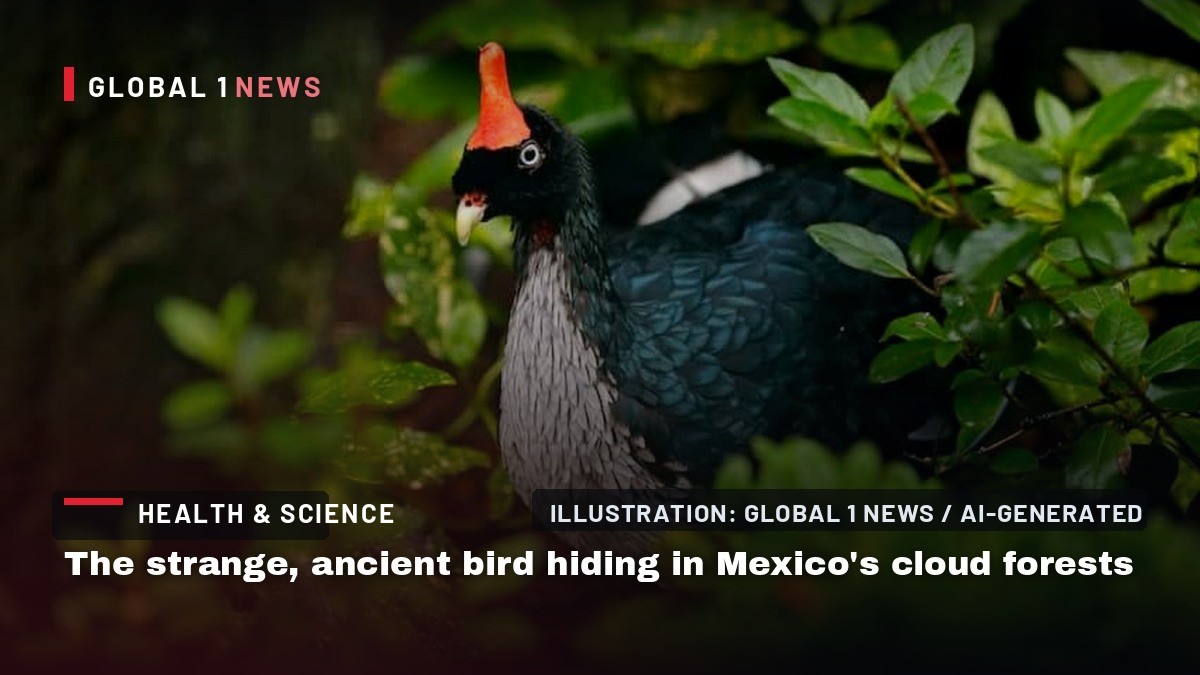
Deep in the mist‑cloaked cloud forests of Chiapas and southern Guatemala lives a bird that feels more like a legend than a creature of flesh and feather. The horned guan, with its dark back, white chest and a startling red “horn” jutting from its forehead, has been puzzling naturalists for almost two centuries. Its story begins in the 1840s, when a Mexican collector named Don Joaquín Quiñones retrieved a strange specimen from the slopes of Volcán de Fuego. Whether he hunted it himself or received it from nearby villagers remains a mystery, but Quiñones recognized that he held something extraordinary. He passed the bird to the 13th Earl of Derby, a British patron of the natural sciences, who in turn loaned it to George Robert Gray of the British Museum. Gray, then head of the museum’s ornithology department, catalogued the bird in his 1844 work “The Genera of Birds,” naming it Oreophasis derbianus and placing it among the guans—a family of chicken‑sized, social, tree‑dwelling birds that range from Mexico to northern South America.
From a Curious Specimen to an Endangered Icon
The horned guan’s journey from a curiosity in a European museum to an emblem of conservation began with its unique appearance. Unlike its relatives, it bears a fleshy, crimson horn on its forehead—a feature that captured the imagination of early naturalists and later became a symbol of its singular lineage. Modern genetics have confirmed that the bird is not a true guan at all; it split from other guans somewhere between 20 and 40 million years ago, forming an independent evolutionary branch that exists only in the Mesoamerican cloud forest. This ancient lineage, as Dr. Fernando González‑García notes, “represents an ancient lineage that originated in and is strictly endemic to the Mesoamerican region.” The bird’s rarity and limited range earned it a place on the IUCN Red List in 2000, and it has remained endangered for more than two decades.
The Elusive Habitat of the Horned Guan
Today the horned guan survives in meager colonies perched on the steep mountain slopes of Chiapas and southern Guatemala. The birds inhabit cloud forests—ecosystems that cling to the misty elevations of the Sierra Madre de Chiapas, where humidity and temperature create a unique environment for orchids, bromeliads and a chorus of other avian species. Because the guan’s population is small and its habitat remote, spotting the bird is a challenge even for seasoned birdwatchers. A typical trek begins before dawn in a four‑wheel‑drive vehicle, followed by a hike through dense forest to a clearing where recent sightings have been reported. Only a knowledgeable local guide can navigate the rugged terrain and know the right moment to pause and listen for the guan’s distinctive calls, especially during the noisy mating season.
Even scientists find the search demanding. Dr. González‑García’s 1995 study, based on two months of fieldwork, recorded just five individuals. Yet the field station at El Triunfo Biosphere Reserve now offers a better chance of observation, particularly when the birds become vocal during their breeding months. The odds improve, but the bird remains a bonus rather than a guarantee for any visitor to the cloud forest.
Feeding, Nesting and Social Life
Despite their reputation as solitary foragers, horned guans often gather in small groups while feeding. Their diet consists of a variety of fruits, flowers and leaves harvested from the forest canopy, though they sometimes descend to the forest floor in search of additional food sources. This opportunistic feeding behavior helps them survive in a habitat where food availability can fluctuate with the seasons.
Nesting habits remained a mystery until the 1980s, when researchers discovered that the birds construct simple nests of leaves and roots in the lower to upper canopy. The nests are relatively small, reflecting the bird’s modest clutch size. While the exact division of labor between male and female during incubation and chick‑rearing is still unknown, the discovery of these nests marked a significant step forward in understanding the species’ life cycle.
Courting in the Cloud Forest
The most spectacular aspect of the horned guan’s biology is its elaborate courtship. From January to March, males move among several females, performing wing‑beating, neck‑stretching and tail‑spreading displays that echo the flamboyance of tropical dances. One of the most unexpected rituals involves dust‑bathing: a male selects a dust bowl, calls to a female, and the pair spends up to half an hour together in the dust. This behavior not only cleans their plumage but also helps eliminate parasites before nesting begins.
These courtship displays are not merely for show; they may be crucial for the species’ long‑term survival. Researchers are still investigating how often horned guans descend to lower slopes—a behavior that could indicate an ability to shift altitude in response to environmental changes. Such flexibility could become essential as climate change threatens their cloud‑forest homes.
Population Pressures and Conservation Efforts
The International Union for Conservation of Nature estimates that only between 600 and 1,700 mature horned guans remain in the wild. Their numbers are low, and the surviving birds are scattered across increasingly isolated forest fragments. Habitat loss, driven by agricultural expansion and logging, continues to shrink the cloud forests that the guans depend on. Additionally, the looming threats of climate change and forest fires compound the risk, as warmer temperatures are expected to increase fire frequency in these high‑elevation ecosystems.
Despite these challenges, there are signs of progress. Anti‑poaching initiatives have reduced illegal hunting, and the bird now enjoys protection within several nature reserves in Chiapas and Guatemala. Conservationists are also working to map the exact distribution of the species along the Sierra Madre de Chiapas, hoping to identify critical corridors that could reconnect fragmented populations.
Hope on the Horizon: Captive Breeding and Unconfirmed Populations
One avenue of hope lies in captive breeding programs. Africam Safari in Puebla, building on the pioneering work of Fundación ARA A.C., has run a “Cloud Forest Ambassadors” initiative that loans horned guan pairs to zoos worldwide, using the fees to fund field research. In 2016, the Saint Louis Zoo announced the hatching of new chicks, though the young birds required intensive hand‑rearing because the parents were inexperienced. While breeding a few individuals in captivity is a promising step, it remains far from a solution for re‑introducing the species into the wild.
Scientists also remain optimistic about undiscovered populations. Rumors persist of horned guans in Oaxaca and Honduras, based on local stories and a single unverified claim that a villager possessed a guan’s head. Though these reports have not yet produced concrete evidence, they encourage continued surveys in neighboring regions, where suitable cloud‑forest habitats still exist.
The Horned Guan as a Symbol of Mesoamerican Heritage
Beyond its scientific intrigue, the horned guan embodies a deeper cultural resonance for the people of the region. Its presence in the misty cloud forests links modern communities to the ancient ejidos and tianguis that have long depended on these mountains for sustenance and identity. When a researcher or traveler catches a glimpse of the bird emerging from the fog, the experience feels like a living connection to the past—a reminder that the same mountains that once sheltered the Maya also protect this singular species.
As climate change and habitat loss press on, the horned guan stands as a test of our collective commitment to protect the natural and cultural patrimony of Mesoamerica. The work of local guides, field biologists, and conservation NGOs demonstrates that, even in the face of uncertainty, there is a steadfast resolve to keep this ancient lineage alive for future generations. The cloud forest may be a hidden world, but its secrets, like the horned guan, are increasingly becoming a shared responsibility.
This article was produced with AI-assisted research and editorial support. Reporting is based on the source material cited below. Sources: Mexico News Daily; mexiconewsdaily.com; Global1.News (27 September 2026).
By Rosa Martinez, Staff Writer
What's Your Reaction?
 Like
0
Like
0
 Dislike
0
Dislike
0
 Love
0
Love
0
 Funny
0
Funny
0
 Wow
0
Wow
0
 Sad
0
Sad
0
 Angry
0
Angry
0

Latin America/Andes Correspondent at Global1.News. Based in Bogota, covering politics, environment, energy, and social movements across the Andean region. Passionate about environmental journalism and communities protecting their land.















Comments (0)