
Philippines Aborts Ayungin Resupply Mission as China Blocks Convoy 60 Miles Out
The Philippines aborted its resupply mission to the grounded BRP Sierra Madre at Ayungin Shoal on 24 September 2026 after Chinese vessels intercepted the convoy 60 nautical miles out. No one was injured; Manila and Beijing give differing accounts.
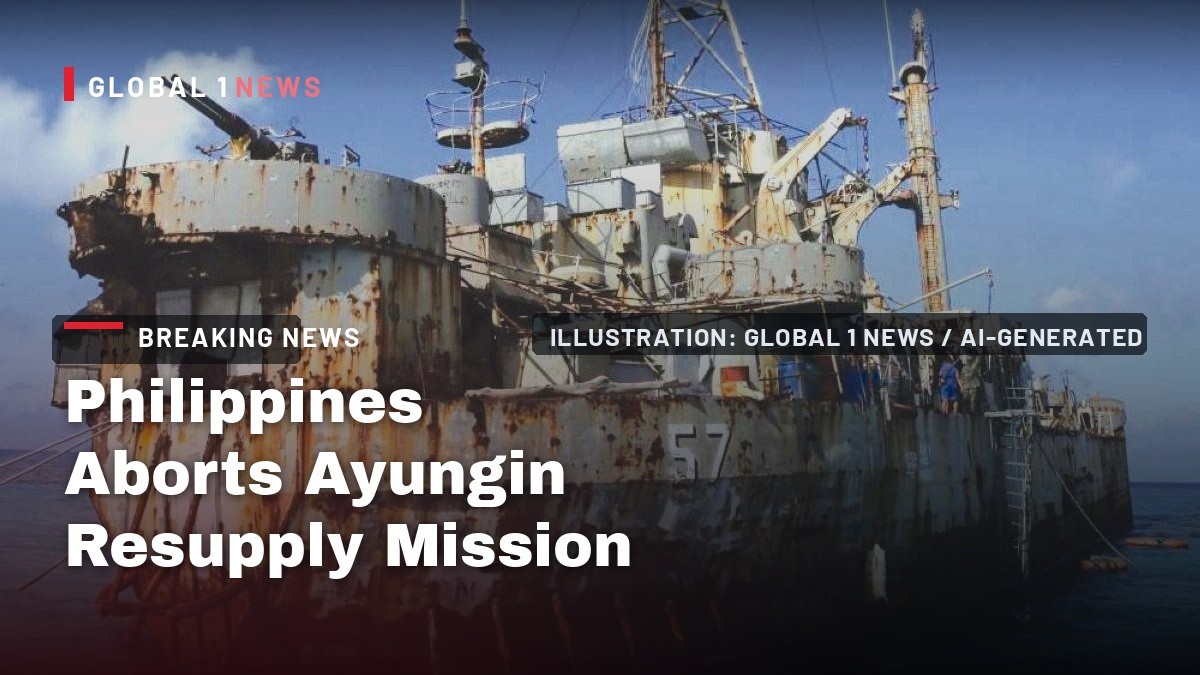
Chinese naval and coast guard vessels intercepted a Philippine resupply convoy in the West Philippine Sea on the night of 24 September 2026, forcing it to turn back about 60 nautical miles short of its destination. Manila confirmed the interference the following day. It is the first time the Philippines has publicly accused China of blocking a rotation and resupply mission since the two governments signed a provisional understanding in July 2024.
Philippines Aborts Ayungin Resupply Mission as China Blocks Convoy 60 Miles Out
Manila, Philippines - 26 September 2026 — The convoy never reached the BRP Sierra Madre. The Armed Forces of the Philippines suspended its rotation and resupply run to the grounded warship at Ayungin (Second Thomas) Shoal after Chinese vessels intercepted it a long way out, and by Saturday morning no replacement mission had been scheduled. What follows is what each side has put on the record, and where those accounts part ways.
The Night the Convoy Turned Back
Folks, the number that matters here is a distance, and it is a big one.
The encounter began at about 8:35 p.m. local time on Thursday 24 September and ran until about 11 p.m., according to Roy Vincent Trinidad, the AFP's spokesman for the West Philippine Sea. The mission itself was discontinued at about 11:08 p.m., according to Jay Tarriela, the Philippine Coast Guard's spokesman for the same waters.
The convoy was still about 111 kilometres - 60 nautical miles - from Ayungin Shoal when the Chinese vessels intercepted it. No collision occurred and no one was injured. "There was no collision, and no one was injured, but the dangerous manoeuvres of the China Coast Guard created a serious risk of collision," Tarriela said.
The National Task Force for the West Philippine Sea said the Chinese moves "put Filipino personnel at risk and obstructed a legitimate humanitarian and sustainment operation."
Trinidad drew a distinction that matters for how the night is described. "They did not technically block (our ships) but we were being monitored, driven away, and they were inching closer and closer," he said. "From miles until yards, thousands of yards, hundreds of yards - so to avoid escalation, it was the judgment call of the ground commander, the unified commander (to abort)."
Why 60 Nautical Miles Changes Everything
Trinidad put the distance at the centre of the story. In past encounters, he said, Chinese vessels would close on Philippine ships only when they were about 15 to 19 kilometres - 8 to 10 nautical miles - from the Sierra Madre. This time they were 60 nautical miles away.
"In the past, they could get as close as about 10 nautical miles to the shoal before actions like these occurred; now, even from 60 nautical miles away, Philippine vessels are already being harassed," he told the Manila Times.
The convoy was M/V Lapu-Lapu, the civilian supply ship the Navy uses for the run, plus three Philippine Navy and Coast Guard support vessels. Two Coast Guard patrol vessels, BRP Malabrigo (MRRV-4402) and BRP Cabra (MRRV-4409), supported the mission. Malabrigo was deployed to "provide security assistance" and was itself shadowed by Chinese Coast Guard vessels, Tarriela said. The purpose was to deliver supplies to, and rotate the personnel aboard, BRP Sierra Madre (LS-57).
Two Accounts of the Same Night
The two Philippine agencies do not agree on how many Chinese vessels were involved, and both counts are now on the record.
Trinidad's account says three People's Liberation Army Navy warships and five China Coast Guard vessels interfered - eight Chinese vessels in all. The Philippine News Agency and the Manila Times add that the PLAN group included two Houbei-class missile boats. USNI News, citing the AFP via ABS-CBN News, says two Type 022-class missile boats; the Type 022 is the Houbei class.
Tarriela's Coast Guard account is different: nine CCG vessels and five Chinese maritime militia vessels deployed to obstruct the mission, with a PLAN warship monitoring from a distance. PhilStar, combining both counts, reported that 15 Chinese vessels shadowed the convoy. USNI News also reported that a Coast Guard graphic shows three Chinese cutters shadowing Cabra and Lapu-Lapu, and that 11 further CCG and maritime militia vessels were seen near the Sierra Madre at Second Thomas and Sabina Shoals.
A Coast Guard monitoring report published by the Inquirer as its lead image puts the totals in a single frame. Timed "as of 24 2300H September 2026" - 11 p.m. on the night of the aborted run - it logs two Philippine Coast Guard vessels, the M/V Lapu-Lapu, nine China Coast Guard cutters and five Chinese maritime militia vessels in the vicinity of the Kalayaan Island Group. Its recap box reads "Total: 17 vessels."
What the Provisional Understanding Actually Says
Manila and Beijing reached a "provisional understanding" in July 2024, after a confrontation at the shoal the previous month. USNI News describes it as "a yet to be disclosed provisional agreement that enabled Philippine forces to access Second Thomas Shoal without harassment."
The mechanics, as the Inquirer reported them: the AFP's Western Command decides when a mission will run and informs the Department of Foreign Affairs, which relays the information to the Chinese foreign ministry. Foreign Affairs Secretary Ma. Theresa Lazaro has maintained that this does not involve seeking Beijing's approval.
The DFA's own wording is blunt. The understanding "is not a grant of or a request for permission to any foreign government" and "does not recognize any foreign jurisdiction over Philippine waters," it said. It "does not require the Philippines to seek permission to undertake RORE missions, nor does it allow boarding and inspection of Philippine vessels, and, above all, it does not concede the Philippines' sovereignty, sovereign rights and jurisdiction."
Beijing's Version: No Approval, No Passage
The China Coast Guard said the Philippines "broke its commitments and, despite China's warnings, dispatched a resupply vessel to deliver supplies to the illegally 'grounded' vessel at Ren'ai Jiao," according to Global Times. The state-run outlet reported that China "urged the Philippines to immediately stop provocations and troublemaking."
Global Times reported that the attempt "had not received prior Chinese approval and therefore was illegal," and that a source said it "fell outside the provisional humanitarian arrangements" between the two countries. It also said permission is the mechanism: under the arrangement, resupply activities "must be reported to China in advance and may proceed only with China's permission."
A source told Global Times the Coast Guard interception was "conducted in accordance with laws and regulations and in a rational and restrained manner," using "on-site tracking and monitoring and verbal warnings," and that "there was no intense confrontation between the two sides." Yang Xiao, a research fellow at the Chinese Academy of Social Sciences, called the Philippine operation "an act of harassment and provocation" and said China's refusal to let it proceed "was entirely reasonable and justified."
A Month of Escalation, Not One Incident
The aborted mission did not arrive out of a quiet stretch.
On 20 July 2026, Chinese Coast Guard personnel approached the Sierra Madre and struck Philippine personnel with wooden batons; two Filipino Navy sailors were injured and the Coast Guard evacuated them to Palawan despite Chinese vessels in the area. President Ferdinand Marcos Jr. summoned Chinese Ambassador Jing Quan to Malacañang the next day. Palace Press Officer Claire Castro called China's actions "illegal, aggressive and barbaric."
On 23 and 24 July, Chinese Coast Guard ships harassed Philippine Coast Guard and Bureau of Fisheries and Aquatic Resources vessels near Scarborough Shoal, including with water cannon.
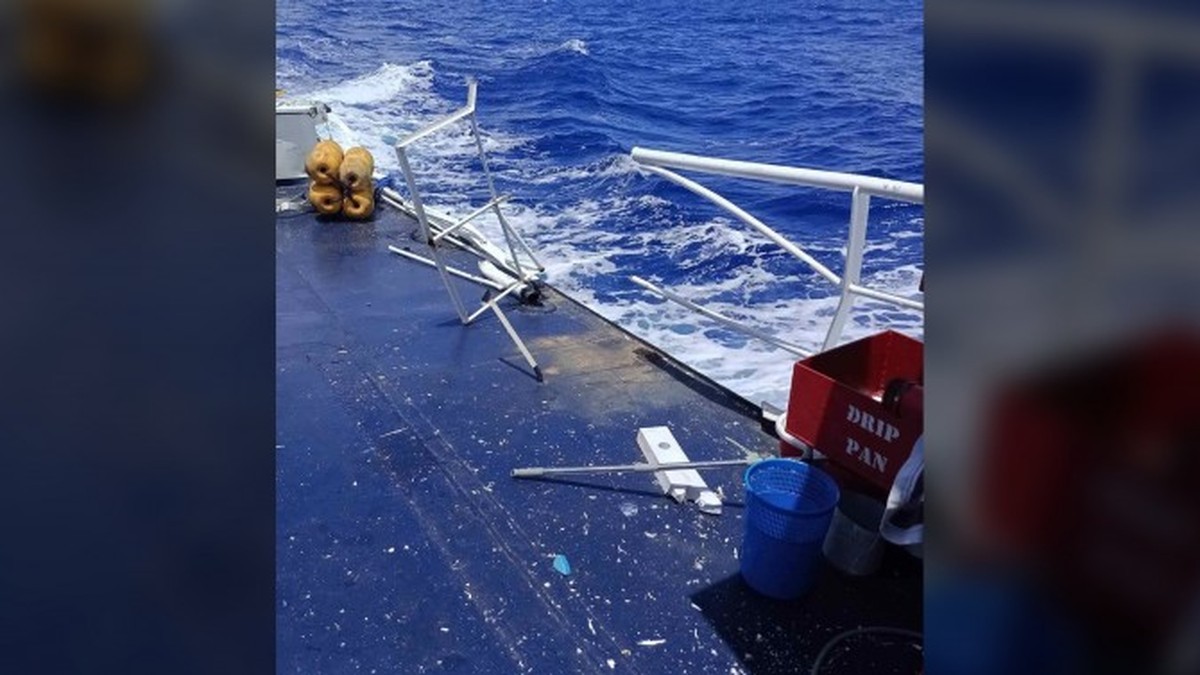
On 18 September, Coast Guard vessel CCG-21585 rammed the BFAR ship BRP Datu Magat Salamat about 54 nautical miles off Palawan while it was distributing fuel assistance to fishermen, damaging railings and deck structures. The Philippine Coast Guard called it an "intentional ramming." China said the Philippine vessel "disregarded repeated solemn warnings, deliberately altered its course and suddenly accelerated to cut across the bow of our vessel."
The Drill That Ran Two Nights Before
The resupply attempt came two days after a Philippine-led multinational maritime drill near Scarborough Shoal involving member states of the Association of Southeast Asian Nations and partners including the United States, Australia, India and Japan, USNI News reported.
These drills are a standing programme. The 17th Multilateral Maritime Cooperative Activity ran from 21 to 25 July 2026 in waters west of Zambales near Scarborough Shoal, with the USS George Washington carrier strike group and Japanese Self-Defense Force assets. The 19th ran from 19 August with US and Australian forces. Whether the timing of the aborted mission was connected to the exercise is not something either government has said.
China's presence in the water has been building. Earlier in 2026 the AFP monitored 48 Chinese Navy and Coast Guard vessels across four key features in the West Philippine Sea, 22 of them near Scarborough Shoal.
Who Is Aboard the Sierra Madre
Ayungin Shoal is a low-tide elevation about 194 kilometres west of Palawan, inside the Philippines' exclusive economic zone and continental shelf. The Philippines deliberately grounded the BRP Sierra Madre, a World War Two-era warship, there in 1999, after it became clear that a Chinese-made structure on Panganiban (Mischief) Reef was going to be used for military purposes. A small group of Filipino soldiers has held the rusting ship ever since.
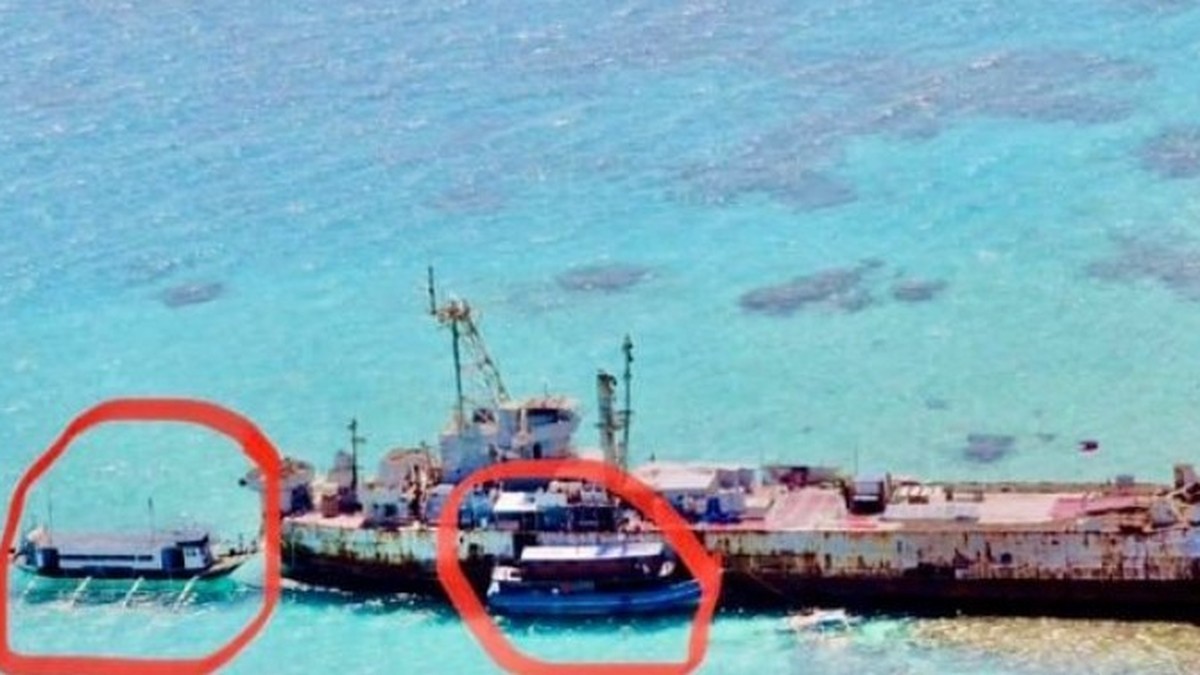
The 2016 arbitral tribunal ruled that Ayungin lies within the Philippines' exclusive economic zone and continental shelf, and that as a low-tide elevation it cannot generate maritime entitlements of its own or be claimed by any other state. China rejects the ruling. The DFA says Philippine vessels "do not require permission to sail to Ayungin" and that only the Philippines may authorise structures there.
USNI News describes what followed the 2016 case: "Since 2022, Philippine and Chinese forces have engaged in an increasingly escalatory standoff involving dangerous maritime maneuvers, rammings, water cannons and a culminating clash in 2024." It also noted a July 2026 melee "with batons and oars."
The Question Neither Side Will Answer
Two numbers remain in dispute, and both matter.
The first is what the 2024 deal actually requires. Its terms are not public. Global Times says resupply runs "must be reported to China in advance and may proceed only with China's permission." Manila denies that. DFA spokesman for maritime affairs Rogelio Villanueva Jr. said the deal was "carefully crafted," approved "by the highest officials of the Philippine government" including National Security Adviser Eduardo Año, and is "not, nor has it ever been, a Provisional Arrangement under Articles 74(3) and 83(3) of UNCLOS" but "an understanding between the Philippines and China aimed at conflict prevention and avoidance."
The second is how well it has worked. The Inquirer said on 26 September that at least 16 RORE operations had proceeded without incident since the deal. Global Times cited Philippine media acknowledging 15 "safe" missions over two years. The DFA earlier cited 13 incident-free runs since July 2024.
Reuters reported that the Chinese embassy in Manila did not immediately respond to a request for comment.
What Comes Next
Trinidad said the aborted run would not stop the military sustaining the Sierra Madre garrison, that contingency plans are in place, and that the AFP does not announce such operations in advance.
The AFP's statement on Friday 25 September was unambiguous: "These actions are irresponsible, are reckless and are inconsistent with applicable provisions of COLREGs (International Regulations for Preventing Collisions at Sea) and UNCLOS (United Nations Convention on the Law of the Sea) as well as the Philippines' rights affirmed by the 2016 Arbitral Award." It went on: "We call on the PLAN Navy and CCG to cease these dangerous actions and exercise restraint. The safety of our personnel remains paramount; nevertheless, these actions will not deter the AFP from performing its mission."
The National Task Force for the West Philippine Sea called on China "to immediately cease interfering with lawful Philippine RoRe missions" and said the Philippines "will continue to conduct lawful operations in the West Philippine Sea."
Folks, there are two things worth watching now: whether the AFP announces another resupply run, and the next round of multinational drills in the same water.
By Jessica Ali, Staff Writer
This article was produced with AI-assisted research and editorial support. Sources: Reuters, the Philippine News Agency, the Philippine Daily Inquirer, Rappler, PhilStar, The Manila Times, GMA News, USNI News, Global Times, Manila Bulletin, Malaya Business Insight, the Canadian Inquirer, KFGO, ABS-CBN News and The Hindu.
What's Your Reaction?
 Like
0
Like
0
 Dislike
0
Dislike
0
 Love
0
Love
0
 Funny
0
Funny
0
 Wow
0
Wow
0
 Sad
0
Sad
0
 Angry
0
Angry
0

Editor-in-Chief at Global1.News. Atlanta-based journalist who cuts through the BS and tells it like it is. Lead anchor, host, and the voice you hear when the spin stops and the truth starts.















Comments (0)