
Lego sales jump 21% as World Cup sets draw new customers, despite Iran war raising plastic costs
Lego posted a 21% jump in first-half sales on Tuesday, powered by World Cup and Formula 1 sets that attracted new customers, even as the Iran war drives up the cost of the plastics used to make its iconic bricks.
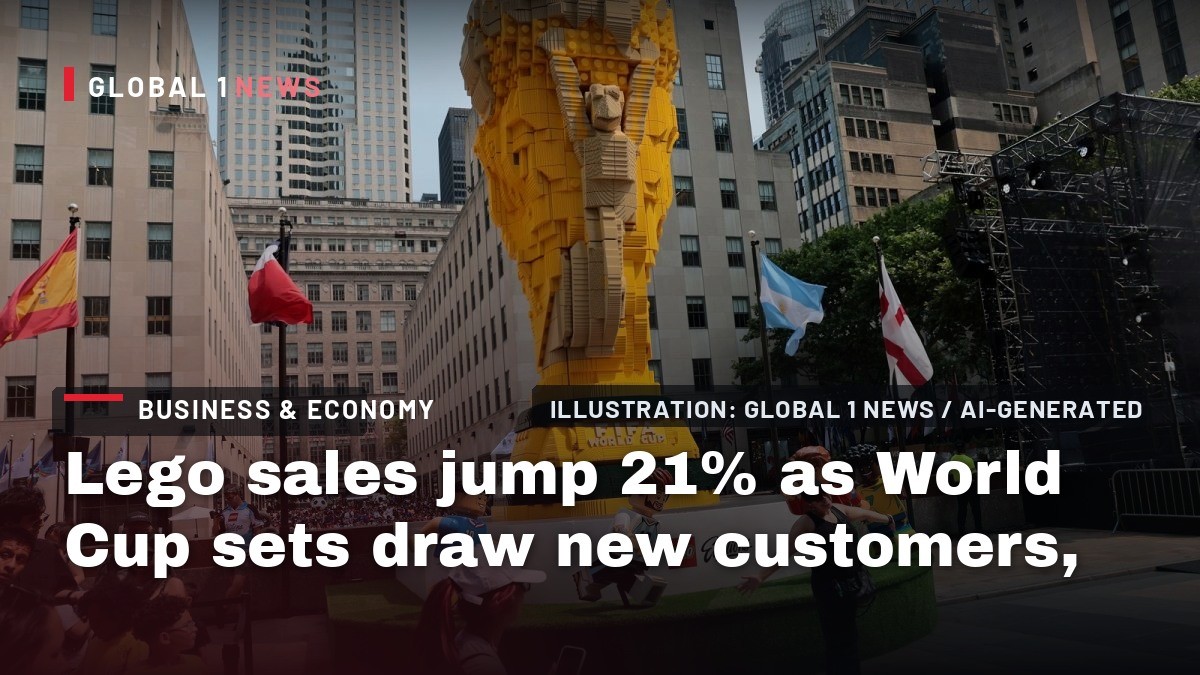
Lego posted a 21% jump in first-half sales on Tuesday, powered by World Cup and Formula 1 sets that attracted new customers, even as the Iran war drives up the cost of the plastics used to make its iconic bricks. The Danish toy giant reported revenue of 41.9 billion Danish crowns ($6.54 billion) for the first six months of 2026, up from 34.6 billion crowns in the same period last year, with operating profit rising 22% to 10.9 billion crowns and net profit climbing 32% to 8.6 billion crowns.
For Israeli consumers and retailers, the numbers offer a window into how global brands are navigating wartime economic strain — and what it may mean for toy prices on local shelves. The surge in global oil prices triggered by Israeli-US strikes on Iran and the subsequent blockade of the Strait of Hormuz during operations Roaring Lion and Epic Fury has raised the cost of plastics, a core raw material for Lego bricks. So far, Lego says the impact has been manageable, but the company acknowledges the second half of the year could tell a different story.
Record growth outpaces rivals Mattel and Hasbro
Lego's growth is outpacing competitors like Mattel and Hasbro, allowing the company to gain market share in a sector that has faced headwinds from inflation and shifting consumer habits. The company's success is attributed to tie-ups with film and entertainment franchises, as well as a deliberate strategy of producing more sets for adults alongside its traditional children's lineup. CEO Niels Christiansen told Reuters in an interview that the product portfolio is "really, really strong and it hits new passion points in this first half." The company also reported an expanded customer base, with Christiansen noting, "We also see more kids in the brand, which is really exciting for us that we managed to grow both the number of kids and consumers active, and also the total amount that they're buying."World Cup, Formula 1, and Pokemon drive demand
Lego launched more than 330 new sets in the first half of 2026, including a $199.99 replica of the official FIFA World Cup trophy, Pokemon sets using its new interactive bricks, and K-Pop Demon Hunters sets that Christiansen said were particularly popular with girls. The World Cup and Formula 1 themes have proven especially effective at drawing in new customers, tapping into global sporting events that capture attention across age groups. The timing is notable: with the World Cup generating excitement worldwide, Lego has positioned itself to capture demand from both children and adult collectors. The Formula 1 partnership similarly leverages a growing global fanbase, particularly in markets like the United States and the Middle East, where the sport has expanded rapidly in recent years.Iran war and the cost of plastics
The war with Iran has injected fresh volatility into global commodity markets. Oil prices rose during the Israeli-US strikes on Iran and the subsequent blockade of the Strait of Hormuz, a critical chokepoint for global energy shipments. Higher oil prices translate directly into higher costs for plastics, which are derived from petroleum feedstocks. Christiansen acknowledged the pressure, telling Reuters, "We are impacted by higher oil prices, but because we purchase so much non-fossil-fuel-based material that is less correlated to the oil price, we've actually been able to manage relatively well." Lego has been shifting towards renewable and recyclable materials to make its bricks, a strategy that appears to be cushioning the blow from oil price spikes.What this means for Israeli toy prices
For Israeli importers and retailers, Lego's resilience is a double-edged sword. On one hand, strong global demand for branded toys suggests that consumers continue to prioritize these purchases even during wartime economic strain. On the other hand, the rising cost of plastics — compounded by shipping disruptions in the Strait of Hormuz and regional supply-chain uncertainties — could eventually filter through to higher prices on Israeli shelves. Israeli toy retailers have been navigating a complex environment since the outbreak of the war, with import costs rising and consumers tightening discretionary spending. The shekel's performance against major currencies, alongside elevated shipping and insurance costs for goods transiting the region, adds further pressure. While Lego has so far absorbed much of the raw-material cost increase, the company's caution about the second half suggests that price adjustments cannot be ruled out.Lego's sustainability investments continue
Despite the wartime headwinds, Lego is pressing ahead with significant investments in sustainability. The company reported free cash flow of 2.1 billion Danish crowns, up from 1.7 billion in the same period in 2025, as it increased "investments in long-term growth, including factory capacity and the acquisition of LEGO and LEGOLAND Discovery Centres." Lego also made "significant continued investments in sustainable materials and solar capacity expansion," according to its statement, and continued its multi-year transition to paper-based bags, aiming to convert the remaining packaging lines across all factories by 2027. The company is planning to construct a large solar park near its Billund, Denmark headquarters, featuring 160,000 panels able to produce 99 GWh per year, which will be operational in 2027.New Virginia factory to serve closer to key markets
As part of its strategy to produce closer to its main markets, Lego is building a factory and distribution center in the US state of Virginia, aiming to open by the middle of 2027. The move reflects a broader trend among global manufacturers to shorten supply chains and reduce exposure to geopolitical disruptions — a lesson many companies have drawn from recent conflicts and trade tensions. For Israeli readers, the Virginia project underscores a wider shift in global manufacturing strategy. Regional production hubs reduce reliance on long shipping routes that pass through vulnerable chokepoints like the Strait of Hormuz. Israeli importers, who have faced their own supply-chain challenges during the war, may watch these developments with interest as global logistics patterns continue to evolve.CEO highlights strong start to 2026
"We are very pleased with our strong start to 2026 and the excitement we see for the LEGO brand," Christiansen said in a public statement released by Lego. "Our product portfolio offers something for everyone, and culturally relevant brand experiences continue to drive demand across the globe. Our success in the market means we can maintain high investment levels in growth and sustainability for both the short and long term." He also praised the company's workforce, saying, "It's been a real highlight to see the passion and commitment of our 34,000 colleagues in our organization who work to inspire kids and fans everywhere."Resilient demand amid wartime economic strain
Lego's performance offers a case study in consumer resilience during wartime. Despite the economic uncertainty generated by the Iran war, demand for branded toys has held up — and in Lego's case, grown substantially. The company's ability to attract new customers through World Cup and Formula 1 partnerships suggests that experiential and passion-driven purchases remain a priority for households even when budgets are tight. In Israel, where the war has reshaped daily life and economic priorities, the toy market has shown similar patterns. Parents continue to seek out quality toys for their children, and global brands with strong emotional resonance — like Lego — tend to fare better than generic alternatives. Educational and construction toys, in particular, tend to hold up better than purely discretionary categories in such periods, though local importers have faced their own cost pressures.Outlook for the second half
Lego's management has signaled caution about the second half of 2026, with Christiansen noting that the company "might see an impact" from higher oil prices in the coming months. So far, the impact has not been significant, but the trajectory of the Iran war and its effect on global energy markets remains uncertain. For Israeli consumers, the key question is whether Lego and other toy manufacturers will pass on higher costs. If oil prices remain elevated and the Strait of Hormuz blockade persists, plastic prices could climb further, eventually forcing price increases across the industry. Lego's heavy investment in non-fossil-fuel-based materials provides some buffer, but it is not immune to the broader commodity cycle.A global brand navigating regional conflict
Lego's first-half results are a reminder that even the most iconic global brands are not insulated from regional conflicts. The Iran war has touched everything from energy prices to shipping routes, and toy manufacturers are no exception. Yet Lego's ability to grow sales by 21% in this environment speaks to the strength of its brand and the enduring appeal of its products. For Israeli readers, the story is both distant and familiar. The war's economic ripple effects are felt in Tel Aviv supermarkets, Jerusalem toy stores, and Haifa port operations alike. Lego's experience — managing higher input costs while maintaining growth — offers a glimpse of how companies can adapt to wartime conditions without sacrificing long-term strategy.Investing through the cycle
Lego's decision to maintain high investment levels despite the uncertain environment reflects a long-term view that many Israeli businesses have also adopted during the war. The company is expanding factory capacity, acquiring LEGOLAND Discovery Centres, and investing in solar energy and sustainable materials — all while navigating a volatile commodity market. The solar park near Billund, with its 160,000 panels and 99 GWh annual capacity, is a significant commitment to reducing the company's carbon footprint. The paper-based bag transition, targeting completion by 2027, similarly signals that sustainability remains a priority even as the company manages wartime cost pressures.What Israeli retailers can learn
Israeli toy retailers and importers watching Lego's results may draw several lessons. First, strong brands with diverse product portfolios are better positioned to weather economic shocks. Second, investment in sustainability and supply-chain resilience can provide a competitive edge when raw material costs spike. Third, consumer demand for passion-driven products — whether World Cup trophies or Formula 1 cars — tends to remain resilient even during wartime. The coming months will reveal whether Lego's cautious outlook materializes into actual cost pressures. For now, the company's first-half performance stands as a testament to the power of strong branding and strategic investment — even in a world reshaped by conflict. This article was produced with AI-assisted research and editorial support. Sources: Jerusalem Post, Reuters. By Hannah Berg, Staff WriterWhat's Your Reaction?
 Like
0
Like
0
 Dislike
0
Dislike
0
 Love
0
Love
0
 Funny
0
Funny
0
 Wow
0
Wow
0
 Sad
0
Sad
0
 Angry
0
Angry
0

Hannah Berg
Israel Correspondent at Global1.News. Based in Tel Aviv, covering Israeli politics, security, technology, and society. Provides balanced, deeply-sourced reporting on one of the most closely-watched regions in the world.












Comments (0)