
St. Petersburg Plans Officials’ Pay Raises Amid Budget Cuts
St. Petersburg’s latest fiscal plan reveals a paradox at the heart of regional governance: while officials’ base salaries are slated for incremental raises, the city is simultaneously slashing spending on essential public services.
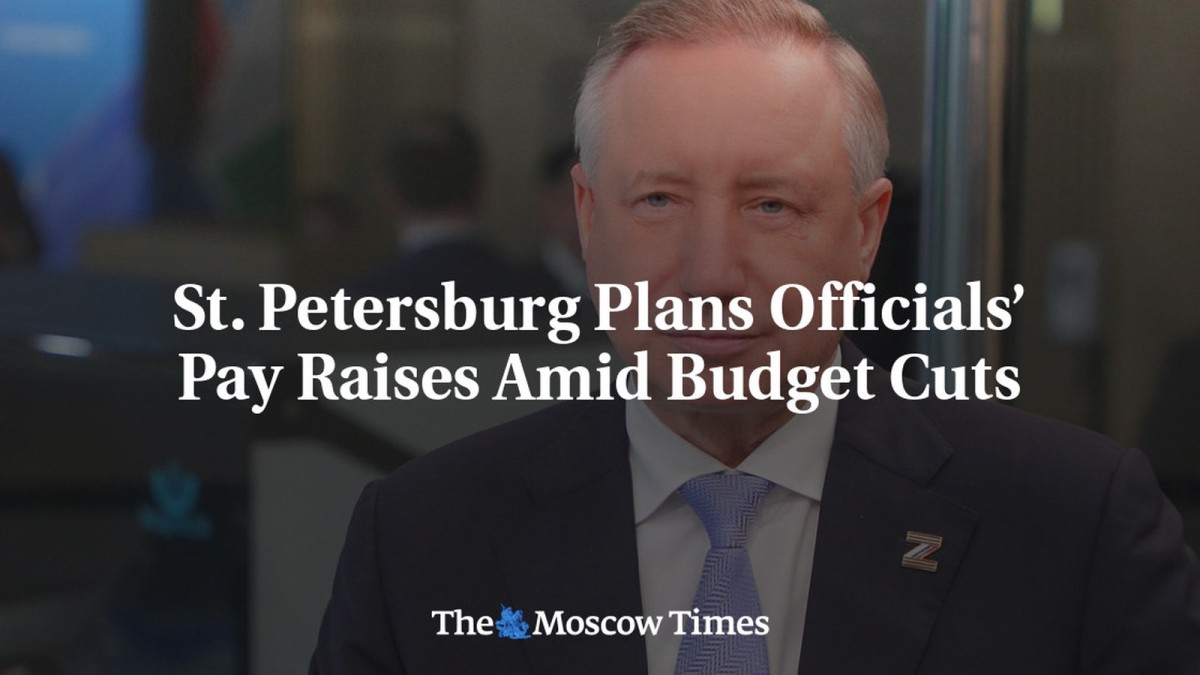
St. Petersburg’s latest fiscal plan reveals a paradox at the heart of regional governance: while officials’ base salaries are slated for incremental raises, the city is simultaneously slashing spending on essential public services. The draft budget, approved on September 29 and submitted to the Legislative Assembly, outlines a three‑year salary escalation of up to five percent per annum for top officials, alongside a 70.2 billion‑ruble reduction in the 2026 budget. This juxtaposition raises questions about fiscal priorities, borrowing strategies, and the broader political calculus within the Kremlin’s regional apparatus.
Salary Increases for the City Elite
The draft budget earmarks a stepwise rise in base pay for the city’s highest officials. By 2029, the Legislative Assembly speaker’s monthly base salary is projected to climb from roughly 149,100 rubles to 168,800 rubles. Deputy speakers and deputy governors would see their base salaries reach 159,400 rubles, while city government members would receive 154,700 rubles per month. These figures translate to an approximate increase of 13 percent for the speaker and a similar range for other senior officials.
These adjustments are presented as part of a broader effort to curb borrowing and narrow the budget deficit. However, the total remuneration for officials—including allowances, bonuses, and supplementary payments—remains higher than the base figures alone, underscoring a compensation structure that extends beyond the headline numbers.
Sharp Cuts to Public Expenditure
Concurrently, the administration proposes a substantial contraction of the 2026 budget, reducing it from 1.651 trillion rubles to about 1.58 trillion rubles. The most significant reduction, 36.7 billion rubles, targets the economy classification, reflecting a broader pullback on state‑driven economic initiatives. Transport spending faces a 9 billion‑ruble cut, while the ambitious Shirotnaya high‑speed highway project loses 10.8 billion rubles.
Social sectors bear a heavy burden as well. Education allocations would shrink by 15.5 billion rubles, and the health‑care committee’s budget would be trimmed by 8.5 billion rubles. Additional reductions affect housing and utilities (6.8 billion rubles), public‑space improvements (2.3 billion rubles), and road repairs (1.9 billion rubles). These cuts signal a reallocation of resources away from public services toward other fiscal priorities.
Increased Payments to Military Personnel
Amid the austerity measures, the city plans to raise payments to Russian troops fighting in Ukraine and their families by 6.4 billion rubles. This increase aligns with the administration’s stated aim of supporting the armed forces, yet it further illustrates the trade‑off between military financing and domestic welfare spending.
The allocation underscores the continued integration of regional budgets into the national war economy. By earmarking additional funds for troops, St. Petersburg reinforces the Kremlin’s narrative that the war effort remains a paramount state priority, even as ordinary citizens face reduced funding for schools, hospitals, and infrastructure.
Fiscal Rationale: Borrowing Costs and Deficit Management
The city administration attributes the spending cuts to “high borrowing costs, a planned cooling of the economy and efforts to reduce borrowing.” By trimming expenditures, officials aim to narrow the 2026 budget deficit by roughly 80 billion rubles, bringing it down from 189 billion rubles to 108.8 billion rubles. The projected deficit for 2027 stands at 103.4 billion rubles.
These figures suggest a deliberate strategy to stabilize the city’s finances in the face of tightening credit conditions. The emphasis on deficit reduction mirrors broader federal directives encouraging regional authorities to limit debt accumulation, a policy reinforced by recent central bank rate hikes and the Kremlin’s warnings against fiscal imprudence.
Political Implications for Regional Power Structures
Salary hikes for senior officials can be read as a tool for consolidating loyalty within the regional elite. By tying personal financial benefit to the city’s fiscal plan, the administration may be securing the support of key bureaucrats for broader austerity measures that could prove unpopular among the electorate.
Such a maneuver aligns with a pattern observed in other Russian regions, where remuneration adjustments are employed to reinforce hierarchical cohesion. The timing—coinciding with the upcoming 2027 budget cycle—suggests an effort to lock in a stable governing coalition before the next round of elections for the Legislative Assembly.
Impact on Citizens and Social Stability
The contraction of education and health‑care funding is likely to have tangible effects on service delivery. A 15.5 billion‑ruble cut to education could translate into reduced school resources, delayed teacher salaries, or postponed infrastructure projects. Similarly, an 8.5 billion‑ruble reduction in health‑care spending may strain hospitals already coping with pandemic‑era backlogs and the demands of a growing elderly population.
These cuts risk eroding public confidence in regional authorities, especially if they coincide with visible improvements in officials’ compensation. The disparity between rising salaries for the political class and shrinking public services could fuel discontent, a dynamic that the Kremlin typically seeks to mitigate through controlled media narratives and targeted social programs.
Strategic Outlook and Kremlin Oversight
St. Petersburg’s budgetary choices reflect a microcosm of the federal government’s balancing act: sustaining the war effort, managing debt, and maintaining social stability. By allocating additional funds to troops while curbing domestic spending, the city aligns itself with Moscow’s strategic priorities.
Looking ahead, the success of this fiscal plan will hinge on the city’s ability to achieve the projected deficit reductions without triggering public unrest. The Kremlin’s oversight mechanisms—particularly the Ministry of Finance’s monitoring of regional borrowing—will likely scrutinize St. Petersburg’s implementation. Any deviation from the planned cuts or salary increases could prompt corrective directives from the federal center, reinforcing the top‑down nature of Russian fiscal governance.
This article was produced with AI-assisted research and editorial support. Reporting is based on the source material cited below. Sources: The Moscow Times; themoscowtimes.com; Global1.News (02 October 2026).
By Irina Volkov, Staff Writer
What's Your Reaction?
 Like
0
Like
0
 Dislike
0
Dislike
0
 Love
0
Love
0
 Funny
0
Funny
0
 Wow
0
Wow
0
 Sad
0
Sad
0
 Angry
0
Angry
0

Russia/Eastern Europe Correspondent at Global1.News. Covering Russian politics, energy, security, and the shifting dynamics of the post-Soviet space. Provides clear-eyed analysis on one of the world's most opaque regions.














Comments (0)