
Kremlin Seizes Russian Subsidiary of German Retailer Metro
President Vladimir Putin signed an executive order on Monday that placed the Russian subsidiary of German retailer Metro AG under “temporary management” of the state.
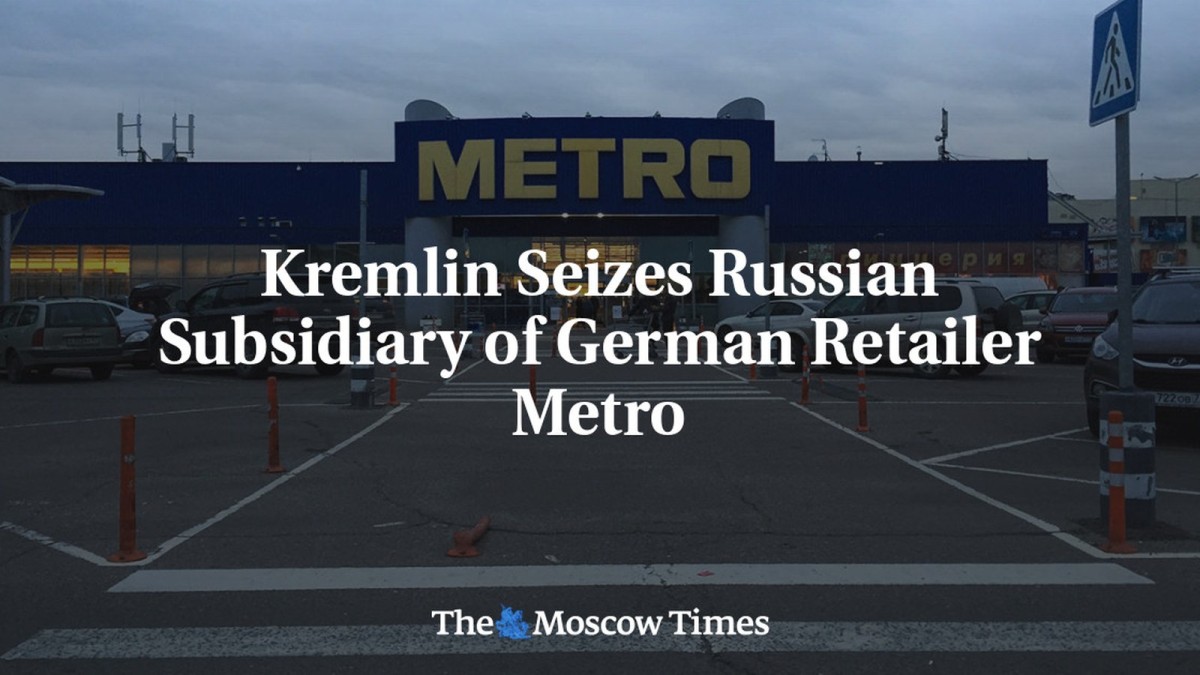
President Vladimir Putin signed an executive order on Monday that placed the Russian subsidiary of German retailer Metro AG under “temporary management” of the state. The decree transferred Metro Russia’s shares to Torg Rus, a management firm registered earlier this month, and named the current Metro Russia chief executive, Johannes Tholey, as the head of Torg Rus. Metro’s Russian arm issued a brief statement saying it would continue to operate as usual, while offering no comment on the specifics of the order.
Legal basis for the seizure
The Kremlin’s action rests on an authority granted by a 2023 decree that allows the state to place foreign assets under temporary management. This legal framework has been invoked repeatedly since then, first against the subsidiaries of Nestlé and the French supermarket chain Auchan earlier in September, and now against Metro Russia. The order is framed by Moscow as a response to “hostile actions” by “unfriendly” foreign governments, a narrative that aligns with the broader pattern of using asset seizures as a tool of political pressure.
Officially, the Russian government presents the measure as a protective step for the Russian economy, arguing that foreign owners are vulnerable to sanctions and geopolitical risk. Such claims are consistently attributed to Kremlin spokespersons and the Prosecutor General’s Office, which have emphasized the need to safeguard domestic markets from external threats.
Timing and diplomatic context
The seizure follows a high‑profile diplomatic encounter between Russian Foreign Minister Sergei Lavrov and his German counterpart at the United Nations General Assembly in New York. Lavrov later complained that the meeting yielded no new information, underscoring the limited diplomatic progress between Moscow and Berlin. The timing suggests that the asset takeover may be intended as a signal to Germany amid escalating tensions.
Just weeks before, Germany accused Russia of orchestrating an attempted drone attack at Leipzig/Halle Airport, prompting Berlin to close a Russian consulate and the Russian cultural centre in the city. Moscow denied the allegations, labeling them fabricated. These reciprocal accusations have heightened the diplomatic strain and provide a backdrop for the Kremlin’s decision to tighten control over German‑linked assets on Russian soil.
Pattern of recent asset seizures
Metro Russia joins a growing list of Western enterprises whose Russian operations have been placed under state control. Earlier in September, the Kremlin seized the Russian subsidiaries of French supermarket chain Auchan, Swiss food giant Nestlé, home‑improvement retailer Lemana PRO (formerly Leroy Merlin), and two French logistics firms. This wave reflects a systematic approach to curtail foreign corporate presence in strategic sectors, particularly retail and food distribution.
The selection of assets spans a range of consumer‑facing businesses, suggesting that the state is targeting sectors that directly affect everyday life. By placing these companies under temporary management, Moscow gains the ability to redirect supply chains, pricing policies, and employment decisions, thereby extending its influence over the domestic market while simultaneously sending a political message to the companies’ home governments.
Impact on Metro’s Russian operations
Metro AG, ranked among the world’s fourth‑largest retailers, now faces the prospect of its Russian business being run by a state‑appointed manager. While the subsidiary’s statement assures continuity of operations, the shift in ownership could lead to changes in procurement, pricing, and strategic priorities. Employees may experience uncertainty regarding job security and corporate culture as the firm adapts to state oversight.
From a commercial perspective, the seizure may disrupt Metro’s supply chains, particularly if the state imposes new regulations or redirects inventory to align with domestic policy goals. The broader retail market could see a reallocation of market share as foreign‑owned chains confront state‑run competitors, potentially reshaping consumer choices and price dynamics across Russia.
Domestic political implications
The Kremlin frames the asset seizures as a defensive measure against “hostile actions” by foreign governments, reinforcing a narrative of external threat that underpins many of President Putin’s recent policies. By portraying foreign retailers as vulnerable to sanctions and political pressure, the state justifies increased intervention in the economy. This rhetoric bolsters the government’s claim to protect Russian consumers and workers from external manipulation.
Moreover, the designation of The Moscow Times as an “undesirable” organization and a “foreign agent” underscores the broader crackdown on independent media. The newspaper’s own statement about facing criminalisation highlights the tightening environment for dissenting voices. The convergence of economic seizures and media repression signals a coordinated strategy to consolidate power and limit external influence on both the market and public discourse.
Geopolitical ramifications
The seizure of Metro Russia is likely to reverberate beyond the immediate commercial sphere, affecting Germany‑Russia relations. By targeting a prominent German retailer, Moscow sends a clear message that German businesses operating in Russia are subject to the same risks as those from other Western nations. This move may prompt German firms to reassess their exposure to the Russian market, potentially accelerating divestments or prompting negotiations for compensation.
Internationally, the pattern of asset seizures contributes to a widening economic divide between Russia and the West. As more foreign assets fall under state control, Russia’s integration with global supply chains could weaken, while the Kremlin deepens its reliance on domestic production and state‑managed enterprises. Such a trajectory may reinforce the bifurcation of the global economy, with long‑term implications for trade, investment, and diplomatic engagement.
Outlook and potential next steps
Looking ahead, the Kremlin is poised to continue its campaign of placing foreign assets under temporary management, especially as diplomatic tensions persist. The recent seizures illustrate a pattern that could extend to other sectors, including energy, technology, and finance, should the state deem them strategically important. Analysts anticipate that future actions will be closely tied to the ebb and flow of Russia’s foreign relations, particularly with countries that have taken a hard line against Moscow.
For Metro AG and other Western firms, the immediate priority will be to navigate the legal and operational challenges posed by state intervention, while seeking diplomatic channels to mitigate further losses. The broader business community will watch closely to gauge the Kremlin’s tolerance for foreign investment under the current geopolitical climate. In the meantime, the Russian government is likely to maintain its narrative of defending national interests against “unfriendly” powers, using asset seizures as a lever in its broader strategy of political and economic consolidation.
This article was produced with AI-assisted research and editorial support. Reporting is based on the source material cited below. Sources: The Moscow Times; themoscowtimes.com; Global1.News (01 October 2026).
By Irina Volkov, Staff Writer
What's Your Reaction?
 Like
0
Like
0
 Dislike
0
Dislike
0
 Love
0
Love
0
 Funny
0
Funny
0
 Wow
0
Wow
0
 Sad
0
Sad
0
 Angry
0
Angry
0
Russia/Eastern Europe Correspondent at Global1.News. Covering Russian politics, energy, security, and the shifting dynamics of the post-Soviet space. Provides clear-eyed analysis on one of the world's most opaque regions.












Comments (0)