
Kim Min-seok Wins Democratic Party Leadership in Historic Ranked-Choice Runoff
Former Prime Minister Kim Min-seok was elected leader of South Korea's ruling Democratic Party on August 17, defeating Jung Chung-rae 54.08 to 45.92 percent in the party's first ranked-choice leadership runoff, a result that consolidates President Lee Jae-myung's grip but leaves a divided Supreme Council.
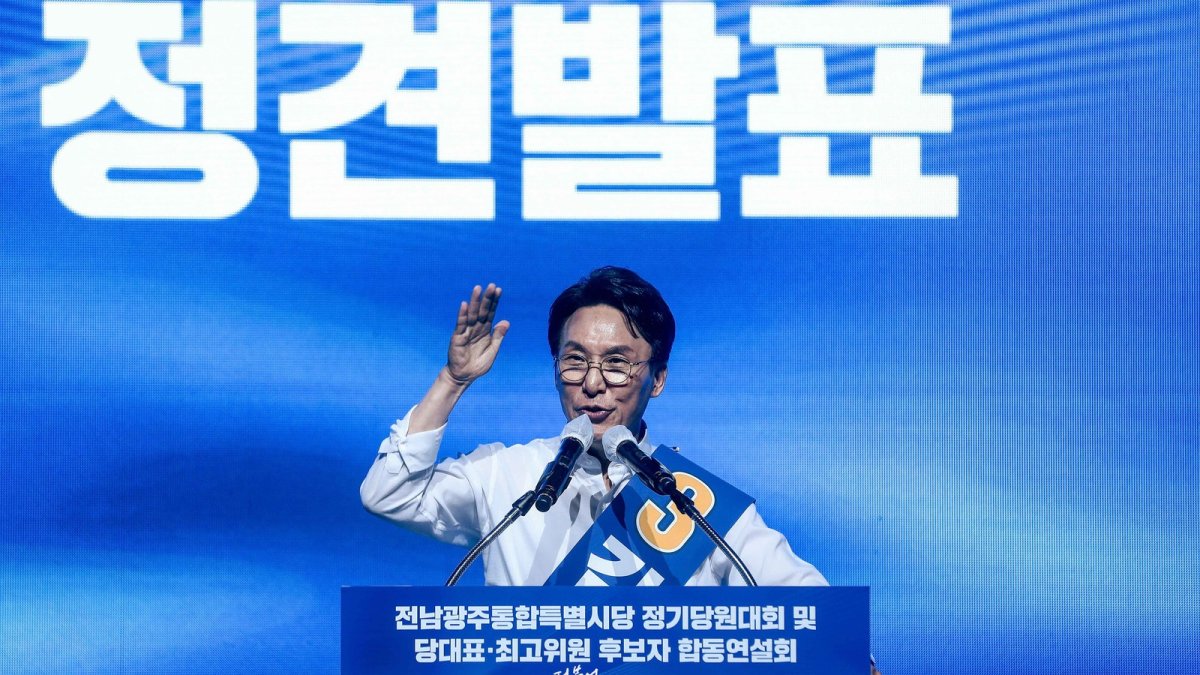
Former Prime Minister Kim Min-seok was elected leader of South Korea's ruling Democratic Party (DP) on August 17, 2026, defeating outgoing party chair Jung Chung-rae by a margin of 54.08 percent to 45.92 percent at the party's national convention in Daejeon. The six-week race, which exposed deep fissures between the camp aligned with President Lee Jae-myung and a harder-line faction associated with Jung, concluded with the party's first-ever ranked-choice runoff. Kim, a four-term lawmaker and key political ally of the president, now assumes a two-year term that places him at the helm of candidate nominations for the April 2028 general elections. The outcome was widely interpreted as a test of how firmly Lee has consolidated control over the DP since assuming the presidency in 2025, yet the accompanying Supreme Council results suggest that consolidation remains incomplete.
The Mechanics of a Historic Ranked-Choice Runoff
This leadership race marked the DP's first under its new one-member, one-vote system, a structural departure from previous contests. Dues-paying members and delegates accounted for 70 percent of the voting weight, while a national opinion survey constituted the remaining 30 percent. The poll, conducted over two days by two polling firms among a combined 4,000 respondents reached by automated phone survey, was limited to Democratic Party supporters and independents to screen out backers of the conservative opposition. Because no rule guarantees a majority winner under this formula, the party adopted ranked-choice voting: if no candidate clears 50 percent on first-preference ballots, the last-place finisher is eliminated and votes are reallocated by second choice. The voting unfolded in regional waves, with results announced progressively. On August 1, Kim narrowly outpolled Jung in Chungcheong, 45.05 percent to 44.61 percent, with Rep. Song Young-gil a distant third at 10.34 percent. Jung answered the next day in Busan, Ulsan, and South Gyeongsang Province, beating Kim 46.65 percent to 43.85 percent. Kim then won Jeju and Incheon on August 8 with 47.75 percent to Jung's 42.08 percent, followed by a fourth round spanning Gangwon Province, Daegu, and North Gyeongsang Province on August 9, where Kim led 48.54 percent to 44.40 percent, narrowing the cumulative gap to 1.48 points. The race turned decisively in Kim's favor on August 15 in Gwangju and the Jeolla provinces, the party's largest single bloc of members at roughly a third of the total. Kim won 57.54 percent there to Jung's 32.65 percent, pushing his cumulative share past 50 percent for the first time. The final regional round, in Seoul and Gyeonggi Province on August 16, went to Kim by a far tighter margin, 46.66 percent to 46.28 percent, pulling his majority back below 50 percent and leaving him with an overall cumulative lead of 49.91 percent to 41.51 percent heading into the convention. With Song eliminated, second-choice votes from his backers were redistributed, producing Kim's final margin. The institutional significance is considerable: a mechanism designed to ensure majority legitimacy has now been tested under real political pressure and will likely shape future leadership contests.The Factional Battle: Pro-Lee Consolidation Versus the Jung Hard Line
The contest was widely described as a proxy fight between the pro-Lee camp and a harder-line faction associated with Jung, who has at times pushed back against the presidential office on the pace of judicial overhaul and other issues. Kim's campaign speech in July framed the race as a referendum on whether the party would fully back Lee's agenda, and he pledged "complete alignment" between party and presidential office during the campaign. Jung, by contrast, faced criticism from some pro-Lee members for focusing on hard-line supporters rather than coordinating with the president, and he was also criticized over the June 3 local elections, in which the DP won 12 of 16 mayoral and gubernatorial seats but lost the Seoul mayoral race. The regional voting patterns reflected this dynamic. Kim's strongest results came in Gwangju and the Jeolla provinces and the greater Seoul area after Lee announced an 800 trillion won ($564 billion) semiconductor investment package for the Gwangju region. The presidential office's intervention appears to have shifted sentiment in the party's most populous regional stronghold, underscoring Lee's leverage over internal party affairs. Overall, however, Lee's approval rating slipped to 44 percent in recent days, the lowest since he took office, according to local media reports. Realmeter recorded a slightly different figure of 43 percent, a 0.3 percentage point slide from the previous week. The divergence between the president's national standing and his ability to deliver the party chairmanship suggests that internal party dynamics operate on a different calculus than general public opinion.A Divided Supreme Council: The Limits of Kim's Mandate
Alongside the chair, the DP seated five Supreme Council members from an eight-candidate field. Voters picked two of the eight names, and the five candidates with the highest combined vote share won seats, with the top finisher becoming senior Supreme Council member. Five of the eight candidates were aligned with the pro-Lee camp-Reps. Park Sun-won, Kim Yong, Seo Mi-hwa, Kim Young-ho, and Im Mi-ae-while three were aligned with Jung's camp-Reps. Choi Min-hee, Han Min-soo, and Lee Sung-yoon. Late on August 16, two lower-ranked pro-Lee candidates, Im Mi-ae and Kim Young-ho, dropped out of the race and threw their support behind Kim Yong in an effort to consolidate pro-Lee votes and prevent Jung's camp from taking three of the five seats. The final results confirmed a split verdict. Choi finished first by vote share with 18.35 percent and will serve as senior Supreme Council member, effectively the party's No. 3 figure, followed in order by Park Sun-won at 17.57 percent, Seo Mi-hwa at 16.60 percent, Lee Sung-yoon at 16.30 percent, and Han Min-soo at 15.86 percent. Three of the five seats went to lawmakers aligned with Jung while only two went to pro-Lee lawmakers. Kim Yong, the candidate whom Im and Kim Young-ho withdrew to support, fell short of a seat despite their last-minute endorsement, finishing with 15.26 percent. The council consists of nine members total: the party chairman, the floor leader, five elected members, and two appointed by the party leader. The outcome leaves incoming DP chair Kim Min-seok with a Supreme Council in which lawmakers aligned with his defeated rival hold a majority of the elected seats. This divide is likely to complicate Kim's efforts to consolidate the party behind President Lee heading into the 2028 general elections. While the chair holds significant authority over candidate nominations, the council's composition provides a structural check on that power. Jung, for his part, apologized to supporters, saying they had "lost by numbers, but won by the value and spirit." The institutional friction between the chair and the council will be a defining feature of Kim's tenure.Kim Min-seok: The 86 Generation Protégé Returns
Kim's political biography is deeply rooted in the history of Korean democratization. He belongs to the so-called 86 generation, student activists who led the pro-democracy movement of the 1980s and later entered mainstream politics. As Seoul National University's student council president, he was recruited into politics in 1990 by the late President Kim Dae-jung and joined the merger of Kim's party with the New Democratic Alliance Party, earning him the nickname "first son of democratic unification." Elected to the National Assembly in 1996 at age 32, he was the youngest lawmaker of his time and won a second term in 2000. His rise stalled in October 2002, when he left the party during a dispute over unifying the presidential candidacies of Roh Moo-hyun and Chung Mong-joon, a decision that resurfaced repeatedly as a line of attack from Jung during the campaign. Kim lost his Assembly seat in 2004 and spent several years outside elected politics, including periods of study in the United States and China. He returned to the party's leadership as a Supreme Council member in 2008 but was later barred from running for office for five years over a political funding case. He founded a small breakaway party in 2014 before it merged back into the DP in 2016 under then-chair Choo Mi-ae. Kim won back a National Assembly seat in 2020 and secured a fourth term in 2024. His alignment with Lee Jae-myung deepened during the 2022 presidential race, when he headed strategy for Lee's campaign. Kim went on to serve as the DP's policy chief and, from 2024, as senior Supreme Council member under Lee's own chairmanship. After Lee's election as president following the impeachment of Yoon Suk-yeol, Kim was named the first prime minister of the Lee administration in mid-2025, a post in which he oversaw the APEC summit in Gyeongju and met with U.S. President Donald Trump and Vice President J.D. Vance in Washington before stepping down at the end of June 2026 to run for party chair. He is now regarded within the DP as a potential future presidential contender.Implications for the 2028 Elections and Party-Presidential Relations
The immediate agenda for Kim is substantial. The DP holds 161 seats in the 300-member National Assembly, and the 2028 parliamentary elections could determine how much legislative momentum Lee retains for the final two years of his term, which ends in 2030. Kim will have authority to nominate candidates for those elections if he stays in the post, making his leadership decisive for the party's electoral strategy. In his acceptance speech, Kim stated that "the party will work for the success of President Lee Jae-myung and his administration" and described the relationship between the party and the presidential office as "a creative horizontal partnership based on full cooperation and support for the president and the government." He also vowed sweeping changes to the party in its "language, policies, attitude and culture." The immediate aftermath of the convention signaled an effort at unity and reconciliation. Kim departed for Geoje, South Gyeongsang Province, to meet residents hit by deadly torrential rain. On Tuesday, he is scheduled to receive Lee's secretaries at the National Assembly, visit the tomb of former President Kim Dae-jung, and pay respect to those devoted to Korea's independence and the Gwangju Democratic Uprising. President Lee will invite Kim, Jung, and Song to Cheong Wa Dae for dinner on Wednesday, according to Lee's chief spokesperson Kang Yu-jung, to "strengthen cooperation between the party and the administration." Kim has also signaled policy independence, saying he will review a controversial government policy raising property taxes on single homeowners who do not live in their own homes: "We need to ask whether the policy properly took into account people's circumstances, including single homeowners." The deeper question is whether Kim can bridge the divide exposed by the Supreme Council results. The historical pattern of the Democratic Party lineage-from Kim Dae-jung through Roh Moo-hyun to the present-has been marked by recurring factional conflict, often between those prioritizing presidential loyalty and those demanding greater party autonomy. Kim's own biography, including his 2002 departure and subsequent return, embodies this tension. His success will depend on whether he can manage a council where his defeated rival's allies hold a majority of elected seats while maintaining the "complete alignment" with the presidential office that his campaign promised. The 2028 elections will be the ultimate test of whether this fragile equilibrium can hold. This article was produced with AI-assisted research and editorial support. Sources: The Diplomat, Yonhap, The Korea Herald, Korea JoongAng Daily. By Prof. David Park, Staff WriterWhat's Your Reaction?
 Like
0
Like
0
 Dislike
0
Dislike
0
 Love
0
Love
0
 Funny
0
Funny
0
 Wow
0
Wow
0
 Sad
0
Sad
0
 Angry
0
Angry
0

Prof. David Park
East Asia/Technology Correspondent at Global1.News. Seoul-based voice covering Korean politics, technology, business, and culture. Analyzes how technology and geopolitics intersect across East Asia.











Comments (0)