
Paraguay’s President Pena impeached over Ueno banking crisis, placed under house arrest
Paraguayan President Santiago Pena was placed under house arrest on Friday after the Senate removed him from office in the wake of a banking collapse that has shaken the nation’s political and financial stability.
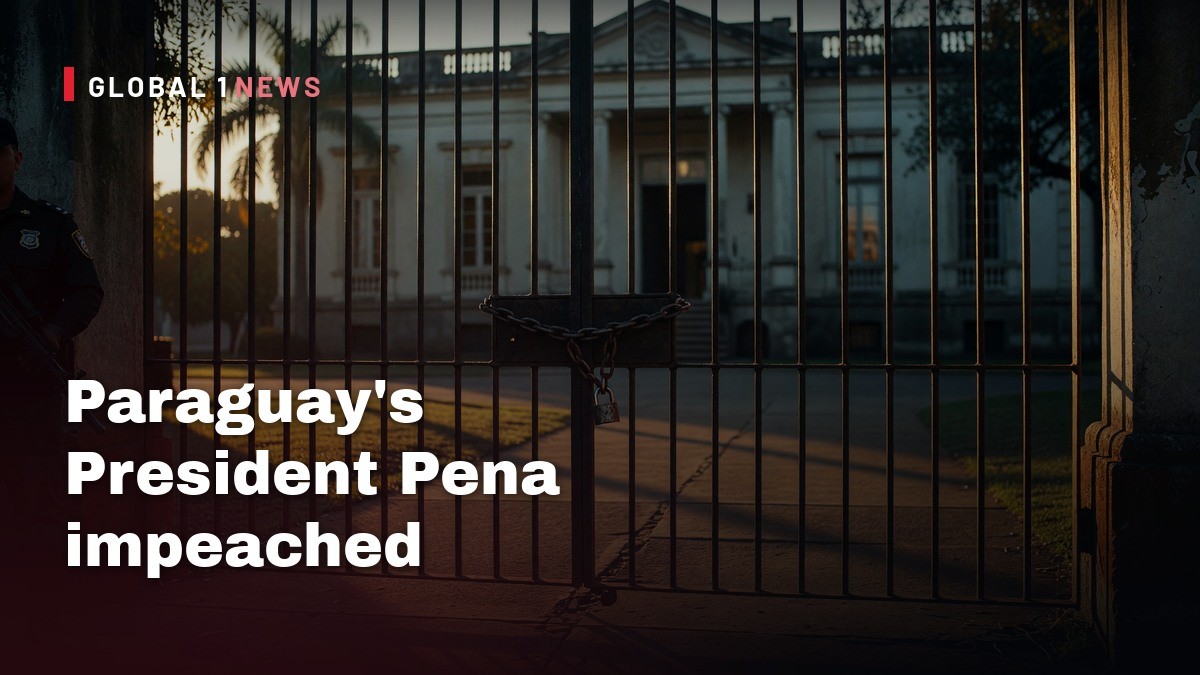
Paraguayan President Santiago Pena was placed under house arrest on Friday after the Senate removed him from office in the wake of a banking collapse that has shaken the nation’s political and financial stability. The rapid sequence of events—Pena’s offer to resign, the Senate’s decision to strip him of presidential immunity, and his failure to appear at the impeachment trial—highlights a profound crisis of governance that reverberates beyond Paraguay’s borders, raising questions about the resilience of democratic institutions in the face of economic turmoil.
Background to the Ueno banking crisis
The immediate trigger for the political upheaval was the failure of a major bank closely linked to President Pena’s administration. While the source material does not detail the bank’s name or the precise mechanisms of its collapse, the association between the financial institution and the government was sufficiently strong to spark public outrage and legislative action. In Paraguay, banks play a crucial role in financing agriculture, small‑business enterprises, and infrastructure projects; thus, a sudden loss of confidence can quickly translate into broader economic distress.
Historically, Paraguayan banks have operated under a regulatory framework that balances state oversight with market liberalisation. The recent crisis suggests a breach of that balance, prompting lawmakers to view the situation not merely as a financial mishap but as a potential abuse of power, given the alleged proximity of the bank to the executive branch.
The impeachment process and removal of immunity
Following the banking collapse, President Pena offered his resignation, a move that could have averted a protracted political showdown. However, legislators pursued impeachment proceedings that would strip him of the immunity traditionally granted to former presidents. This decision reflects a determination within the Senate to hold the head of state accountable, even at the cost of destabilising the executive office.
The impeachment process in Paraguay requires a Senate trial, during which the president can defend himself against charges of breach of trust. In this case, Pena did not attend the trial despite earlier pledging to do so, effectively forfeiting his opportunity to contest the allegations directly. The Senate’s subsequent vote to remove him from office underscores the seriousness with which they regarded the breach of trust charge, even though the source material does not specify the exact legal arguments presented.
House arrest and legal implications
Immediately after the Senate’s decision, Pena was placed under house arrest on suspicion of breach of trust. This measure, while less severe than detention in a prison facility, imposes significant restrictions on his freedom and signals that the judicial authorities consider the allegations credible enough to warrant preventive custody. The house arrest also serves as a symbolic gesture, reinforcing the message that no individual, regardless of former status, is above the law.
In Paraguayan law, breach of trust typically involves the misuse of official authority for personal or political gain, or the failure to act in the public interest. The exact nature of the alleged breach in Pena’s case is not detailed in the source material, but the swift transition from impeachment to house arrest suggests that investigators found sufficient prima facie evidence to justify the precautionary measure.
Political fallout and the future of Paraguay’s democracy
The rapid removal of a sitting president raises concerns about political stability. Paraguay has experienced periods of authoritarian rule and democratic transition in its recent history; the current episode tests the strength of its democratic institutions. On one hand, the Senate’s willingness to pursue impeachment demonstrates a functioning system of checks and balances. On the other, the abrupt loss of executive leadership could create a power vacuum, potentially inviting opportunistic factions to vie for influence.
International observers will be watching closely to see how Paraguay navigates the succession process. The constitution provides for an interim leader, typically the vice president or a designated official, to assume duties until a new election can be organised. The effectiveness of this transition will be pivotal in maintaining both domestic confidence and foreign investment, especially given the banking sector’s central role in the economy.
Economic repercussions of the banking collapse
The failure of a major bank tied to the government inevitably dampens investor sentiment. Paraguay’s economy, heavily reliant on agriculture and export of commodities, depends on stable credit channels to finance planting cycles and processing facilities. A banking crisis can tighten credit, raise borrowing costs, and delay payments to suppliers, thereby slowing economic activity.
While the source material does not provide quantitative data on the scale of the financial loss, the political response—impeachment and house arrest—implies that the collapse had significant ramifications. The government’s credibility in managing the economy is now under scrutiny, and any perceived mismanagement could lead to capital flight or a slowdown in foreign direct investment, particularly from neighbouring Brazil and Argentina, which have close economic ties with Paraguay.
Regional implications and diplomatic considerations
Paraguay’s political turmoil does not occur in isolation. The country is a member of regional blocs such as Mercosur and the Union of South American Nations, where political stability is a prerequisite for coordinated economic policies. A banking crisis that leads to a presidential impeachment may prompt neighboring governments to reassess their exposure to Paraguayan financial institutions and to consider contingency plans for trade and investment.
Diplomatically, the impeachment could affect Paraguay’s standing in multilateral negotiations, especially if the new leadership is perceived as less experienced or less trustworthy. Conversely, the decisive action taken by the Senate may be viewed positively by partners who value rule of law and accountability, potentially offsetting some of the negative economic sentiment.
Looking ahead: governance reforms and public trust
The episode underscores the need for stronger governance frameworks that separate political authority from financial oversight. In the aftermath, Paraguay may consider reforms aimed at enhancing transparency in the relationship between the state and private banking entities, tightening conflict‑of‑interest regulations, and reinforcing the independence of financial regulators.
Rebuilding public trust will be essential. The populace, having witnessed the president’s resignation offer followed by his removal and house arrest, may demand greater accountability from future leaders. Civil society organisations, already active in monitoring government actions, are likely to push for legislative changes that prevent a repeat of the circumstances that led to the current crisis.
In sum, the impeachment of President Santiago Pena and his subsequent house arrest mark a watershed moment for Paraguay. While the immediate cause—a banking collapse—has been identified, the broader implications for democratic resilience, economic stability, and regional relations will unfold over the coming months. The manner in which Paraguay’s institutions respond will determine whether this crisis becomes a catalyst for enduring reforms or a prelude to further instability.
This article was produced with AI-assisted research and editorial support. Reporting is based on the source material cited below. Sources: South China Morning Post; scmp.com; Global1.News (07 November 2026).
By Kenji Tanaka, Staff Writer
What's Your Reaction?
 Like
0
 Dislike
0
 Love
0
 Funny
0
 Wow
0
 Sad
0
 Angry
0

Japan Correspondent at Global1.News. Tokyo-based voice covering Japanese politics, technology, economy, and culture. Tracks the intersection of tradition and innovation in one of the world's most dynamic societies.












Comments (0)