
Pope in 'pretty good health' as he starts Latin America tour
When Pope Leo XIV touched down in Montevideo on a bright November morning, the crowds that lined the seafront shouted his name with a fervor that echoed the streets of Buenos Aires and the plazas of Lima.
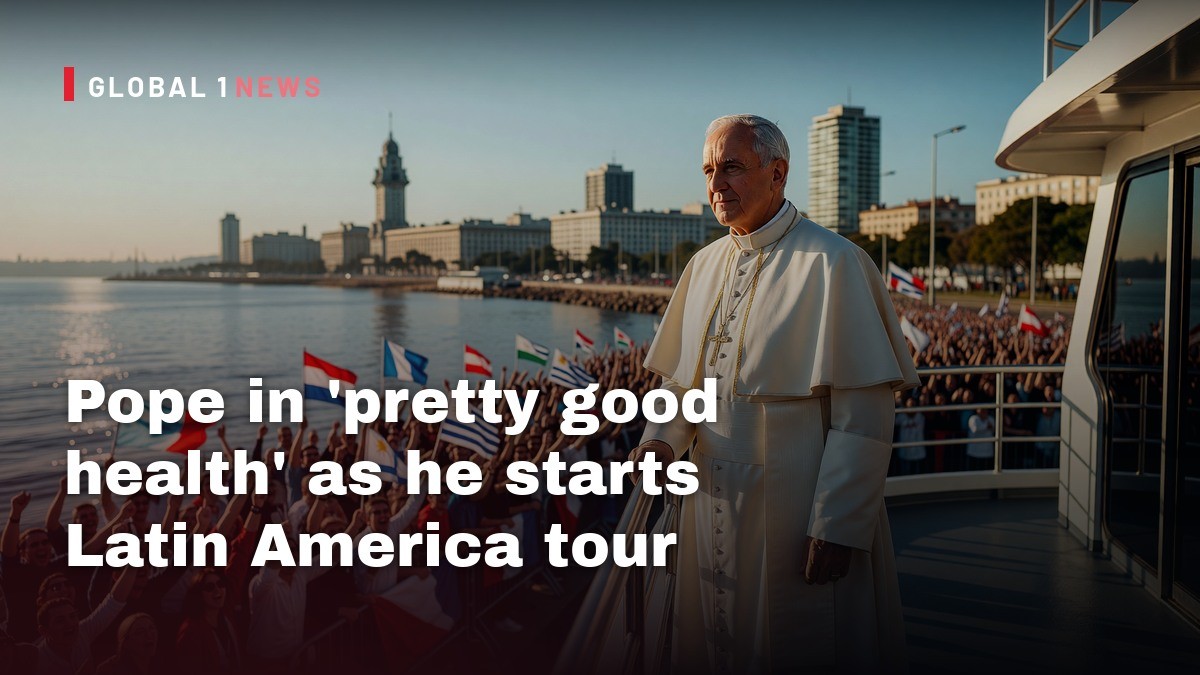
When Pope Leo XIV touched down in Montevideo on a bright November morning, the crowds that lined the seafront shouted his name with a fervor that echoed the streets of Buenos Aires and the plazas of Lima. The 71‑year‑old pontiff, who had undergone lung‑cancer surgery just three weeks earlier, declared himself “in pretty good health” and “very happy” to be on the continent once more. His arrival marked the opening act of a 12‑day pilgrimage across Uruguay, Argentina and Peru—a journey that the Vatican framed as a “homecoming” to the lands where Leo first served as a missionary and bishop.
From the operating table to the Popemobile
The Pope’s health update came aboard the plane that would carry him to Uruguay. He told reporters traveling with him that the “marvellous medical staff” had ensured his recovery was swift and that the tumour removed during last month’s operation had not spread. He added that he felt “in quite good health,” a statement that carried weight for a man whose very survival had been called into question just weeks before. The surgery, described by Vatican officials as successful, removed a lung tumour and left the pontiff free to embark on a tour that many had feared might be postponed.
His words were more than a personal reassurance; they were a signal to the faithful across Latin America that the Church’s leadership remained resilient. The Pope’s confidence, expressed in the simple phrasing of “I must confess… I was convinced that this journey had to go forward,” underscored a determination to fulfill his pastoral duties despite personal health challenges. For a region that has long looked to the papacy for moral guidance, the message was clear: the Church would not retreat from its mission, even when its head faced a life‑threatening illness.
A message of hope in Plaza Independencia
Standing before a sea of faces in Montevideo’s historic Plaza Independencia, Leo spoke of universal healthcare as a right that should be “accessible to everyone.” He linked his own experience of receiving timely, life‑saving treatment to the plight of “many men and women who lack the means to obtain a timely diagnosis” or receive proper care. The Pope’s call resonated in a continent where public health systems often struggle with underfunding and inequity, and where the shadow of the COVID‑19 pandemic still lingers in collective memory.
His words were not abstract theology; they were a direct appeal to governments and societies to bridge the gap between the privileged few and the marginalized many. By invoking his personal brush with mortality, Leo framed the issue of health access as a moral imperative, urging the faithful and the political class alike to act. The speech, delivered in a language that blended pastoral warmth with a clear policy stance, positioned the papacy as a vocal advocate for social justice in a region where health disparities remain stark.
The symbolic weight of a “homecoming” to Peru
While the Pope’s first stop was Uruguay, the itinerary’s highlight is his return to Peru, a country that hosted his early ministry. The Vatican described the Peruvian leg as a “homecoming,” a phrase that carries deep symbolic resonance. Leo’s formative years as a missionary and later as a bishop in Peru forged his understanding of the region’s social fabric, its struggles with poverty, and its vibrant faith traditions.
This return is more than a nostalgic pilgrimage; it signals a reaffirmation of the bonds forged decades ago. For many Peruvians, the Pope’s presence evokes memories of a time when the Church was a central pillar in community life, offering education, health services, and a voice for the disenfranchised. In a nation still wrestling with political instability and economic inequality, the Pope’s visit is poised to rekindle a dialogue about the Church’s role in public life, especially in the wake of his recent health ordeal.
Argentina: a pilgrimage to the predecessor’s homeland
On Sunday, Leo will travel to Argentina, the birthplace of his predecessor Pope Francis, who famously chose not to return to his native land during his papacy. The contrast is striking: while Francis remained absent from his homeland, Leo’s itinerary deliberately includes it, perhaps as a subtle nod to continuity and divergence within the Vatican’s approach to Latin America.
Argentina’s streets will soon echo with the same reverence that greeted Pope Francis years ago, but this time the tone may be different. Leo’s visit arrives at a moment when the nation is grappling with economic turbulence and social unrest. By stepping onto Argentine soil, the Pope not only pays homage to his predecessor’s legacy but also signals an intention to engage directly with a populace that looks to the Church for moral guidance amid uncertainty.
The logistics of a 20,000‑mile journey
The Vatican announced that Leo will cover more than 20,000 miles on this sixth international tour, a logistical feat that underscores the scale of his commitment. The itinerary, spanning three countries over 12 days, demands a tightly coordinated effort from Vatican staff, local organizers, and security personnel. The sheer distance traveled reflects a deliberate choice to reach diverse audiences across the continent, from Uruguay’s coastal capital to Argentina’s sprawling urban centers and Peru’s Andean highlands.
Such an extensive itinerary also highlights the papacy’s strategic emphasis on Latin America, a region that houses a majority of the world’s Catholics. By dedicating a substantial portion of his travel calendar to this part of the world, Leo reaffirms the importance of Latin American voices within the global Church, especially as the region confronts challenges ranging from secularization to socio‑economic inequality.
The Pope’s personal narrative as a catalyst for public discourse
Leo’s own battle with lung cancer, disclosed only after the operation, has sparked a wave of reflection among the faithful. The Vatican’s brief mention that the tumour was discovered during a routine scan and that “the cancer has not spread” offers a glimpse into the private vulnerability of a public figure. For many Catholics, the Pope’s openness about his health adds a human dimension to an office often shrouded in ritual and protocol.
This personal narrative has already prompted discussions about the future of the papacy. The article’s reference to “Catholics questioning what comes next” hints at a broader contemplation of succession, governance, and the Church’s direction. Leo’s decision to proceed with the tour, despite his recent surgery, may be read as an effort to quell uncertainty, projecting stability and continuity at a time when the institution faces both internal and external pressures.
Looking ahead: the broader implications for Latin America
Beyond the immediate spectacle of crowds and speeches, Leo’s tour carries deeper implications for the region’s social and political landscape. His emphasis on universal healthcare aligns with ongoing debates in Uruguay, Argentina and Peru about expanding public health coverage, especially for marginalized communities. By framing health access as a moral issue, the Pope adds a powerful ethical weight to policy discussions that often stall in partisan gridlock.
Moreover, the Pope’s presence serves as a reminder of the Church’s capacity to mobilize large segments of the population. In societies where religious identity remains a cornerstone of communal life, the papal visit can amplify calls for reform, inspire grassroots activism, and pressure governments to address systemic inequities. As the tour unfolds, observers will watch how the Pope’s messages translate into concrete actions on the ground—whether through increased funding for clinics, advocacy for patient rights, or renewed solidarity among faith‑based NGOs.
In the final analysis, Pope Leo XIV’s journey across Latin America is more than a post‑surgical goodwill tour. It is a carefully choreographed convergence of personal resilience, pastoral outreach, and strategic engagement with the continent’s most pressing social challenges. As he steps from the Popemobile into the streets of Montevideo, Buenos Aires, and Lima, the Pope carries with him a narrative of hope that intertwines his own survival with the broader hope of millions seeking a more just and compassionate world.
This article was produced with AI-assisted research and editorial support. Reporting is based on the source material cited below. Sources: BBC News Latin America; bbc.co.uk; Global1.News (07 November 2026).
By Elena Vasquez, Staff Writer
What's Your Reaction?
 Like
0
 Dislike
0
 Love
0
 Funny
0
 Wow
0
 Sad
0
 Angry
0
Latin America Correspondent at Global1.News. Based in Mexico City, covering politics, economics, energy, and culture across the region. Brings an on-the-ground perspective to stories spanning from the Rio Grande to Patagonia.












Comments (0)