
Colombia's Deadliest Earthquake in 27 Years: 294 Killed as New President Leads Rescue
In a recent DW News report, journalists Evelyn Schreiber and Felipe Abondano described the terror of experiencing an unusually long earthquake that rattled Cali and Bogotá for nearly two minutes. The quake that struck western Colombia on August 10, 2026, has now claimed at least 294 lives,...
In a recent DW News report, journalists Evelyn Schreiber and Felipe Abondano described the terror of experiencing an unusually long earthquake that rattled Cali and Bogotá for nearly two minutes. The quake that struck western Colombia on August 10, 2026, has now claimed at least 294 lives, injured more than 4,100 people, and left 143 missing — a tragedy that resonates deeply across Latin America, where families from Mexico City to Caracas know the devastating weight of the earth shifting beneath their feet.
Colombia's Deadliest Earthquake in 27 Years: 294 Killed, Hundreds Trapped as Nation Faces Its First Major Test Under New Leadership
Bogotá, Colombia — August 2026 — The ground beneath western Colombia convulsed at 07:34 local time on Monday, August 10, unleashing a magnitude 7.4-7.5 earthquake that turned bustling city streets into fields of rubble and transformed the first week of a new presidency into a national emergency. The quake, centered just 20 kilometers from the town of San José del Palmar in the department of Chocó, struck at an intermediate depth of 110.3 kilometers according to the US Geological Survey (USGS), though Colombia's own Geological Survey (CGS) measured it at 96 kilometers. Professor of natural hazards Robert Weiss told DW's David Levitz that the depth of the quake, more than 100 kilometers underground, influenced its impact — a factor that seismologists say helped determine which communities suffered the most catastrophic damage.
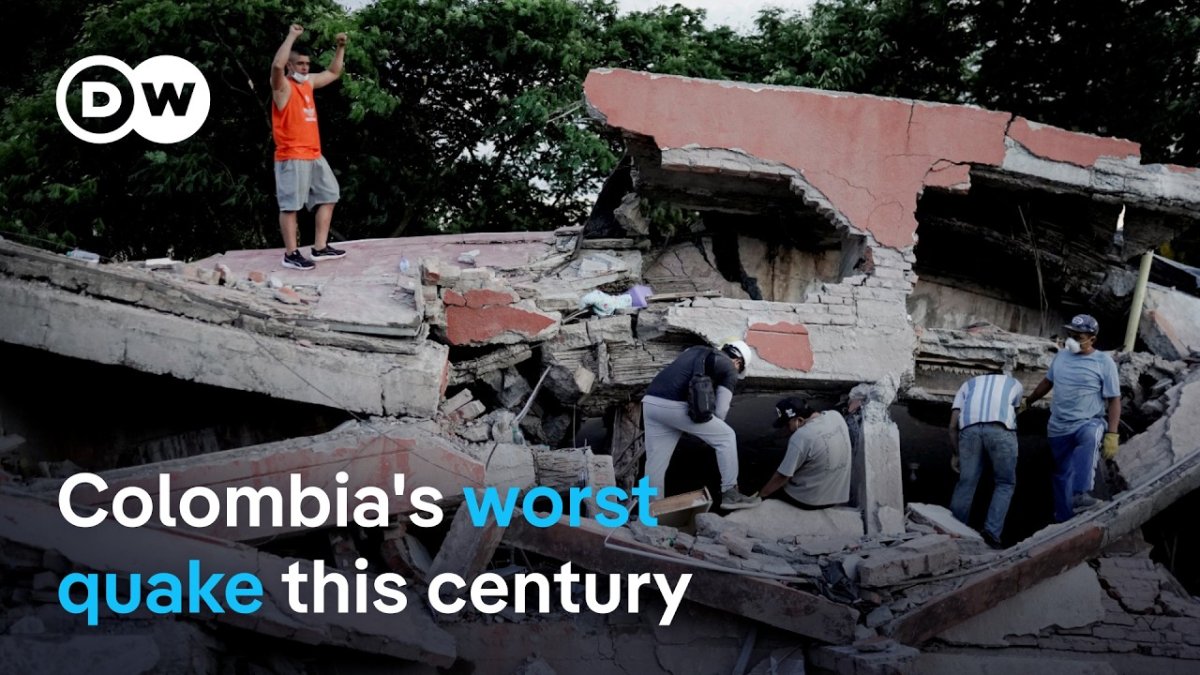
The Disaster Unfolds — A Two-Minute Nightmare
The Colombian Geological Survey called this the strongest earthquake in Colombia in a decade and the largest since the 1979 Tumaco earthquake. The shaking lasted around two minutes — an eternity for those who lived through it — and was felt in 32 of Colombia's departmental capitals. The tremor's reach extended far beyond national borders, with reports of shaking in Panama, Ecuador, and Venezuela, three neighboring countries already on edge after twin quakes in Venezuela killed more than 6,000 people just six weeks earlier.
More than 100 aftershocks followed the initial rupture, the largest a magnitude 5.0 that struck at 08:18, just 44 minutes after the main event. For residents of Cali, the largest city near the epicenter, the aftershocks brought fresh terror as rescue operations began. The death toll of at least 294 makes this the deadliest earthquake in Colombia since the 1999 Armenia/Pereira quake, a tragedy that killed more than 1,000 people and remains seared into the national memory.
In Cali, the capital of Valle del Cauca department, at least 95 people were killed and 949 injured. In the first days after the quake, 239 people were trapped in collapsed buildings. More than 5,000 buildings were damaged or destroyed, with 40 collapsing entirely. The city's health infrastructure was devastated — 18 hospitals were damaged, and more than 600 patients had to be evacuated from the University Hospital of Valle after its upper floors collapsed. The image of patients being carried down staircases and across debris-strewn streets became one of the defining visuals of the disaster.
A New President's First Crisis — De la Espriella Takes Command
The earthquake struck just days after Abelardo de la Espriella, Colombia's new right-wing president, was sworn into office. The timing could not have been more challenging for a leader who inherited a nation still recovering from decades of internal conflict and economic strain. De la Espriella moved quickly, declaring a state of national disaster and three days of national mourning. He activated rescue teams, ordered the establishment of a Unified Command Post to coordinate the emergency response, and traveled to Quibdó and Cali on the evening of August 10 to survey the damage firsthand.
By August 12, the new president escalated his response, declaring an economic emergency and proposing a "Miracle Fund" designed to channel national and international contributions toward rebuilding infrastructure. Finance Minister Miguel Gómez Martínez announced that the government would activate a World Bank loan of up to US$450 million and issued a one-month extension for income tax payments to ease the burden on affected businesses and families.
On August 15, de la Espriella made a direct appeal to US President Donald Trump by phone, asking him to suspend tariffs on Colombian exports to help businesses recover and accelerate the nation's rebuilding efforts. This request echoes the trade tensions that Mexico itself has navigated under the USMCA/T-MEC framework, where tariff threats have repeatedly tested the economic relationship between the United States and its Latin American partners.
Latin America on Alert — Regional Solidarity in a Time of Crisis
The Colombia earthquake comes at a moment of heightened seismic anxiety across the region. The June 2026 twin quakes in neighboring Venezuela killed more than 6,000 people, and the proximity of these disasters has put Latin American nations on high alert. Seismologists are careful to note that the Colombia quake and the Venezuela quakes are separate events and not connected — a distinction that matters for scientific accuracy even as the human toll creates a sense of regional vulnerability.
Mexico's response has been particularly meaningful given the country's own history with catastrophic earthquakes. The 1985 Mexico City earthquake, which killed thousands, and the 2017 Puebla-Morelos quake, which claimed more than 360 lives, gave Mexicans a deep understanding of what Colombia now faces. President Claudia Sheinbaum expressed solidarity with Colombia, and Mexico's Topos de Azteca rescue team — the world-renowned urban search-and-rescue volunteers who have been icons of hope since the 1985 disaster — deployed to Colombia to join the rescue efforts. These volunteer rescuers, known for their willingness to crawl into unstable rubble to reach survivors, represent the best of Mexican solidarity and expertise.
The earthquake's timing — just days after de la Espriella's inauguration and weeks after Venezuela's twin quakes — reshapes Latin America's political landscape, where Mexico plays a central role. The region now faces the challenge of coordinating disaster response across borders while managing the economic fallout of multiple simultaneous crises.
Impact on Communities — From Cali's Streets to Chocó's Towns
The human cost of this earthquake is measured not just in statistics but in the shattered lives of families across western Colombia. In Pereira, the capital of Risaralda department, at least 101 people were killed and 65 buildings collapsed. The Matecaña International Airport partially collapsed, cutting off a vital transportation link for the region. In Quibdó, the capital of Chocó, 8 people were killed and 42 structures collapsed. In the epicentral town of San José del Palmar, 20 buildings collapsed and 400 homes were damaged — a devastating blow to a small community that now faces the challenge of rebuilding from near-total destruction.
Valle del Cauca department suffered the heaviest toll, with at least 133 dead and about 5,000 homes destroyed. In the town of El Cairo, approximately 80% of homes were destroyed, leaving families homeless and communities in shock. The Quindío department reported 1 dead, 334 injured, and more than 10,000 homes damaged or destroyed. The scale of destruction across multiple departments has overwhelmed local resources and tested the capacity of the national government to respond effectively.
Rescue work has been carried out by soldiers, rescue personnel, and relatives of the trapped, with volunteers forming human chains to pass concrete and debris by hand. At least 38 people were rescued from rubble in Cali in the first days. Cali Mayor Alejandro Eder appealed for more rescuers, and Bogotá Mayor Carlos Fernando Galán dispatched 100 rescuers to assist. By August 11, more than 220 rescue specialists and 100 military engineers were operating in Cali, working around the clock to reach survivors trapped beneath the wreckage.
Reactions and Responses — A Global Outpouring of Support
The international response has been swift and substantial. US Secretary of State Marco Rubio offered American assistance, while Panama's President José Raúl Mulino said Panama would send aid. Venezuela's Félix Plasencia said Venezuela was ready to send rescue workers and humanitarian aid — a significant gesture given the recent earthquakes that devastated Venezuelan communities. Chile sent a 10-ton shipment of food, hygiene items, and medicines. Israel sent an aid delegation, and El Salvador's President Nayib Bukele and Guatemala's Bernardo Arévalo offered help. Condolences came from leaders including Brazil's Lula, France's Macron, and Spain's Sánchez.
Private sector and civil society responses have also been notable. Starlink announced free internet service for customers in Chocó, Caldas, Valle del Cauca, Risaralda, and Quindío until September 12, helping families stay connected and coordinate relief efforts. FC Barcelona raised at least €100,000 (approximately US$115,000) and launched another fundraising campaign. Chef José Andrés donated US$1 million to small food businesses, recognizing that restaurants and food vendors are often the backbone of community resilience. A Miami benefit concert "United for Our Own" for victims of the Venezuela and Colombia earthquakes was held August 16 at the Kaseya Center, featuring Marc Anthony, Ricardo Montaner, Feid, Silvestre Dangond, and others — a cultural expression of pan-Latin American solidarity.
Yet amid the outpouring of support, frustration has also emerged. Protests were held at Cali's city hall by residents criticizing the absence of authorities in affected areas. The Cali city government said rebuilding could take up to three years and cost at least US$3.2 billion — a staggering figure for a city already grappling with economic challenges. The gap between official promises and on-the-ground reality has become a source of tension, as families in the hardest-hit neighborhoods wait for help that has been slow to arrive.
What to Watch For
In the coming weeks and months, Colombia faces a long and difficult road to recovery. The economic emergency declared by President de la Espriella will test the new administration's ability to manage a crisis of this magnitude. The proposed "Miracle Fund" will require sustained international support, and the World Bank loan of up to US$450 million will need to be deployed efficiently to rebuild homes, hospitals, and infrastructure. The tariff suspension request to President Trump, if implemented, could provide a much-needed boost to Colombian businesses struggling to recover.
For Mexican readers, this disaster carries particular resonance. Mexico's own experience with earthquakes — from the 1985 tragedy that gave birth to the Topos de Azteca to the 2017 Puebla-Morelos quake that tested the nation's resilience — offers both lessons and hope for Colombia. The importance of robust civil protection systems, like Mexico's Protección Civil, has never been clearer. The regional solidarity demonstrated in response to this earthquake — from Mexico's rescue teams to Venezuela's offer of aid despite its own recent tragedy — reflects a Latin American identity that transcends borders in times of crisis.
The road ahead for Colombia will be measured in years, not weeks. Rebuilding Cali alone could take up to three years and cost billions. But the resilience of the Colombian people, supported by their Latin American neighbors and the international community, offers hope that this tragedy will ultimately strengthen the nation. As Mexico knows all too well, the earth may shake, but communities can rebuild — and often emerge stronger, more organized, and more united than before.
By Rosa Martinez, Staff Writer
This article was produced with AI-assisted research and editorial support. Reporting is based on sources cited in the article.
What's Your Reaction?
 Like
1
Like
1
 Dislike
0
Dislike
0
 Love
0
Love
0
 Funny
0
Funny
0
 Wow
0
Wow
0
 Sad
0
Sad
0
 Angry
0
Angry
0
Latin America/Andes Correspondent at Global1.News. Based in Bogota, covering politics, environment, energy, and social movements across the Andean region. Passionate about environmental journalism and communities protecting their land.












Comments (0)