
Collymore concludes Dakar Youth Olympics Campaign
Jacob Collymore, the Grenadian swimmer who has already amassed a CARIFTA gold and seven OECS titles, wrapped up a demanding three‑event stint at the 2026 Youth Olympic Games in Dakar, Senegal.
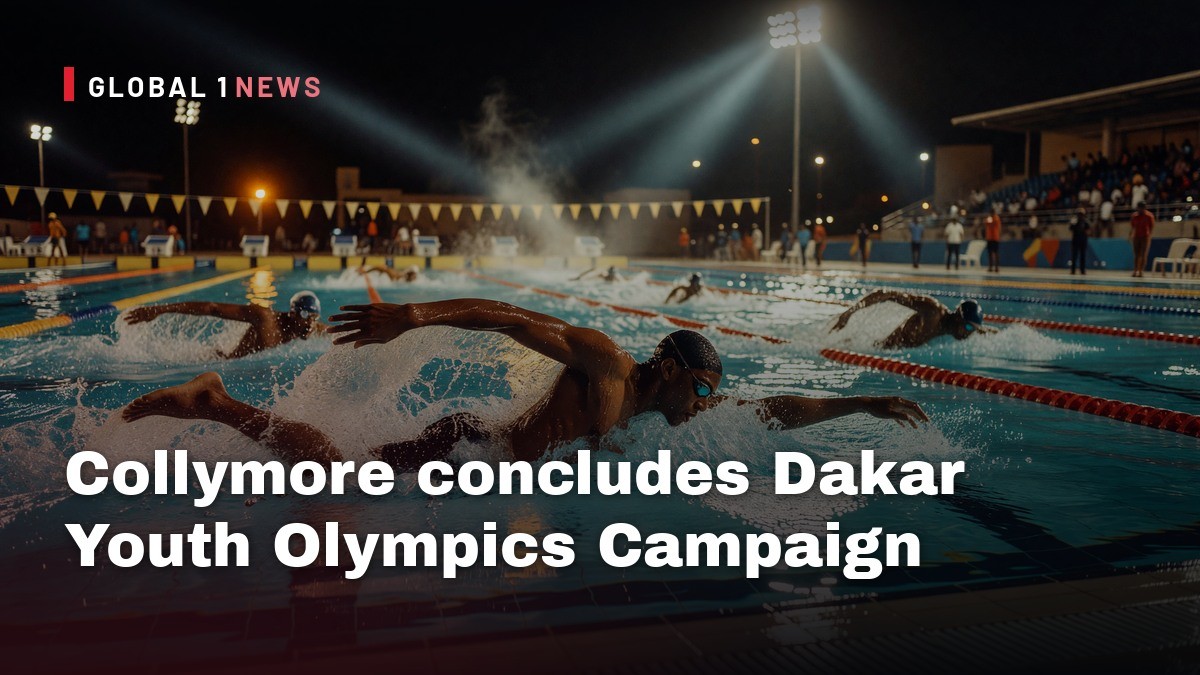
Jacob Collymore, the Grenadian swimmer who has already amassed a CARIFTA gold and seven OECS titles, wrapped up a demanding three‑event stint at the 2026 Youth Olympic Games in Dakar, Senegal. The 16‑year‑old’s campaign, which saw him line up in the 100 m butterfly, 100 m freestyle and 50 m butterfly, forms the climax of an intensive international season that also featured the CARIFTA Aquatic Championships and the Central American and Caribbean Games. While the results fell short of his personal bests, the experience offers a vivid snapshot of a young athlete navigating the pressures of global competition and the broader Caribbean sporting landscape.
Opening the Campaign: 100 m Butterfly
Collymore’s first race in Dakar took place on 1 November, when he swam from Lane 8 in Heat 2 of the 100 m butterfly. He clocked an opening 50 m split of 27.40 seconds, positioning himself in the middle of the pack. By the finish, his time had risen to 1:01.07, earning him eighth place in his heat and 25th overall out of a field of thirty swimmers. The mark was noticeably slower than his personal best of 58.48 seconds, a time he set earlier in the year at the CARIFTA Aquatic Championships.
Only the eight fastest swimmers across all four preliminary heats progressed to the final, meaning Collymore’s 25th place left him out of the final round. Nevertheless, his performance provided a benchmark against the world‑class standards present at the Youth Olympics, highlighting the gap that still exists between regional dominance and global competitiveness.
Mid‑Week Challenge: 100 m Freestyle
The following day, 2 November, saw Collymore take to the pool for the 100 m freestyle, this time from Lane 5. He opened with a 26.81‑second split for the first 50 m, before touching the wall at 55.51 seconds, finishing seventh in his heat. The heat was won by Suriname’s Sean‑Verno Dipokromo, who posted a time of 53.26 seconds. Overall, Collymore placed 44th out of seventy‑three athletes, just shy of his lifetime best of 54.38 seconds.
Despite not advancing, the race demonstrated Collymore’s capacity to maintain a competitive pace across multiple events in a short period. Coach Justin Steele later reflected that the meet was “challenging” for the teenager, underscoring the physical and mental demands of back‑to‑back races at an elite level.
Final Sprint: 50 m Butterfly
Collymore’s final event arrived on 4 November, where he delivered his strongest overall placing of the Games. Swimming from Lane 3, he executed a clean sprint to finish fifth in his heat with a time of 26.11 seconds. This performance positioned him 20th overall in the field, narrowly missing his personal best of 25.45 seconds.
The 50 m butterfly, the discipline in which he secured his first CARIFTA gold, proved a fitting conclusion to his Dakar campaign. While the time fell short of his best, the proximity to his personal record suggested that the experience gained at the Youth Olympics could translate into future improvements, especially as he prepares for the 2027 season and the regional qualifying circuit.
Coach’s Perspective: Learning from a Tough Meet
National Swim Coach Justin Steele offered a measured appraisal of Collymore’s performance, describing the Youth Olympics as “a challenging meet” and emphasizing its value as a learning experience. Steele highlighted that the results were a direct reflection of the swimmer’s preparation, implying that while the outcomes were not podium‑finishing, they were nonetheless indicative of the groundwork laid throughout the season.
The coach’s comments also point to a broader narrative within Caribbean sport: the need to bridge the gap between regional success and global competitiveness. For athletes like Collymore, exposure to world‑class fields is essential to calibrate training regimes, refine race strategies, and build the psychological resilience required for future international meets.
Season in Review: From CARIFTA to CAC Games
Collymore’s three‑event slate in Dakar capped an intensive international itinerary that began earlier in the year with the CARIFTA Aquatic Championships, where he set a personal best of 58.48 seconds in the 100 m butterfly. He also represented Grenada at the Central American and Caribbean (CAC) Games, further broadening his exposure to high‑level competition across the region.
These successive appearances underscore a strategic approach by Grenada’s swimming federation to provide its top talent with continuous competitive opportunities. By stacking the calendar with regional and international meets, the federation aims to nurture athletes capable of challenging the traditional powerhouses in the sport.
Looking Ahead: 2027 Season and Regional Qualifiers
With the Youth Olympic campaign behind him, Collymore now turns his focus toward the upcoming 2027 season. The next phase will involve a series of regional qualifying events, which will serve as the gateway to major championships such as the World Junior Championships and potentially the senior Commonwealth Games.
Given his age and the incremental improvements demonstrated throughout the Dakar meet, there is optimism that Collymore can shave fractions of a second off his personal bests. Continued support from his coaching team, coupled with targeted training blocks, will be crucial in translating the lessons learned in Senegal into podium‑ready performances.
Caribbean Context: Youth Development and the Road to Global Success
Collymore’s journey reflects a broader trend in Caribbean sport: the emphasis on youth development as a pipeline to elite performance. Nations across the region are investing in talent identification programmes, seeking to replicate the success stories of athletes who have broken through on the world stage.
While the Youth Olympic results may not have yielded medals, they provide valuable data points for coaches, administrators and policymakers. By analysing split times, race tactics and the psychological impact of competing abroad, stakeholders can refine training curricula and allocate resources more effectively. For Grenada, nurturing swimmers like Jacob Collymore could eventually translate into greater representation at global meets, enhancing the nation’s sporting profile and inspiring the next generation of Caribbean athletes.
This article was produced with AI-assisted research and editorial support. Reporting is based on the source material cited below. Sources: Now Grenada; nowgrenada.com; Global1.News (07 November 2026).
By Sharon Sahatoo, Staff Writer
What's Your Reaction?
 Like
0
 Dislike
0
 Love
0
 Funny
0
 Wow
0
 Sad
0
 Angry
0

Caribbean Correspondent at Global1.News. Based in Port of Spain, Trinidad, covering Caribbean politics, economy, energy, climate, and culture. Amplifying the voices and stories of the Caribbean region.













Comments (0)