
Iran, Oman Agree on Hormuz Revenue-Sharing Deal, But Strait Stays Closed Unless US Yields
Iran and Oman have reached a tentative agreement on control and revenue-sharing for the Strait of Hormuz, but the world’s most critical energy chokepoint will remain shut to commercial traffic unless the United States returns to the framework of a lapsed interim peace deal, Iran’...
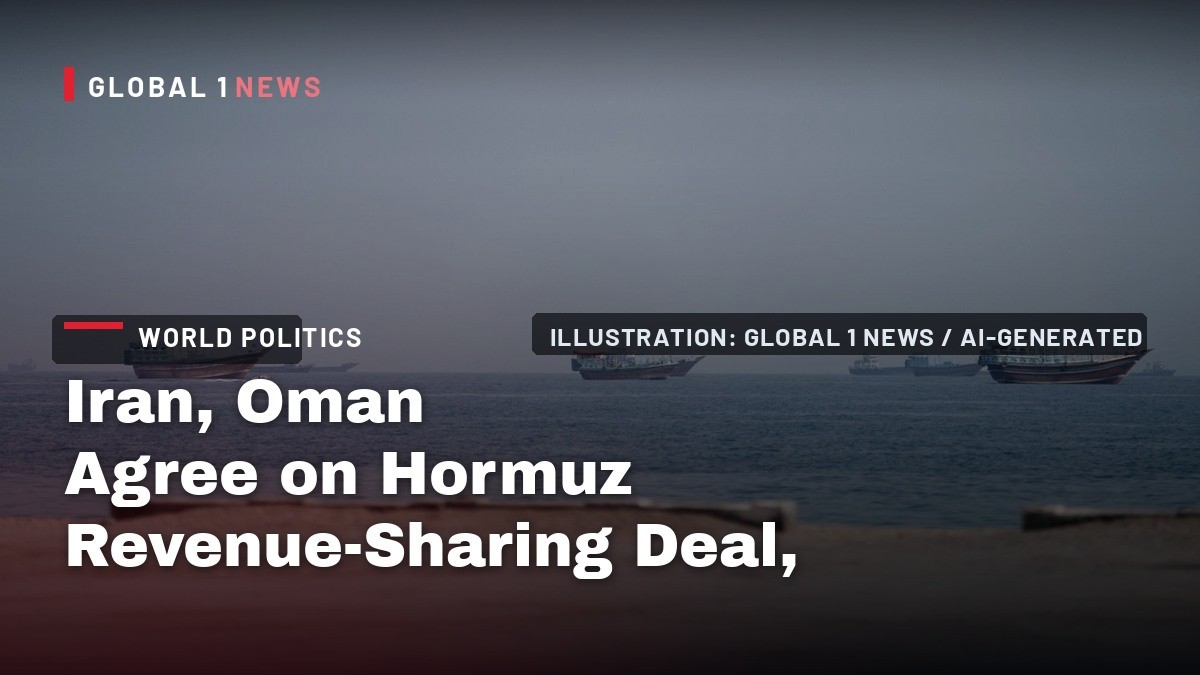
Iran and Oman have reached a tentative agreement on control and revenue-sharing for the Strait of Hormuz, but the world’s most critical energy chokepoint will remain shut to commercial traffic unless the United States returns to the framework of a lapsed interim peace deal, Iran’s Islamic Revolutionary Guard Corps (IRGC) said Wednesday.
The announcement, confirmed by Iran’s Deputy Foreign Minister Kazem Gharibabadi, marks a significant diplomatic development in a conflict that began with US and Israeli strikes on Tehran on February 28 and has since crippled global energy markets. Yet the deal’s conditional nature — and Washington’s explicit rejection of any arrangement that legitimizes Iranian control over the waterway — suggests the strait’s fate remains deeply entangled in the broader US-Iran standoff.
What Was Announced: A Temporary Corridor and a Revenue Split
Speaking to Iranian state media, IRGC spokesman Hossein Mohebbi confirmed that Tehran and Muscat have concluded roughly a month of on-and-off negotiations over the strait, which passes through the territorial waters of both nations.
“The Strait of Hormuz belongs to Iran and the country of Oman … We have been in negotiations with Oman for about a month, and we have reached results that are acceptable to both sides,” Mohebbi said. “In these negotiations, agreements have been reached regarding the share of each country in the waters of the Strait and the share of Iran and Oman in its revenues.”
Gharibabadi, speaking on state television Tuesday, provided the operational detail: the two countries have agreed on a temporary transit corridor measuring 7 miles (11.3 kilometers) wide. The entry point of the route will lie within Iranian territorial waters, with part of the exit route also passing through Iranian-controlled waters, he said.
Iranian army spokesperson Mohammad Akraminia added that vessels will be subject to Iranian surveillance before entering the strait and will only be permitted to pass if Tehran grants explicit permission. This provision, if enforced, would effectively give Iran veto power over every ship transiting the corridor.
Critically, Gharibabadi emphasized that the agreement does not constitute a reopening of the strait. “The agreed-upon transit route with Oman is a temporary route,” he said, warning that the waterway will not fully reopen until the United States fulfills its commitments under the June memorandum of understanding (MoU).
The War Context: From February Strikes to a Collapsed Ceasefire
The current crisis traces back to February 28, when US and Israeli forces launched strikes on Iran. The attacks came as Tehran and Washington were reportedly engaged in talks in Oman, a dynamic that has fueled Iranian accusations of bad faith throughout the conflict.
Iran closed the strait in early March, permitting passage only to a select group of ships it deemed “friendly.” In April, the IRGC issued a route map for those permitted vessels, routing traffic closer to the Iranian coast and designating a large section of Omani territorial waters as “restricted.” The US has accused Iran of planting sea mines in the waterway — an allegation Tehran has neither confirmed nor denied, though it has stated that following its designated route would minimize the risk of encountering them.
The United States responded by enforcing a naval blockade of Iranian ports in and around the strait, aiming to cripple Iran’s economy by restricting its fuel exports. The result was a dual blockade: Iran choking outbound Gulf energy shipments, and the US choking Iranian oil exports.
On June 17, the two sides signed a memorandum of understanding brokered through Omani mediation, agreeing to a ceasefire lasting up to 60 days to facilitate peace negotiations. Under the MoU, Iran agreed to keep the strait open for all traffic, free of charge, for the duration of the ceasefire.
The agreement’s vague wording proved its undoing. Tehran and Washington disagreed over which routes ships should take, and the waterway fractured into two disputed courses: a southern route approved by Oman and backed by the US, and a northern route approved by Iran. The southern route has been used by commercial carriers under US naval protection, but passage remains perilous. On Tuesday, an oil tanker was disabled by an unidentified projectile near Oman’s Ash Shishah, close to the strait’s entrance, according to the United Kingdom’s Maritime Trade Operations (UKMTO).
Active hostilities have largely subsided in recent weeks, replaced by a US strategy of economic strangulation. But diplomatic efforts toward a broader peace deal have stalled, and Iran has refused direct talks with Washington since US bombing of Iranian territory in July. Tehran maintains it will speak directly only to Oman about the waterway’s future.
The Economics: A Chokepoint in Crisis
The stakes are measured in barrels and cubic feet. Before the war, the Strait of Hormuz handled more than 20 percent of global oil and liquefied natural gas (LNG) shipments from Gulf producers — roughly 130 ships crossing daily. It is the only sea route connecting the Gulf to the open ocean, making it indispensable for Saudi Arabia, the UAE, Kuwait, Iraq, and Qatar.
Brent crude, the global benchmark, traded at approximately $66 a barrel just before the war began. In March, as the strait closed and panic set in, prices spiked to nearly $120 a barrel. The price surged past $100 on several occasions, most recently on July 23, as the conflict dragged on and supply fears mounted.
This week, however, oil prices fell for a third consecutive day, dropping more than $2 a barrel to a two-week low. The decline follows signs of renewed efforts to seek a mediated end to the war — and markets appear cautiously hopeful that the Iran-Oman agreement, however conditional, represents a step toward de-escalation.
The economic pain has been felt most acutely in Asia, where countries such as Japan, South Korea, India, and China are heavily dependent on Gulf shipments. Energy shortages have rippled through regional economies, and the prolonged closure has forced importers to seek alternative — and more expensive — supply routes.
The US Pressure Campaign: Crushing Operations and Sanctions Waves
Washington has responded to the diplomatic impasse with escalating economic warfare. President Donald Trump announced last week what he called the “most crushing economic operation ever” against Iran, threatening sanctions against any country doing business with Tehran.
On Monday, US Treasury Secretary Scott Bessent laid out a wave of new sanctions targeting 60 entities around the world accused of facilitating Iranian oil sales. The sanctions notably did not include Chinese financial institutions suspected of facilitating Iranian oil exports — a gap that analysts suggest reflects Washington’s reluctance to provoke Beijing directly.
Iran has also announced a blacklist of 45 ships in an apparent effort to stop ship-to-ship transfers used by Gulf energy producers to evade the Iranian blockade. Some companies have indicated they plan to stop using vessels added to the blacklist, according to sources cited by Reuters.
Iran denounced the US effort to isolate its economy as an act of “gross lawlessness,” expressing confidence that many countries would not join the pressure campaign. Gharibabadi urged nations to resist American pressure, saying Washington was “mistaken about its ability to enforce its sanctions against our neighbours.”
The US has threatened to punish countries that continue doing business with Iran but has said it will not impose penalties immediately — a delay that may reflect concerns about alienating key partners or triggering further market disruption.
Oman’s Mediator Role: Neutrality With Strategic Ambition
Oman has long played the role of regional intermediary, maintaining close ties with both Tehran and Washington. The sultanate’s relationship with the United States stretches back nearly 200 years, yet it has consistently refused to take sides in the US-Iran confrontation, positioning itself as the indispensable channel between the two adversaries.
Omani Foreign Minister Badr Albusaidi met his Iranian counterpart Abbas Araghchi in Tehran on Tuesday to discuss the temporary navigation corridor and a project to clear mines, according to a joint statement. Albusaidi said on X that he hoped the countries would “soon announce” the corridor, adding that “future management of the strait and a permanent solution will follow in due course.” Technical talks are planned to develop a long-term arrangement, including mechanisms for information sharing and navigational and security services.
Notably, Oman has not publicly stated that it intends to join Iran in controlling the strait. The sultanate’s public posture remains that of a facilitator rather than a co-belligerent. But the revenue-sharing arrangement, if implemented, would give Muscat a direct financial stake in the waterway’s governance — a significant shift for a country that has traditionally avoided entanglement in the strait’s security politics.
Oman’s position is not without risk. Trump threatened on August 17 to bomb Oman if it “gets in the way” of a peace deal, telling Fox News: “If Oman gets in the way, we’ll bomb the s*** out of them.” He made a similar threat in May, saying, “Nobody is going to control it. It’s international waters, and Oman will behave just like everybody else, or we will have to blow them up.”
These threats underscore the precariousness of Oman’s balancing act. The sultanate is seeking to formalize its role as the region’s mediator while extracting economic benefit from its geographic position — but it is doing so in the shadow of a US president who has explicitly threatened military action against it.
Strategic Calculus: What Each Side Wants
Iran’s objectives are clear and consistent. Tehran wants sanctions relief, the release of frozen assets, and formal recognition of its role in the strait’s governance. The revenue-sharing agreement with Oman serves multiple purposes: it provides a financial stream, legitimizes Iran’s claim to the waterway, and creates a regional partner with a vested interest in defending that arrangement.
Gharibabadi insisted the US must fulfill its commitments under the June MoU — including sanctions relief and the release of frozen Iranian assets — if it wants to resume peace talks. This is the crux of Iran’s position: the strait is a bargaining chip, and Tehran will not surrender its leverage without concrete concessions.
The United States wants Iran to relinquish control of the strait entirely as a condition of ending the war. Washington has consistently rejected any arrangement that formalizes Iranian authority over the waterway, viewing it as a strategic victory for Tehran and a threat to global energy security. The US has also strongly opposed any Iranian attempt to charge fees to shipping companies using the strait, though international law permits charges for services such as insurance, environmental protection, and docking.
An exclusive understanding between Iran and Oman runs directly contrary to Washington’s core demand. Rather than curbing Iranian control, such a deal would lend it greater legitimacy by formalizing Tehran’s position through a bilateral agreement with a US ally. As Laleh Khalili, a professor of Gulf studies at the University of Exeter, told Al Jazeera: “In part, a solution mediated without US intervention and which in fact allows Oman and Iran to manage passage through Hormuz, which lies entirely within the two countries’ territorial waters, would show how impotent the United States is and has been.”
Trump is also likely angered by being cut out of a deal relating to a waterway Washington considers vital to its interests and those of its allies. The backchannel he claimed to have opened with the IRGC — which Iranian officials immediately denied — appears to have yielded nothing.
Regional Implications: Energy Security and the New Governance of Hormuz
The Iran-Oman agreement, if it holds, would fundamentally reshape the governance of the Strait of Hormuz. For the first time, the two littoral states would jointly manage the waterway, with a formal revenue-sharing mechanism. This arrangement would bypass the United States entirely and establish a precedent that could have lasting implications for the region’s energy security architecture.
Gulf producers — Saudi Arabia, the UAE, Kuwait, and Qatar — would be forced to navigate a new reality in which their primary export route is controlled by Tehran and Muscat. The 45-ship blacklist and the threat of Iranian surveillance over all transiting vessels would give Tehran enormous leverage over Gulf energy exports, a prospect that will alarm Riyadh and Abu Dhabi.
Asian importers, particularly China, Japan, and South Korea, face a similar dilemma. They depend on Gulf energy but have limited ability to influence the strait’s governance. The US naval blockade and Iranian counter-blockade have already disrupted their supply chains; a formalized Iran-Oman arrangement could either stabilize the situation or entrench Iranian control, depending on how it is implemented.
The revenue-sharing mechanism itself raises unresolved questions. Under international law, tolls for passing through natural waterways such as Hormuz are forbidden, even when they are not technically in international waters. However, fees for services such as insurance, environmental protection, and docking can be charged. It remains unclear how Iran and Oman intend to generate revenue from the corridor without violating these principles — or whether they will simply disregard them.
Historical Echoes and the Road Ahead
The current standoff is not the first time the Strait of Hormuz has been at the center of US-Iran confrontation. During the Iran-Iraq War in the 1980s, the “Tanker War” saw both sides attack shipping in the Gulf, prompting US naval intervention. In 2011-2012, Iran threatened to close the strait in response to sanctions, and the US responded with a buildup of naval forces. Each time, the strait remained open — but each time, the threat itself was enough to roil markets and reshape regional security calculations.
This conflict is different. The strait has actually been closed for months, and the economic damage has been severe. The Iran-Oman agreement represents the first concrete step toward reopening it, but the conditions attached — US acceptance of Iranian terms and a return to the June MoU framework — remain unmet.
The IRGC’s message on Wednesday was unambiguous: “If the United States stops obstructing and returns to the agreement, we can open the Strait of Hormuz within the framework of the agreement reached … If the United States does not accept our conditions, the Strait of Hormuz will not be opened under any circumstances.”
Washington has not formally responded to the Iran-Oman announcement. But given Trump’s public threats against Oman and his administration’s insistence that Iran relinquish control of the strait, a US acceptance of this arrangement appears unlikely in the near term.
The coming weeks will test whether the Iran-Oman corridor can be operationalized despite US opposition, whether Washington will escalate its economic pressure campaign, and whether the strait’s closure — now entering its sixth month — will continue to exact a mounting toll on global energy markets. For the Gulf states and Asian importers alike, the stakes could not be higher.
By Malik Hassan, Staff Writer
This article was produced with AI-assisted research and editorial support. Sources: Daily Sabah, Al Jazeera, Reuters, Bloomberg.
What's Your Reaction?
 Like
0
Like
0
 Dislike
0
Dislike
0
 Love
0
Love
0
 Funny
0
Funny
0
 Wow
0
Wow
0
 Sad
0
Sad
0
 Angry
0
Angry
0

Middle East Correspondent at Global1.News. Based in Beirut, covering politics, conflict, energy, and society across the Middle East. Brings context and depth to a region often reduced to headlines.










Comments (0)